
Top Purchasing KPIs for Small Business
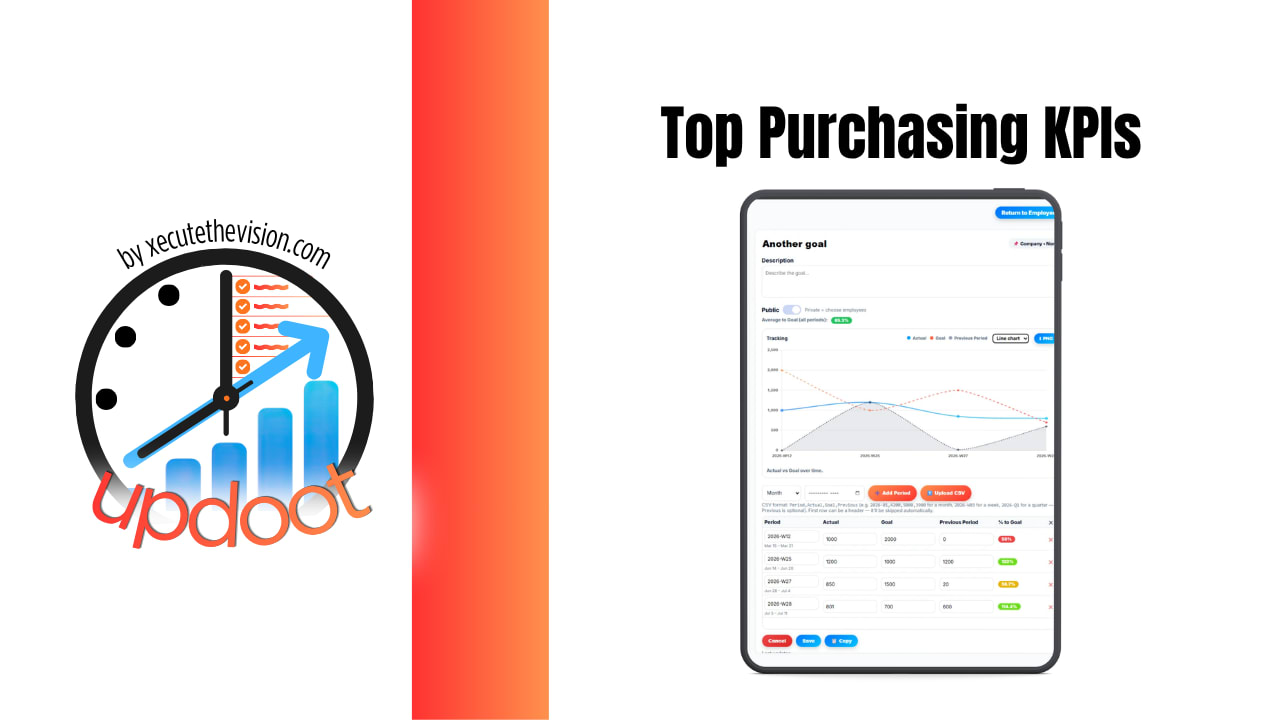
Top purchasing KPIs for small business, with a free scorecard below and the full list of what to track. Purchasing is where small businesses lose money quietly: approvals that take days, invoices paid for goods that never arrived, and spend happening outside any process at all. These seven KPIs make that visible, each with a formula, a realistic target, and where the number comes from.
Free Purchasing KPI Scorecard
Score Your Purchasing KPIs
Enter your own target and current actual for each KPI. Percent to goal and status update as you type, and lower-is-better metrics are scored correctly.
Why Purchasing KPIs Matter for a Small Business
Purchasing is one of the few areas where a small business can find margin without selling anything more. Money already committed, paid twice, or paid for goods that arrived short is recoverable margin, and none of it requires winning a new customer.
The second reason is control. In most small businesses spend leaves through email threads and personal cards, and the first anyone in finance hears about it is the invoice. Measuring off-contract spend and cycle time turns that from a recurring surprise into something manageable.
The third is supplier leverage. On-time delivery and defect rates accumulate into evidence, and evidence is what turns a supplier negotiation from a conversation about impressions into one about their own performance record.
The Top Purchasing KPIs
These cover the three things purchasing controls: how fast you buy, whether you get what you paid for, and whether the money went through a process at all.
Purchase Order Cycle Time
What it is. The average time from a purchase request being raised to the purchase order reaching the supplier.
How to calculate it. Total days from request to PO issued ÷ Number of POs
What good looks like. Two to three days for routine spend. Anything beyond a week means people will start bypassing the process, which is where off-contract spend comes from.
Why it matters. Slow approvals are the root cause of most purchasing indiscipline. Nobody circumvents a fast process, so this metric predicts your maverick spend better than any policy does.
Where the number comes from. Request created and PO issued timestamps. If approvals happen by email, this cannot be measured, which is itself the finding.
On-Time Delivery Rate
What it is. The share of purchase orders delivered by the date the supplier committed to.
How to calculate it. (POs delivered on time ÷ Total POs delivered) × 100
What good looks like. Above 95% for reliable suppliers. Track it per supplier rather than as a single blended figure, since one poor performer will drag the average and hide everyone else's reliability.
Why it matters. Late materials stop work, and in a small business that idle time usually costs more than the item. Per-supplier data is also the most persuasive thing you can bring to a price negotiation.
Where the number comes from. Promised delivery date on the PO against actual receipt date. Requires receiving to be recorded at the time, not reconstructed later.
Three-Way Match Exception Rate
What it is. The share of invoices that do not reconcile against the purchase order and the receiving record.
How to calculate it. (Invoices with a match exception ÷ Total invoices) × 100
What good looks like. Under 5%. A higher rate is not an accounts payable problem; it means something upstream is wrong in ordering or receiving, and AP is where it surfaces.
Why it matters. Every exception is an invoice someone has to investigate, and unresolved exceptions are how businesses pay for goods that arrived short or never arrived at all. This is the metric that directly protects cash.
Where the number comes from. Comparison of PO, goods receipt, and invoice. Without recorded receiving there is no three-way match, only a two-way one that cannot catch short deliveries.
Cost Savings vs Budget
What it is. Spend avoided through negotiation, consolidation, or supplier switching, measured against the budgeted or previous price.
How to calculate it. ((Budgeted cost − Actual cost) ÷ Budgeted cost) × 100
What good looks like. A few percent annually is realistic for a small business without a dedicated buyer. Be conservative and only count savings you can point to a before and after price for.
Why it matters. It is the metric that justifies spending any time on purchasing at all. It is also the easiest to overstate, so a strict definition protects its credibility with whoever approves the budget.
Where the number comes from. Budgeted or prior price against actual paid, item by item. Cost avoidance on price increases you negotiated away is legitimate but should be reported separately.
Off-Contract Spend
What it is. The share of total spend that happened outside the approved process or with unapproved suppliers, often called maverick spend.
How to calculate it. (Spend without an approved PO ÷ Total spend) × 100
What good looks like. Under 5%. Above 15% means the process is being routinely bypassed and the real cause is almost always that the official route is slower than sending an email.
Why it matters. Off-contract spend costs more per item, forfeits negotiated pricing, and is invisible until the invoice arrives. It is also the clearest signal that your approval process needs to be faster rather than stricter.
Where the number comes from. Invoices with no matching approved PO, as a share of total spend. The count itself often surprises owners more than the percentage.
Supplier Defect Rate
What it is. The proportion of received items that are damaged, incorrect, short-shipped, or otherwise unusable.
How to calculate it. (Defective or incorrect items received ÷ Total items received) × 100
What good looks like. Under 2% for most goods. Track per supplier, because the average across all suppliers tells you nothing you can act on.
Why it matters. Defects cost far more than the item, because they trigger a return, a re-order, and usually a delay to the work that needed them. This is the number that identifies which supplier relationship is genuinely costing you.
Where the number comes from. Receiving records with a condition or discrepancy note. Requires receiving staff to record shortfalls rather than simply accepting the delivery.
Invoice Accuracy Rate
What it is. The share of supplier invoices that are correct on first submission, matching the agreed price and quantity.
How to calculate it. (Invoices requiring no correction ÷ Total invoices) × 100
What good looks like. Above 98%. Persistent inaccuracy from one supplier is a relationship issue worth raising directly, since every wrong invoice consumes your time to catch.
Why it matters. Incorrect invoices are the mechanism by which agreed prices quietly fail to be the prices you pay. Small overcharges across many invoices add up and are rarely caught without matching.
Where the number comes from. Count of invoices needing correction or query before payment, from your AP records or purchasing system.
How to Track These KPIs
A scorecard fails for process reasons far more often than measurement ones. This is the sequence that makes it stick.
Step 1: Pick five to seven, not twenty
A small business cannot act on twenty numbers, and a scorecard nobody acts on stops being updated within two months. Choose the handful where a change would actually alter a decision, and park the rest.
Step 2: Record the baseline before setting a target
Measure where you are now for at least one full period. Targets invented without a baseline are guesses, and a guess that turns out to be wildly off gets quietly abandoned rather than corrected, which takes the whole scorecard down with it.
Step 3: Set a target you can defend
Base it on your own history plus a realistic improvement, not on a benchmark from a company ten times your size. A target roughly ten to twenty percent better than your baseline is usually achievable and still meaningful.
Step 4: Give every KPI one named owner
Not a department, a person. A metric owned by everyone is watched by no one, and the owner's job is to explain the movement and propose the response rather than simply report the number.
Step 5: Set the review cadence and keep it
Monthly works for most of these, weekly for anything volatile. Put it in the calendar as a standing item. The value of a KPI is almost entirely in the trend, and a trend requires consistent measurement intervals.
Step 6: Review movement, not the number
The review question is never "what is the number." It is "why did it move, and what are we doing about it." Anything on target gets thirty seconds; anything off target gets a named action with a date.
Step 7: Change what you track when it stops being useful
Purchasing KPIs depend almost entirely on receiving being recorded. If nobody logs what arrived, four of these seven metrics cannot be calculated at all, so fixing receiving usually comes before fixing measurement.
Common Pitfalls
Measuring price and nothing else. The cheapest supplier that delivers late and short is more expensive than a slightly dearer one that does not. Price without on-time delivery and defect rate is half the picture and drives bad sourcing decisions.
Treating off-contract spend as a discipline problem. It is almost always a speed problem. People bypass the process because the process is slow, so tightening the rules without shortening the approval time simply pushes more spend underground.
Skipping the receiving record. Without recorded receipts you have a two-way match, which confirms you were billed what you ordered but not that anything arrived. Short deliveries then get paid in full and nobody ever knows.
Overstating savings. Counting a supplier's opening price against their negotiated price as a saving inflates the number and destroys its credibility. Only count against a budget or a prior actual price.
Blending supplier metrics. One average on-time rate across every supplier hides the one relationship causing most of the disruption. These metrics are only actionable per supplier.
Ignoring cycle time on small purchases. Applying the same multi-step approval to an $80 order and an $80,000 one trains everyone to route around the process for routine items, and that habit then extends to purchases that genuinely needed review.
Reviewing purchasing annually. Supplier performance drifts and price increases arrive quietly. A quarterly review of these numbers catches both while there is still time to renegotiate.
Where the Data Usually Breaks Down
The most common gap is that purchasing runs on email. Requests, approvals, and orders live in threads, so cycle time is unmeasurable, there is no list of approved POs to compare invoices against, and off-contract spend cannot be identified because there is no contract record to be off.
The second is missing receiving. Someone signs for a delivery and puts it away, with no record of what arrived or in what condition. That single gap makes three-way matching, on-time delivery, and defect rate impossible to calculate.
The third is that supplier terms are not recorded anywhere. Agreed prices live in a quote in someone's inbox, so invoice accuracy cannot be checked systematically and price creep goes unnoticed for years.
How Updoot Tracks These KPIs
The awkward part of KPI tracking in a small business is usually not the dashboard, it is that the underlying numbers live in different places and someone has to assemble them by hand each month. That assembly step is what kills most scorecards.
For purchasing specifically, Updoot handles requests, multi-tier approvals with dollar thresholds, one-click purchase orders, partial and full receiving, three-way matching, GL codes, and a vendor directory with scorecards. Because the request, the PO, the receipt, and the invoice sit on one record, cycle time, exception rate, and on-time delivery come out of the workflow rather than needing to be assembled, and off-contract spend becomes visible as invoices with no matching approved order.
In Updoot, the KPI and goals tool holds company, department, or individual targets alongside actuals, tracked weekly, quarterly, or annually, with percent-to-goal, at-risk and on-track flags, previous-period comparison, and bar or line charts. Because targets and actuals sit on the same record, the scorecard is current rather than reconstructed, and every report copies to Excel or Google Sheets in one click. It is included at $5 per user per month alongside the rest of the platform.
Signs Your KPIs Aren't Working
The tipping point usually announces itself the same way: an invoice arrives for something nobody remembers approving, a delivery is short and it is discovered weeks later, people buy on personal cards because waiting for approval takes too long, and nobody can name your least reliable supplier without checking. When purchasing runs on email and memory, the losses are real and permanently invisible.
Related Reading
Best Purchasing Software for Streamlining Orders →
Best Procurement Software for Order and Invoice Management →
What Is a Vendor Scorecard? A Complete Guide →
Best Three-Way Match Software for Small Business →
Frequently Asked Questions
Purchase order cycle time, on-time delivery rate, three-way match exception rate, cost savings against budget, off-contract spend, supplier defect rate, and invoice accuracy. Together they cover how fast you buy, whether you receive what you paid for, and whether spend went through a process.
Purchasing that happens outside the approved process or with unapproved suppliers. It typically costs more per item, forfeits negotiated pricing, and stays invisible until the invoice lands. Above 15% of total spend indicates the process is being routinely bypassed.
Make the approved route faster rather than stricter. People bypass purchasing processes because waiting is slower than sending an email, so threshold-based approvals that clear routine spend quickly usually cut maverick spend more than any policy statement.
The share of invoices that do not reconcile against the purchase order and the receiving record. Under 5% is healthy. A high rate is not an accounts payable failure; it means something is wrong upstream in ordering or receiving and AP is simply where it becomes visible.
Because slow approvals are the root cause of most purchasing indiscipline. Nobody circumvents a fast process, so cycle time predicts off-contract spend better than any policy. Two to three days for routine purchases is a reasonable target.
Per supplier, never blended. Track on-time delivery, defect rate, and invoice accuracy for each one. A single average across all suppliers hides the specific relationship causing most of your disruption, and per-supplier data is what makes a price negotiation evidence-based.
Quarterly for supplier performance and savings, monthly for cycle time and exception rate. Supplier performance drifts and price increases arrive quietly, so an annual review catches both far too late to renegotiate.
Final Takeaway
Purchasing KPIs find margin without selling anything more. Start with cycle time and off-contract spend, because those two are linked and fixing the first usually fixes the second. Then get receiving recorded, since three of these metrics are impossible without it. Use the scorecard above to set targets from your own baseline.