
What Is a Vendor Scorecard? A Complete Guide
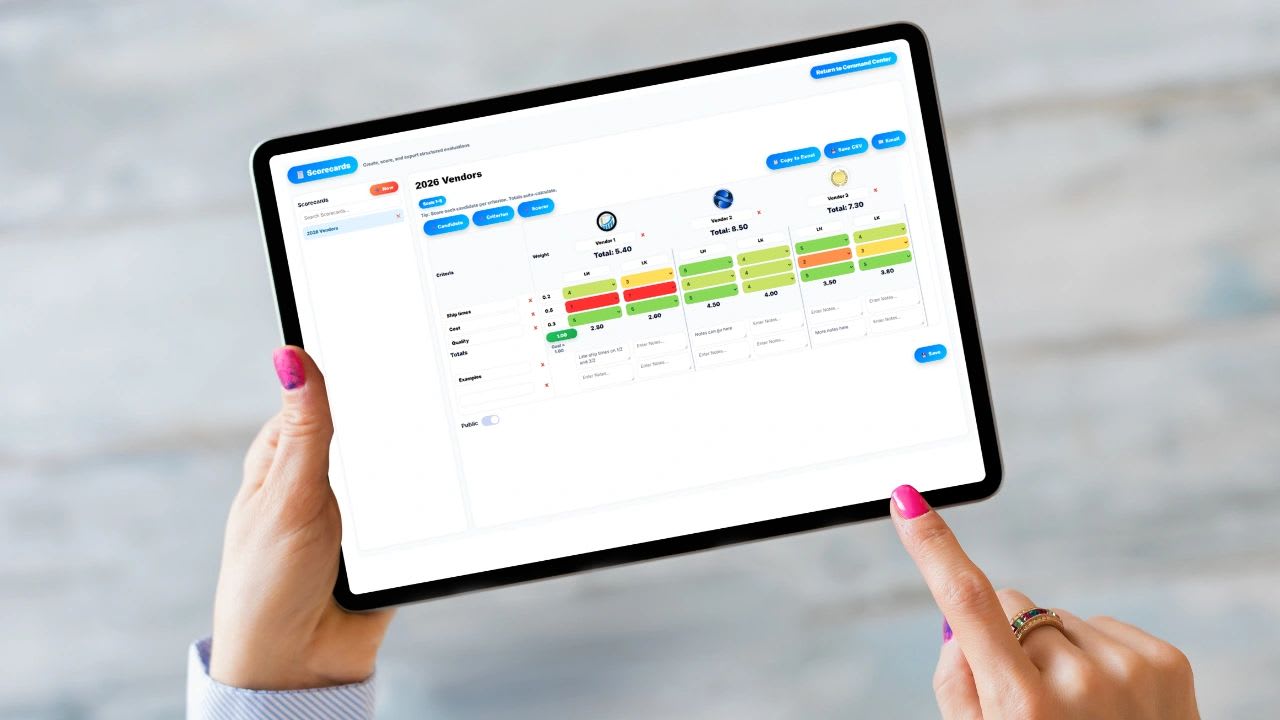
A vendor scorecard is a report card for your suppliers. It rates each vendor on the things that affect your business, like on-time delivery, quality, cost, communication, and compliance, using the same scale every time so you can see who is helping and who is quietly hurting you.
When a supplier ships late or sends bad parts, the damage shows up in your schedule, your margins, and your customers' patience. Without a scorecard, most businesses only notice after a crisis. With one, the warning signs are visible months earlier.
This guide shows what to measure, how weighted 1 to 5 scoring works, and how to turn the results into better supplier relationships. You can score your own vendors with the free tool below.
What Is a Vendor Scorecard?
A vendor scorecard, also called a supplier scorecard, is a structured tool for measuring supplier performance over time. Instead of relying on memory or the last complaint, it scores every vendor against the same categories, weights those categories by importance, and produces a single number you can track and compare. The goal is simple: turn vendor performance into data you can manage.
Why Vendor Scorecards Matter
Many companies evaluate suppliers only when something goes wrong. That reactive approach is expensive. A scorecard helps you:
- Improve supplier performance. Vendors who know they are measured on clear criteria tend to perform better.
- Reduce risk. Declining delivery or quality scores flag problems before they disrupt your operations.
- Negotiate from facts. "Your on-time delivery score dropped from 4.5 to 3.1 this quarter" is a very different conversation from "you have been late a lot."
- Align vendors with your priorities. If speed matters most, weight delivery heavily. If margins are tight, weight cost.
What to Measure on a Vendor Scorecard
| Category | Question It Answers | Example Metrics |
|---|---|---|
| On-time delivery | Does the vendor deliver as promised? | % on time, average days late, schedule adherence |
| Quality | Is what they deliver acceptable? | Defect rate, returns, rework, warranty claims |
| Cost and billing | Are they predictable and competitive? | Price changes, invoice accuracy, total cost of ownership |
| Communication | How easy are they to work with? | Response time, issue resolution time, proactive updates |
| Compliance and risk | Do they meet contractual and regulatory requirements? | Insurance, safety records, required documents, contract terms |
| Innovation (strategic vendors) | Do they help you improve? | Cost-saving ideas, process improvements, integration support |
Most businesses start with four to six categories. More than that makes scoring slow, and slow scorecards stop being used.
How the 1 to 5 Scoring Scale Works
| Score | Label | Meaning |
|---|---|---|
| 5 | Excellent | Consistently exceeds expectations with no issues |
| 4 | Good | Meets expectations with minor issues |
| 3 | Acceptable | Meets minimum standards but needs improvement |
| 2 | Poor | Frequent issues that affect your performance |
| 1 | Unacceptable | Significant failure |
The key is consistency. Write down what each score means for each category, such as "5 = 98% or more on time," so every manager scores the same way.
Vendor Scorecard Example
Here is a weighted scorecard for one supplier:
| Category | Weight | Score (1 to 5) | Weighted Score |
|---|---|---|---|
| On-time delivery | 30% | 4 | 1.20 |
| Quality | 25% | 5 | 1.25 |
| Cost and billing | 20% | 3 | 0.60 |
| Communication | 15% | 4 | 0.60 |
| Compliance | 10% | 5 | 0.50 |
| Total | 100% | 4.15 out of 5 |
Use the total to place each vendor in a tier:
- 4.5 to 5.0: Strategic partner. Deepen the relationship.
- 3.5 to 4.4: Approved vendor. Keep and maintain.
- 2.5 to 3.4: Monitor closely. Agree on an improvement plan.
- Below 2.5: Replace. Start sourcing alternatives.
Free Vendor Scorecard Tool
Free Vendor Scorecard Tool
Set how much each category matters to your business, then score each vendor from 1 to 5. The tool calculates weighted scores, assigns a tier, and ranks your suppliers.
Category Weights (%)
Add a Vendor
Try changing the weights to match your priorities. A vendor that looks fine when cost is weighted heavily can drop a tier when delivery matters most.
Vendor Scorecard Template for Excel
Paste this template into cell A1 of a blank sheet to score one vendor per tab. It calculates the weighted total and the tier automatically.
Category	Weight	Metric Used	Score (1-5)	Weighted Score
On-Time Delivery	0.30	% of orders delivered by promised date	4	=B2*D2
Quality	0.25	Defect or return rate	5	=B3*D3
Cost and Billing	0.20	Price stability and invoice accuracy	3	=B4*D4
Communication	0.15	Average response time to issues	4	=B5*D5
Compliance	0.10	Insurance, safety, and contract documents current	5	=B6*D6
Total	=SUM(B2:B6)			=SUM(E2:E6)
Tier				=IF(E7>=4.5,"Strategic Partner",IF(E7>=3.5,"Approved",IF(E7>=2.5,"Monitor Closely","Replace")))
How to Set Up a Vendor Scorecard Program
- List your vendors and rank them by spend and risk. Start with the ten or so suppliers that matter most. You can add the rest later.
- Choose four to six categories that reflect what hurts you most when a vendor falls short.
- Assign weights. A distributor you rely on for same-week delivery might weight delivery at 40%, while a software vendor might weight uptime and support instead.
- Define each score with a measurable threshold, so a 4 in delivery always means the same thing.
- Gather the data. Pull delivery dates from purchase orders, defects from receiving logs, and billing issues from accounts payable. Data beats memory.
- Tell vendors how they will be measured before the first review. No one should be surprised by the criteria.
- Score, share, and schedule the next review.
Sample Scoring Definitions for On-Time Delivery
| Score | On-Time Delivery Rate |
|---|---|
| 5 | 98% or more of orders arrive by the promised date |
| 4 | 95% to 97% |
| 3 | 90% to 94% |
| 2 | 80% to 89% |
| 1 | Below 80% |
Adjust the thresholds for your industry. The point is that anyone scoring a vendor on delivery reaches the same number from the same data.
Vendor Scorecards for Service Providers
Scorecards are not only for suppliers of physical goods. Cleaning companies, IT providers, staffing agencies, subcontractors, and software vendors can all be scored. Swap the categories to fit: response time to service requests, work quality, staff reliability, billing accuracy, and contract compliance often replace delivery and defect rates.
How Often to Update Vendor Scorecards
| Vendor Type | Review Frequency |
|---|---|
| Strategic or high-spend vendors | Quarterly |
| Regular vendors | Twice a year |
| Low-impact suppliers | Once a year |
Consistency matters more than frequency. A scorecard updated every quarter for two years tells you far more than one done in a hurry after a bad month.
Using Scorecards in Vendor Review Meetings
A quarterly review meeting with each key vendor turns the scorecard into a conversation. Keep it short and structured. Start with what went well so the vendor knows what to keep doing. Walk through each category score and the data behind it. Focus most of the time on the lowest category and agree on one or two specific changes, with an owner on each side and a date to check progress. End by confirming the next review date.
Vendors often have useful feedback too. Late deliveries can trace back to your own last-minute orders or unclear specifications. A good review surfaces both sides, which is why the best supplier relationships tend to improve over time instead of slowly souring.
Signs a Vendor Is Becoming a Risk
- Scores falling in the same category for two reviews in a row
- More frequent price increases or billing errors
- Slower responses and missed commitments on fixes
- Expired insurance certificates or missing compliance documents
- Key contacts leaving or constant turnover on their side
- Becoming dependent on a single vendor with no backup
When two or more of these appear, start qualifying an alternative supplier even if you do not switch yet. Having a backup ready is the best protection against sudden disruption.
How to Act on Vendor Scorecard Results
- Share the scorecard with the vendor. Results kept in a drawer change nothing.
- Agree on an improvement plan for any category scored 2 or below, with a target and a date.
- Reward strong performers with more volume, longer contracts, or preferred status.
- Use trends in negotiations and renewal decisions.
- Replace chronic underperformers. If a vendor scores in the "monitor" range for three quarters with no improvement, act.
Common Vendor Scorecard Mistakes
- Too complicated. If scoring one vendor takes 45 minutes, nobody will do it.
- Not sharing results. Vendors cannot improve on feedback they never see.
- Not acting on the data. A scorecard that never leads to a decision becomes meaningless.
- Scoring on emotion. Base scores on delivery records, defect logs, and invoices, not on the last frustrating phone call.
Managing Vendors With Updoot
Updoot's 1 to 5 scorecard scoring lets you define vendor categories, apply consistent weights, track scores over time, and see trends at a glance, so underperformers stand out and top vendors are easy to reward. It sits alongside your projects, budgets, and operations data, starting at $5 per user per month.
Final Thoughts
A vendor scorecard is not about punishing suppliers. It is about clear expectations and honest data. Pick four to six categories, weight them to match your priorities, score consistently on a 1 to 5 scale, review on a schedule, and act on what you learn. When you manage suppliers deliberately, their performance and yours improve together.
Opens in Google Drive. View and download for free.
Related Reading
Best Procurement Software for Order and Invoice Management →
Frequently Asked Questions About Vendor Scorecards
What is a vendor scorecard?
A vendor scorecard is a tool for evaluating supplier performance using consistent categories such as on-time delivery, quality, cost, communication, and compliance, usually scored on a 1 to 5 scale and weighted by importance.
What should be included in a vendor scorecard?
Most scorecards include on-time delivery, quality, cost and billing accuracy, communication and responsiveness, and compliance. Strategic vendors may also be scored on innovation and value added.
How do you calculate a weighted vendor score?
Multiply each category score by its weight and add the results. For example, a delivery score of 4 at 30% weight contributes 1.2 points. The total is a score out of 5.
How often should vendor performance be reviewed?
Review strategic vendors quarterly, regular vendors twice a year, and low-impact suppliers once a year.
What is a good vendor scorecard score?
On a 5-point scale, 4.5 and above usually indicates a strategic partner, 3.5 to 4.4 an approved vendor, 2.5 to 3.4 a vendor to monitor, and below 2.5 a vendor to replace.
Should you share scorecards with vendors?
Yes. Sharing results and agreeing on improvement plans is what turns a scorecard from a report into a tool that actually improves performance.