Purchase Order vs Invoice: What's the Difference with Free Templates
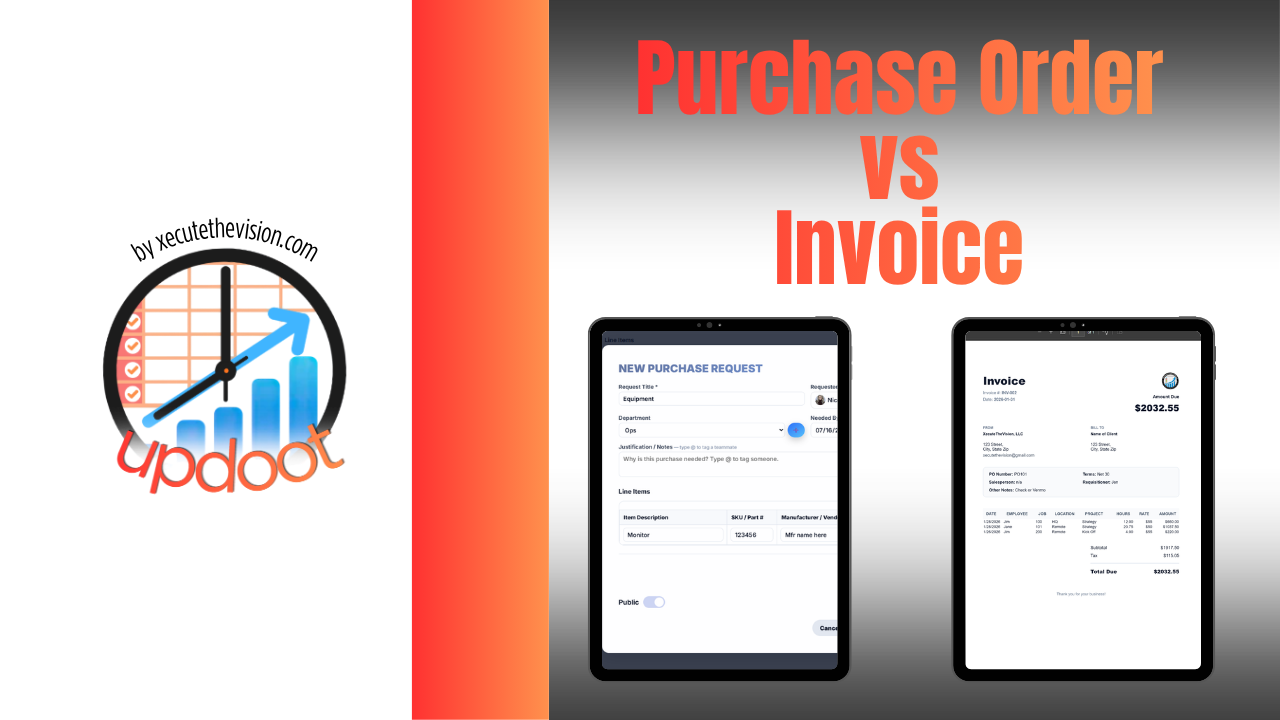
Purchase order vs invoice is one of the most common points of confusion in small business bookkeeping, and the short version is this: a purchase order comes from the buyer before the sale, and an invoice comes from the seller after it. They look similar, they often list the same items, and they sometimes get used interchangeably in casual conversation, but they represent opposite ends of the same transaction and serve completely different purposes in your paperwork.
This guide breaks down exactly what separates a purchase order from an invoice, who creates each one, when each is used, and what has to be on them to be useful. Below that, there are two free interactive templates, one for a purchase order and one for an invoice, that you can fill in directly on this page, print, or copy as text for your own records. At the end, this covers how Updoot turns both of these from static templates into a connected system that tracks a purchase from request all the way through payment.
Quick Answer
A purchase order is created by the buyer before a purchase, authorizing a vendor to supply specific goods or services at an agreed price. An invoice is created by the seller after the goods or services are delivered, billing the buyer for payment. The purchase order says "here is what we are agreeing to buy"; the invoice says "here is what you now owe for what was delivered."
Key Takeaways
- A purchase order comes from the buyer before the sale; an invoice comes from the seller after it.
- A PO authorizes a future purchase and locks in price and quantity; an invoice requests payment for a completed one.
- Not every purchase needs a PO, but every sale eventually needs an invoice to get paid.
- Where a PO exists, the invoice should reference its PO number so the two can be matched before payment.
- Both documents need clear numbering, dates, line items, and totals to be usable as records, not just as requests for money.
Table of Contents
What Is a Purchase Order?
A purchase order, usually shortened to PO, is a document a buyer sends to a vendor to formally request specific goods or services at an agreed price and quantity. It is created before anything is delivered and before any money changes hands. Once the vendor accepts it, a PO functions as a legally binding agreement to buy what is listed, at the price listed, under the terms listed.
The purpose of a PO is control. It gives the buyer a written record of exactly what was ordered, so there is no ambiguity later about quantity, price, or specifications. It gives the vendor a clear, approved order to fulfill. And internally, it gives a business a way to track committed spending, money that is going to go out even though no invoice has arrived yet, which is easy to lose sight of without a formal order in place.
What Is an Invoice?
An invoice is a document a seller sends to a buyer after goods or services have been delivered, requesting payment for what was provided. Where a PO is a request to buy, an invoice is a bill. It lists what was delivered, the agreed price, any taxes or fees, the total amount due, and the terms of payment, including the due date.
An invoice is the seller's formal record that a sale occurred and that payment is now owed. For accounting purposes, it is the document that triggers accounts receivable on the seller's side and accounts payable on the buyer's side. Unlike a PO, an invoice does not need the buyer's prior agreement to exist; a seller can invoice for work completed even if no formal purchase order was ever issued, which is common in service businesses and freelance work.
Purchase Order vs Invoice: Side-by-Side Comparison
| Purchase Order | Invoice | |
|---|---|---|
| Created by | The buyer | The seller |
| Sent to | The vendor | The buyer |
| Timing | Before the purchase | After delivery |
| Purpose | Authorize and request a purchase | Bill for a completed sale |
| Triggers | An order to fulfill | A payment obligation |
| Required? | Optional, used for control | Needed to get paid |
The easiest way to keep the two straight is to remember which direction each document travels and when. A purchase order flows from buyer to seller, before the fact. An invoice flows from seller to buyer, after the fact. If you find yourself unsure which one you are looking at, check who sent it and whether the goods have already been delivered.
When You Need Each One
Not every transaction needs a purchase order. A one-off purchase from a local supplier, a small recurring subscription, or a quick service call often goes straight to an invoice with no PO involved, and that is perfectly normal for a small business without a formal procurement process. Purchase orders earn their keep once a business wants pre-approval before money is committed, once purchasing volume grows enough that duplicate or unauthorized orders become a real risk, or once a company wants a documented paper trail for every dollar it spends, particularly for larger purchases, capital equipment, or new vendor relationships.
An invoice, on the other hand, is close to universal. Almost every sale eventually needs one, whether or not a PO preceded it, because the invoice is what actually triggers payment and what both sides use for their own bookkeeping and tax records. A business can operate without ever issuing a purchase order. It cannot get paid, or pay anyone else, without an invoice somewhere in the process.
Free Purchase Order and Invoice Templates
Use the tabs below to fill in a purchase order or an invoice. Add line items as needed, and the total updates automatically. Print the finished document or copy it as plain text to paste into an email or your own records. Nothing you type is saved or sent anywhere; it stays in your browser.
Purchase Order & Invoice Templates
Switch between templates, fill in the fields, then print or copy.
Line Items
Line Items
Why the Two Documents Should Match
When a purchase order exists, the invoice that eventually arrives for that order should reference the PO number and should agree with it on item, quantity, and price. This is the basis of the three-way match used in purchasing controls: the purchase order shows what was approved, a receiving record shows what actually arrived, and the invoice shows what is being billed. Payment only goes out once all three agree.
When those documents do not match, that mismatch is exactly what catches billing errors before they become overpayments: a vendor billing for more units than were ordered, a price that crept up from what was quoted, or an invoice for something that was never ordered at all. Keeping the PO number on the invoice, and keeping both documents organized and easy to compare, is what makes catching those errors possible instead of a matter of luck.
Stop rebuilding POs and invoices from scratch
Updoot Purchasing turns a purchase request straight into a trackable purchase order, and connects it to receiving and invoicing so every document lines up automatically, no re-typing and no lost paperwork.
Start Free TodayDoing This Automatically With Updoot
A fillable template is a real improvement over building a purchase order or an invoice from a blank document every time, and the templates above will serve a small business well for occasional use. But once purchasing and invoicing happen every week, doing this by hand means re-typing the same vendor names, re-entering line items that already exist somewhere else, and manually checking whether an invoice actually matches the PO it claims to reference.
Updoot Purchasing handles that automatically. A purchase request, once approved, becomes a numbered purchase order without anyone retyping it. Approval levels route by dollar value so the right person signs off before an order goes out. Every PO is tracked from request through delivery, and when a vendor invoice comes in, Updoot checks it against the purchase order and the receiving record before it is approved for payment, the same three-way match described above, done automatically instead of by hand. It lives inside the same $5-per-user platform as time tracking, projects, and HR, so a small business gets real purchase order and invoicing controls without a separate procurement tool.
Frequently Asked Questions
A purchase order is sent by the buyer to the seller before the sale, asking for specific goods or services at an agreed price. An invoice is sent by the seller to the buyer after the goods or services are delivered, requesting payment for what was actually provided. The purchase order authorizes a future purchase; the invoice bills for a completed one.
The buyer creates the purchase order, since it represents their request and their approved budget for the purchase. The seller creates the invoice, since it represents their bill for what they delivered. In a typical transaction, the PO comes from the customer first and the invoice comes from the vendor afterward.
No. Small, routine, or low-dollar purchases often skip a formal PO and go straight to an invoice, especially for very small businesses or one-off purchases. Purchase orders become valuable once a business wants pre-approval, budget control, or a paper trail before money is committed, which is common for larger purchases, recurring vendors, or any company enforcing an approval process.
Yes. Many businesses, especially service providers and freelancers, invoice directly without ever issuing or receiving a purchase order. A PO is an added control step some buyers require, not a requirement of every commercial transaction. Where a PO does exist, most accounts payable teams expect the invoice to reference the PO number so the two can be matched.
A purchase order should include a PO number, the date, the vendor, the ship-to and bill-to information, a line-item list of what is being ordered with quantities and prices, and the total. An invoice should include an invoice number, the date, a reference to the PO number if one exists, the bill-to information, a line-item list of what was delivered, the total due, and payment terms including the due date.