
Performance Review Template (Copy and Paste)
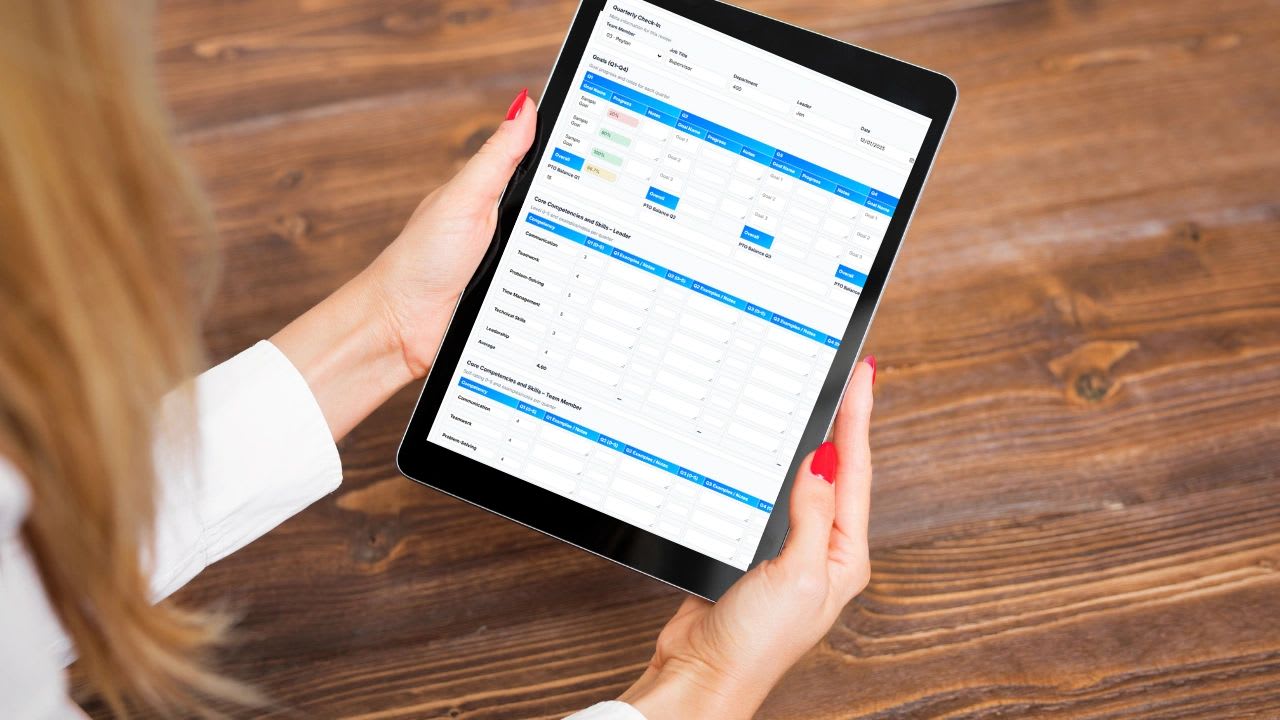
Performance review templates give every manager the same structure for evaluating employees, so reviews are fair, consistent, and easy to document. Copy the free performance review template below, then use this guide to prepare, write, and run reviews that actually improve performance.
Performance reviews are one of the most important tools a leader has to improve results, align the team with company goals, and develop future leaders. Yet many companies struggle with them because the process becomes inconsistent, unclear, or overly subjective. A strong template fixes most of that by making sure every review covers the same ground and ends with a plan.
Free Performance Review Template (Copy and Paste)
Copy this template into a document or email, or paste it into your HR system. It covers every section described in this guide, including ratings and signatures. Prefer a spreadsheet? Open the free performance review spreadsheet and choose File > Make a copy.
PERFORMANCE REVIEW

Employee Name:
Job Title:
Department:
Manager:
Review Period:
Review Date:

1. PERFORMANCE SUMMARY
Summarize the employee's overall performance during this review period.

2. KEY RESPONSIBILITIES
Evaluate how well the employee performed their core responsibilities.
Responsibility:
Rating (1-5):
Notes:

3. GOALS AND RESULTS
List the goals set last period and the results achieved.
Goal:
Result:
Comments:

4. STRENGTHS
Strength 1:
Strength 2:
Strength 3:

5. AREAS FOR IMPROVEMENT
Area 1:
Area 2:

6. DEVELOPMENT PLAN
Development Goal:
Training or Support Needed:
Action Plan and Timeline:

7. EMPLOYEE FEEDBACK
Employee comments on their performance, challenges, and support needed.

8. GOALS FOR NEXT REVIEW PERIOD
Goal 1:
Goal 2:
Goal 3:

OVERALL RATING (1-5):

Manager Signature:                Date:
Employee Signature:               Date:
What Is a Performance Review?
A performance review is a structured evaluation of an employee's work, achievements, strengths, and areas for improvement over a set period of time. Most companies run reviews annually, twice a year, or quarterly. The purpose is to evaluate performance, give feedback, identify development opportunities, align the employee with company goals, and recognize achievements. Done well, a review is not just a grade on the past. It is a plan for improving performance and helping the employee grow.
Why Companies Use Performance Review Templates
Without a template, reviews drift. One manager focuses on attitude, another on output, and a third relies on whatever happened last week. A template makes sure every review includes the same core areas, which brings consistency across employees, clear evaluation criteria, easier documentation, better goal tracking, and more productive conversations. It also lets HR and leadership compare results and spot trends across teams.
What to Include in a Performance Review Template
Employee Information
Record the employee's name, job title, department, manager, review period, and review date. These details keep reviews properly documented and comparable over time.
Performance Summary
Give a high-level overview of the period, including major contributions, key achievements, and the overall performance level. This section sets the tone for the conversation.
Key Responsibilities
Evaluate how well the employee performed the core duties of the role, such as project delivery, customer service, sales, or operations. Use a rating, written feedback, or both.
Goals and Results
Connect the review to measurable outcomes: quarterly goals, SMART goals, KPIs, and project milestones. If a goal was missed, discuss why and what should change.
Strengths
Call out the skills and behaviors you want to see more of, such as leadership, problem solving, communication, initiative, and collaboration. Recognizing strengths shows employees where they add the most value.
Areas for Improvement
Focus constructive feedback on specific behaviors, skills, and processes. The goal is growth, not criticism.
Development Plan
List the skills to build, training opportunities, new responsibilities, and career goals. A good review looks forward, not just backward.
Employee Feedback
Give the employee room to share challenges, support they need, ideas for improvement, and career goals. A review should be a conversation, not a verdict.
How the Performance Review Process Works
- Prepare. The manager gathers performance data such as KPIs, project results, customer feedback, and team contributions. The employee may complete a self-evaluation.
- Evaluate. The manager completes the template, documenting performance in each section.
- Meet. The manager and employee discuss highlights, areas for improvement, development opportunities, and future goals, with the focus on growth.
- Set goals. New goals are set for the next period, ideally using the SMART framework so they are specific and measurable.
Best Practices for Effective Performance Reviews
Use Data When Possible
Metrics make reviews more objective. Sales numbers, project completion rates, customer satisfaction scores, and response times give the conversation facts to stand on.
Avoid Recency Bias
It is easy to remember only the last few weeks. Keep notes throughout the period and review the whole timeframe.
Focus on Growth
Every piece of feedback should come with a clear suggestion for development.
Keep Reviews Consistent
Use the same template and rating scale for everyone in a role so reviews are fair.
Stay Constructive
Even when performance is a problem, keep the conversation focused on solutions. If performance needs formal correction, move to a structured performance improvement plan.
Performance Rating Scale Example
A rating scale only works when everyone uses it the same way. Define each level in writing and share the definitions before reviews begin.
| Rating | Label | What it means |
|---|---|---|
| 5 | Exceptional | Consistently exceeds every expectation and raises the performance of others. |
| 4 | Exceeds expectations | Regularly goes beyond the requirements of the role. |
| 3 | Meets expectations | Reliably delivers what the role requires. This is solid, valued performance. |
| 2 | Needs improvement | Meets some expectations but has clear gaps that need a plan. |
| 1 | Unsatisfactory | Does not meet the core requirements of the role. |
Make sure managers understand that a 3 is a good rating. When every manager rates everyone a 4 or 5, the scale stops meaning anything.
Performance Review Phrases and Example Comments
Specific comments are more useful than general praise. These examples show the difference between a strength comment and an improvement comment in common categories.
| Category | Strength example | Improvement example |
|---|---|---|
| Communication | Keeps stakeholders updated before they have to ask, which prevented surprises on the client launch. | Share project risks earlier so the team has time to adjust. |
| Quality of work | Reports are accurate and need little revision. | Double-check figures before sending; two invoices this quarter needed corrections. |
| Productivity | Consistently completes assigned work ahead of deadlines. | Break large tasks into milestones so progress is visible sooner. |
| Teamwork | Volunteers to help teammates during busy periods. | Ask for help sooner when workload is heavy instead of waiting until deadlines slip. |
| Leadership | Coaches newer employees and documented the onboarding process. | Delegate more tasks so you can focus on planning. |
Self-Evaluation Questions to Send Before the Review
A self-evaluation gives the employee a voice and surfaces work the manager may not have seen. Send these questions a week before the meeting:
- What accomplishments are you most proud of this period?
- Which goals did you meet, and which did you miss? What got in the way?
- What skills have you improved?
- Where would more support, training, or resources help you?
- What is one thing you would do differently next period?
- What goals do you want to set for the next period?
- What would you like to learn or take on in your career?
- How can your manager better support your work?
How to Run the Review Meeting
Plan about an hour and follow a simple agenda so the conversation stays balanced:
- Open (5 minutes). Explain the purpose and structure of the meeting.
- Employee self-assessment (10 minutes). Let the employee share their view first.
- Manager feedback (15 minutes). Walk through the template, starting with strengths and results, then areas for improvement with specific examples.
- Development and goals (20 minutes). Agree on the development plan and goals for the next period.
- Close (10 minutes). Summarize decisions, confirm next steps, and set dates for check-ins.
Common Performance Review Biases to Avoid
Recency bias weighs the last few weeks more than the whole period. Halo and horns bias lets one strong or weak trait color every rating. Leniency bias rates everyone high to avoid hard conversations, while central tendency bias rates everyone a 3. Similarity bias favors people who work or think like the reviewer. Keeping notes throughout the period and tying every rating to a specific example are the best defenses against all of them.
Handling Disagreement in a Review
Employees will sometimes disagree with a rating. Listen fully, ask for specific examples, and be willing to change a rating when new information justifies it. If you still disagree, explain your reasoning with evidence and record the employee's view in the Employee Feedback section. Documented, respectful disagreement is far better than a silent employee who leaves the meeting feeling unheard.
A Spreadsheet Version for Your Whole Team
If you run reviews for several people, a spreadsheet helps you standardize categories, compare performance across teams, and track goals and development plans in one place. The free 5 Levers toolkit includes performance and goal tracking templates you can start using today.
How Updoot Simplifies Performance Reviews
Managing reviews across documents and email gets complicated as a team grows. Updoot's performance review and people vault keeps reviews, goals, KPIs, and feedback in one place, so managers can track performance over time, document every conversation, and connect each employee's goals to company priorities.
Final Thoughts
A well-structured performance review template helps you evaluate employees fairly, give meaningful feedback, and support real development. When reviews focus on growth, clear goals, and constructive feedback, they become one of the most powerful tools you have for improving team performance.
Opens in Google Drive. View and download for free.
Related Reading
How to Do a Performance Review Step by Step →
How to Write a Year-End Performance Review →
The Complete Guide to Performance Reviews: Types, Topics, Scoring →
Frequently Asked Questions About Performance Review Templates
What is a performance review template?
A performance review template is a structured form used to evaluate an employee's performance, goals, strengths, areas for improvement, and development plan in a consistent way.
What should be included in a performance review?
Include employee information, a performance summary, key responsibilities, goals and results, strengths, areas for improvement, a development plan, employee feedback, goals for the next period, and signatures.
How often should performance reviews be done?
Most companies review performance annually or twice a year, and many add quarterly check-ins so feedback and goals stay current.
How do you make performance reviews fair?
Use the same template and rating scale for everyone in a role, base ratings on data, review the whole period to avoid recency bias, and focus feedback on specific behaviors.
Can I use this performance review template for free?
Yes. Copy the template on this page into a document, email, or HR system, or make a copy of the free Google Sheets version.
What is a good performance review rating scale?
A five-point scale with written definitions works well: exceptional, exceeds expectations, meets expectations, needs improvement, and unsatisfactory. Make sure managers treat meets expectations as solid performance.
What should an employee write in a self-evaluation?
Include accomplishments, goals met and missed with reasons, skills improved, support needed, and goals for the next period. Specific examples make a self-evaluation far more useful.