
Management Meeting: What It Is, Types, and How to Run One Well
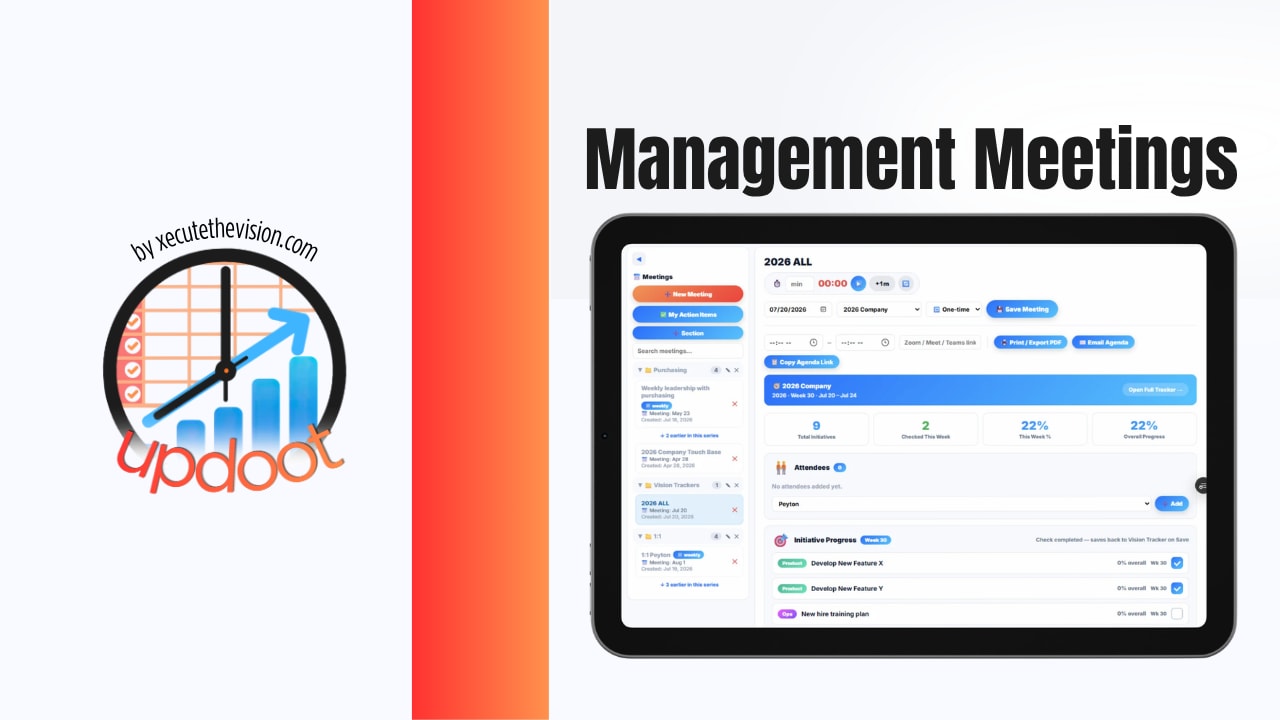
"Management meeting" is one of those terms everyone uses and almost nobody defines. It gets applied to a quick daily standup, a formal quarterly strategy session, a one-on-one, and a full staff meeting, all under the same label. That looseness is part of why so many management meetings feel unproductive: people show up unsure what kind of meeting they're actually in, so the conversation defaults to whatever feels most urgent rather than what the meeting was actually built for. This guide defines what a management meeting is, walks through the distinct types you'll actually run as a manager, and lays out a practical approach for planning, running, and following up on them so each one does the job it's supposed to.
Quick Answer
A management meeting is any recurring or one-off meeting a manager uses to align priorities, review progress, solve problems, or make decisions with their team, peers, or leadership. The main types are one-on-ones, team or staff meetings, daily standups, leadership meetings, strategic planning sessions, cross-functional meetings, and performance reviews. Each type has a different purpose and works best with its own cadence and structure, and effective ones share a clear purpose, an advance agenda, and a reliable process for tracking what gets decided.
What Is a Management Meeting?
A management meeting is a meeting where a manager is using the time to coordinate people, review work, or drive a decision, rather than simply broadcasting information one direction. The manager might be leading the meeting, as with a team meeting or a one-on-one with a direct report, or participating as a peer, as with a leadership team meeting among department heads. What makes it a management meeting isn't the org chart position of who's in the room, it's the function: aligning on priorities, surfacing problems early, and turning discussion into decisions and action.
That's a broad definition on purpose, because "management meeting" isn't really one thing. It's a category that covers several distinct meeting types, each suited to a different purpose, and treating them as interchangeable is where a lot of meeting fatigue comes from.
Types of Management Meetings
One-on-Ones
A recurring meeting between a manager and a single direct report, focused on individual priorities, blockers, feedback, and career development. This is the most personal type of management meeting, and it's where issues that would never surface in a group setting tend to come out. Weekly or biweekly is standard.
Team or Staff Meetings
A meeting covering the whole team or department, typically used for shared updates, cross-team coordination, and decisions that affect the group as a whole. These work best with a tight, consistent agenda, since a team meeting with no structure quickly turns into a series of individual status reports nobody else needed to hear.
Daily Standups
A short, frequent check-in, often 10 to 15 minutes, focused narrowly on what's being worked on, what's blocked, and what's next. Standups are meant to catch problems early, not to replace deeper discussion, which is why they work best kept strictly brief.
Leadership or Department Head Meetings
A meeting among managers or department heads, often led by a senior leader, focused on cross-department alignment, resourcing decisions, and escalations that individual teams can't resolve on their own. These meetings tend to carry more weight per topic and benefit from pre-reading, since live time is scarce and expensive across that many senior roles.
Strategic Planning Sessions
Less frequent, longer sessions, often quarterly or annually, focused on setting direction rather than reviewing weekly execution. These meetings need real preparation beforehand and enough uninterrupted time to think, not just react, which is why cramming strategic planning into a standard one-hour meeting rarely produces good outcomes.
Cross-Functional or Stakeholder Meetings
A meeting bringing together people from different teams or functions around a shared project or initiative, where no single manager owns the whole agenda. These require more explicit facilitation than a normal team meeting, since attendees don't share the same context or reporting line by default.
Performance Review Meetings
A formal, usually periodic conversation evaluating a direct report's performance against goals and expectations, often connected to compensation or development planning. These carry more structure and documentation than a typical one-on-one, and benefit from being clearly separated from regular check-ins so feedback doesn't get diluted by routine status updates.
How to Approach a Management Meeting
Before the Meeting: Define the Purpose
Every management meeting should have a clear answer to "what does this meeting need to produce?" before it's scheduled. A meeting meant to share information might not need to be a meeting at all; a written update often works better. A meeting meant to make a decision needs the right people in the room and the relevant context distributed in advance. Naming the purpose up front shapes everything else, including who needs to attend and how long it should run.
Before the Meeting: Build and Share the Agenda
An agenda distributed ahead of time does two things: it lets people prepare instead of thinking on their feet, and it gives the meeting a shape that keeps discussion from drifting toward whatever feels most urgent in the moment. Even a short standup benefits from a known, consistent structure people can rely on meeting after meeting.
During the Meeting: Facilitate, Don't Just Attend
Someone needs to actively keep the meeting on track, watch the clock, and make sure quieter voices get space to contribute. In a management meeting specifically, that's usually the manager's job, and it's easy to let slip when the manager is also the one most invested in the topic being discussed. Naming a facilitator role, even informally, helps keep the conversation moving toward a decision rather than circling the same points.
During the Meeting: Separate Discussion From Decision
Not every agenda item needs a decision by the end of the meeting, and treating every topic as though it does creates pressure to decide before the group has actually thought it through. Label items clearly as information, discussion, or decision, so people show up with the right mindset for each one.
After the Meeting: Capture and Distribute Outcomes
Decisions and action items that only live in someone's meeting notes tend to evaporate. A short recap sent out within a day, naming what was decided, who owns each follow-up, and by when, is what turns a meeting from a conversation into actual forward progress.
After the Meeting: Review Before the Next One
Recurring management meetings work best when they open by briefly checking the status of what was committed to last time. This is a small habit that has an outsized effect on whether people trust that the meeting actually matters, since it makes clear that commitments made in the room don't just disappear until someone happens to remember them.
Cadence by Meeting Type
| Meeting Type | Typical Cadence | Typical Length |
|---|---|---|
| Daily Standup | Daily | 10-15 minutes |
| One-on-One | Weekly or biweekly | 25-30 minutes |
| Team / Staff Meeting | Weekly | 30-45 minutes |
| Leadership Meeting | Weekly or biweekly | 60-90 minutes |
| Cross-Functional Meeting | As needed by project | 30-60 minutes |
| Strategic Planning | Quarterly or annually | Half-day to full-day |
| Performance Review | Quarterly or annually | 45-60 minutes |
The general principle behind this table: meetings meant to catch problems early happen often and stay short, while meetings meant for deeper strategic or evaluative work happen less often and get more time. Trying to run a strategic planning conversation in a 30-minute weekly slot, or trying to make a daily standup do the work of a strategy session, is a common source of frustration on both ends of that spectrum.
Common Management Meeting Mistakes
Running Every Meeting the Same Way
A standup, a one-on-one, and a strategic planning session need different structures. Applying one generic agenda template to all of them means each one is either too rigid or too loose for its actual purpose.
Letting Meetings Become Status Reports
If most of the time in a team or leadership meeting is spent on updates that could have been written down and read in advance, the meeting has drifted from coordination into broadcast. Move status to a pre-read and use live time for the parts that actually require discussion.
Too Many Recurring Meetings Covering the Same Ground
When the same topic gets discussed in a standup, a team meeting, and a one-on-one in the same week, something's redundant. A useful check is asking whether a piece of information genuinely needs a different audience or level of depth each time it comes up, or whether one of the meetings can absorb it and the others can drop it.
No Follow-Through Between Meetings
A meeting that produces decisions nobody tracks afterward trains people to stop taking the meeting seriously. If action items consistently disappear until someone happens to bring them up again, the structure for capturing and reviewing them is missing, not the discipline of the people in the room.
Where Updoot Fits In
Updoot's meeting tools are built around the fact that not every management meeting looks the same. Templates cover one-on-ones, team meetings, and other recurring formats, and agendas, notes, and action items all live in the same place rather than scattered across email and personal notebooks. Because it sits inside the same platform as the rest of Updoot's work management tools, a decision made in a leadership meeting or a commitment made in a one-on-one connects directly to the tracking system your team already uses, so follow-through doesn't depend on someone remembering to check a separate document before the next meeting rolls around.
Frequently Asked Questions
A management meeting is any recurring or one-off meeting where a manager and their team, peers, or leadership align on priorities, review progress, solve problems, or make decisions. It's a broad category that includes staff meetings, one-on-ones, leadership team meetings, daily standups, and strategic planning sessions, unified by the fact that a manager is using the meeting to coordinate people and decisions rather than just share information.
The most common types are one-on-ones between a manager and a direct report, team or staff meetings covering the whole group, daily standups for quick status alignment, leadership or department head meetings, strategic planning sessions, cross-functional or stakeholder meetings, and performance review meetings. Each serves a different purpose and works best with a different structure and cadence.
It depends on the type. Standups are typically daily, one-on-ones weekly or biweekly, team meetings weekly, leadership meetings weekly or biweekly, and strategic planning quarterly or annually. The general principle is that meetings meant to catch problems early happen more often and run shorter, while meetings meant for deeper strategic work happen less often and run longer.
Effective management meetings have a clear purpose defined before the meeting, an agenda distributed in advance, a consistent structure people can rely on, active facilitation that keeps discussion on track, and a reliable process for capturing and following up on decisions and action items. Meetings that lack any one of these tend to drift into status updates that could have been handled asynchronously.
There's no fixed number, but a useful check is whether people are spending more time preparing for and attending meetings than doing the work those meetings are meant to coordinate. A common warning sign is when the same information gets discussed in more than one recurring meeting, which usually means one of them can be cut or merged.
Final Thoughts
The phrase "management meeting" covers a lot of ground, and most of the frustration around meetings comes from treating that ground as flat. A daily standup, a one-on-one, and a quarterly planning session are solving completely different problems, and each deserves its own purpose, structure, and cadence rather than a single copy-pasted format. Start by naming what each recurring meeting on your calendar is actually for, cut or merge the ones that overlap, and make sure whatever gets decided in the room has somewhere to live afterward. That's most of what separates a management meeting that moves things forward from one that just fills the hour.