
The Level 10 Meeting Template: How to Run It and Why It Works
Level 10 meeting templates give EOS teams the same 90-minute agenda every week, so meetings stay focused and end with clear owners. Use the free printable Level 10 agenda below, then learn how to run each section.
Most weekly team meetings fail for the same reasons. No fixed structure. Too many topics. Nobody owns the follow-through. People walk out unsure what was decided or who is doing what. The Level 10 Meeting fixes all of that with a 90-minute agenda that has been refined across thousands of companies running the Entrepreneurial Operating System.
This guide covers what a Level 10 Meeting actually is, where it comes from, how to run each section correctly, what the most common mistakes are, and a complete template you can use immediately.
What Is a Level 10 Meeting?
A Level 10 Meeting is a structured weekly team meeting that runs exactly 90 minutes and follows the same agenda every week without exception. It was developed as part of the Entrepreneurial Operating System (EOS), created by Gino Wickman and detailed in his book Traction. EOS is a framework for running small to mid-size businesses with more clarity, accountability, and execution discipline.
The name comes from rating the meeting at the end on a scale of 1 to 10. The goal is to run a meeting so useful, so focused, and so action-oriented that the team rates it a 10. Most teams start around a 6 or 7 and improve as they get comfortable with the format.
The Level 10 Meeting is not a status update. It is not a brainstorm. It is a problem-solving meeting with a structured format that forces the team to surface real issues and solve them -- every single week.
Why Most Meetings Fail
Before you can understand why the Level 10 format works, you need to understand why most meetings do not.
The typical weekly meeting has no fixed agenda. Topics are added ad hoc, often by whoever speaks first or loudest. Discussions run long because there is no time discipline and no facilitator keeping things moving. Important issues get talked around but never resolved. The meeting ends with vague commitments, no documented to-dos, and no clear owners. The same problems resurface next week.
This creates a pattern where meetings feel like a waste of time because they largely are. Teams show up, talk for an hour, and leave having accomplished nothing structural. Leaders spend the rest of the week following up on things that should have been resolved in the meeting.
The Level 10 Meeting works because it inverts this entirely. The agenda is fixed. Every section has a time limit. Issues do not get discussed -- they get solved and assigned to an owner before moving on. The meeting rating at the end creates accountability for the quality of the meeting itself, not just the work that comes out of it.
The Level 10 Meeting Agenda
The agenda never changes. That consistency is the point. Once your team knows the format, the meeting runs faster and more effectively because nobody is figuring out what is happening next.
90-Minute Level 10 Agenda
This Level 10 template will stop working.
Beyond 1 or 2 users, spreadsheets become more of a problem than a solution. Manual entry is slow, error prone, and doesn't scale. Updoot does all of this for you.
- Slow. Someone rebuilds the agenda and scorecard every week
- Error-prone. Rocks and to-dos drift out of date between meetings
- Forgotten. Issues and decisions get lost after the meeting
- Live. Run the meeting from your live scorecard and Rocks
- Connected. Issues List and IDS built into the agenda
- Accountable. Every to-do leaves the meeting with an owner
Free Printable Level 10 Meeting Agenda
Fill in the fields below and click Print or select it all and copy paste to Word or Google Docs. No sign-up required.
📋 Level 10 Meeting Agenda
Type directly into any field. Print when ready.
| Time | Section | Notes / Outcomes |
|---|---|---|
| 5 min | Segue | |
| 5 min | Scorecard Review | |
| 5 min | Rock Review | |
| 5 min | Headlines | |
| 5 min | To-Do Review | |
| 60 min | IDS | |
| 5 min | Conclude |
To-Dos Assigned This Meeting
| Task | Owner | Due Date |
|---|---|---|
Each Section Explained in Depth
Segue (5 Minutes)
The segue opens the meeting with one personal win and one professional win from each person. It sounds soft but it serves a real purpose. It shifts people out of whatever they were doing before the meeting, creates a brief moment of human connection, and sets a constructive tone. Teams that skip the segue often spend the first ten minutes of IDS with energy that is still stuck on the last fire they were fighting.
Keep it to one sentence per person. This is not a life update -- it is a signal that the meeting has started and the team is present. If someone tries to turn their segue into a five-minute story, cut it. That is the facilitator's job.
Scorecard Review (5 Minutes)
The scorecard is a list of 5 to 15 weekly metrics the team tracks to measure business health. Each metric has a target. Each week, the actual number goes in and the metric is either on track or off track -- shown as a green or red indicator. Metrics commonly tracked include revenue, leads generated, conversion rate, customer churn, response time, hours billed, or any number specific to your business.
The scorecard review is not a discussion. It is a read-through. If a metric is off track, it gets added to the issues list for IDS. You do not solve it during the scorecard section -- you surface it. This is an important distinction that keeps the first four sections moving quickly.
Rock Review (5 Minutes)
Rocks are the three to seven most important priorities each person has committed to completing this quarter. They are bigger than weekly to-dos but smaller than annual goals. Each person reports on each rock with one of two answers: on track or off track.
No detail. No explanation unless asked. If a rock is off track, it goes on the issues list. The rock review keeps quarterly priorities visible every week so they do not get buried under daily urgency. Most teams that do not have rocks find that their quarterly priorities get reviewed quarterly -- which is too late to course-correct.
Customer and Employee Headlines (5 Minutes)
This section surfaces anything significant from your customers or your team that the group needs to hear. A major client complaint. A big win that should be celebrated. An employee who gave notice. A pattern of support tickets pointing to a product issue. A team morale concern. Anything that is relevant to the group and might affect how you operate this week.
Again -- if something raised here needs discussion or resolution, it goes to the issues list. Headlines are for awareness, not problem solving.
To-Do List Review (5 Minutes)
Every action item assigned at the previous meeting is reviewed. Each one is either done or not done. No partial credit, no extended explanation. If it is not done, the facilitator needs to understand why briefly -- was it deprioritized legitimately, or did it fall through the cracks? Consistently incomplete to-dos from the same person is itself an issue that eventually needs to go on the issues list.
The to-do list is what creates accountability between meetings. Without it, the meeting is just talk. The weekly review makes it visible that commitments were or were not honored, which changes behavior over time.
IDS -- Identify, Discuss, Solve (60 Minutes)
IDS is the core of the Level 10 Meeting. It is where the real work happens and where most teams get the most value. Every issue that was added to the list during the preceding sections -- off-track metrics, off-track rocks, headlines that need resolution, anything else the team flagged -- gets worked through here.
Before IDS starts, the team quickly prioritizes the issues list. Which three issues, if solved today, would create the most value? Those go first. The facilitator moves through issues in priority order, and each one follows the same process.
Identify means getting agreement on what the real issue actually is. Often what was raised as the issue is actually a symptom. A team member says "our sales numbers are down" -- that is a symptom. The real issue might be that a key account manager left two months ago and nobody has been assigned their accounts. Getting to the root issue before discussing solutions saves enormous time.
Discuss means the team briefly surfaces relevant context and perspectives. Not an open-ended debate -- a focused exchange that informs the solution. Good facilitators cut discussion when it starts circling rather than moving toward resolution.
Solve means the team arrives at a clear decision or action. Every issue ends with either a to-do assigned to a specific owner with a due date, or a decision that is documented. If an issue is too complex to solve in the remaining IDS time, it gets elevated to a larger project or pulled into a separate working session -- it does not just stay unresolved on the issues list indefinitely.
Conclude (5 Minutes)
The close confirms all new to-dos created during IDS, ensures everyone is aligned on the same action items and owners, and reviews any messages that need to cascade to the broader team. Then every person rates the meeting from 1 to 10. Ratings under 8 should come with a brief explanation -- what would have made it better? That feedback is used to improve the next meeting.
The meeting rating is not just a feel-good exercise. It creates explicit accountability for the quality of the meeting and signals to the team that running a great meeting is something the team is actively working on, not something that just happens.
The Level 10 Meeting Template
| Section | Time | What to Record |
|---|---|---|
| Segue | 5 min | Personal win, professional win per person |
| Scorecard | 5 min | Metric / Target / Actual / On-Off Track / Issues flagged |
| Rock Review | 5 min | Rock / Owner / On Track or Off Track / Issues flagged |
| Headlines | 5 min | Customer updates / Employee updates / Issues flagged |
| To-Do Review | 5 min | Task / Owner / Done or Not Done |
| IDS | 60 min | Issue / Root cause / Resolution / Owner / Due date |
| Conclude | 5 min | New to-dos / Cascading messages / Meeting rating |
Download the ready-to-use Level 10 Meeting template in Google Sheets.
Common Mistakes That Break the Level 10 Meeting
Letting IDS Turn Into a Discussion Club
The most common failure mode is an IDS section where issues get discussed at length but never resolved. The facilitator needs to enforce the Solve part of IDS. If the team has been discussing the same issue for ten minutes and is going in circles, either make a decision and move on or acknowledge that it needs a dedicated working session and put a to-do on someone to schedule it. Unresolved issues that sit on the list week after week destroy trust in the meeting.
Skipping Sections When Time Is Short
When teams run long in early sections they often skip the scorecard or rock review to get to IDS faster. This is backwards. The scorecard and rocks exist specifically to surface issues for IDS. Skipping them means you are walking into the most important section of the meeting without the information you need. Start on time. Enforce the time allocations from the first section.
Not Having an Issues List Between Meetings
Issues should be added to the list throughout the week as they arise -- not collected in your head and recalled from memory at the start of IDS. A shared issues list that anyone on the team can add to at any time means IDS starts with a populated, prioritized list instead of ten minutes of "does anyone have anything to bring up?"
Treating To-Dos as Optional
If to-dos are consistently not completed and there is no consequence or discussion, the to-do list becomes meaningless and the meeting loses its accountability function. Not done to-dos should at minimum be explained briefly. Patterns of incomplete to-dos should be raised as an issue in IDS.
No Designated Facilitator
Without someone explicitly responsible for keeping time and moving the meeting forward, Level 10 Meetings drift into the same patterns as every other meeting. The facilitator does not have to be the most senior person in the room -- it just has to be someone with the authority and willingness to cut off a discussion when time is up and move on.
Who Benefits Most From Level 10 Meetings
The Level 10 Meeting format works best for leadership teams and department teams in businesses with 5 to 150 employees. It is especially effective for companies that have been running on informal processes -- verbal updates, scattered Slack discussions, and ad hoc problem solving -- and are starting to experience the friction that comes when those processes stop scaling.
Founders who are still in every decision, operations leaders dealing with constant escalations, and teams where the same problems keep surfacing week after week are the clearest candidates. If your weekly meeting currently feels like a status report with no resolution, the Level 10 format will feel dramatically different within a few weeks of consistent implementation.
Running Level 10 Meetings Inside Updoot
The Level 10 Meeting is only as effective as the systems connected to it. If your scorecard data lives in one spreadsheet, your rocks are tracked somewhere else, your to-dos are in Slack, and your issues list is in someone's notebook, the meeting becomes a coordination exercise rather than a problem-solving session.
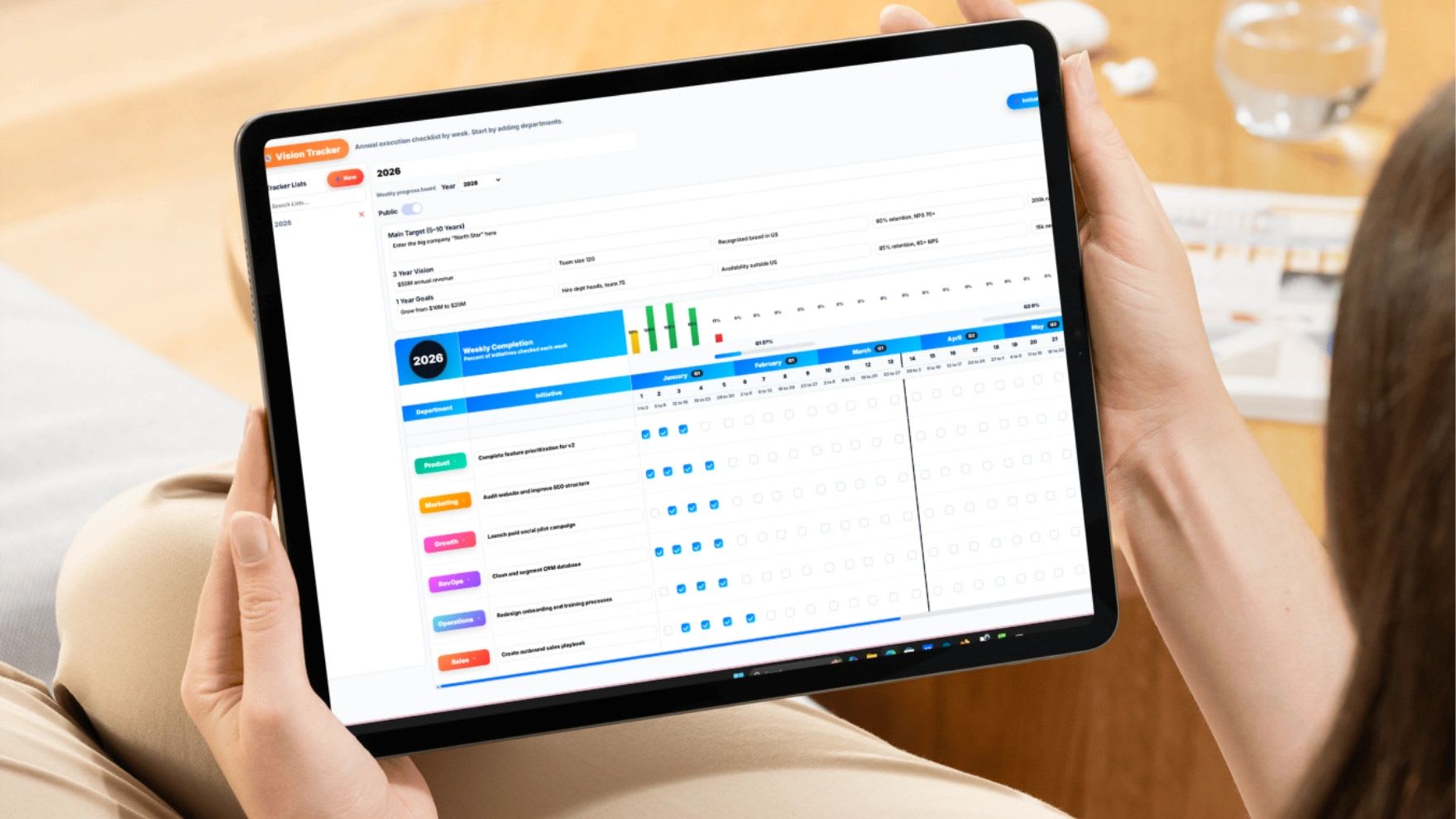
Updoot's meeting and vision tracker connects your scorecard, quarterly rocks, to-do list, and issues list in one place so the Level 10 Meeting runs from live data rather than manually compiled reports. KPIs update automatically, rocks stay visible throughout the quarter, and to-dos track completion week over week. The meeting becomes a reflection of how the business is actually running -- not how someone remembers it running.
Related Reading
Vision Tracker and Meeting Software →