What Is in a Typical Business Budget? Every Line Item Explained
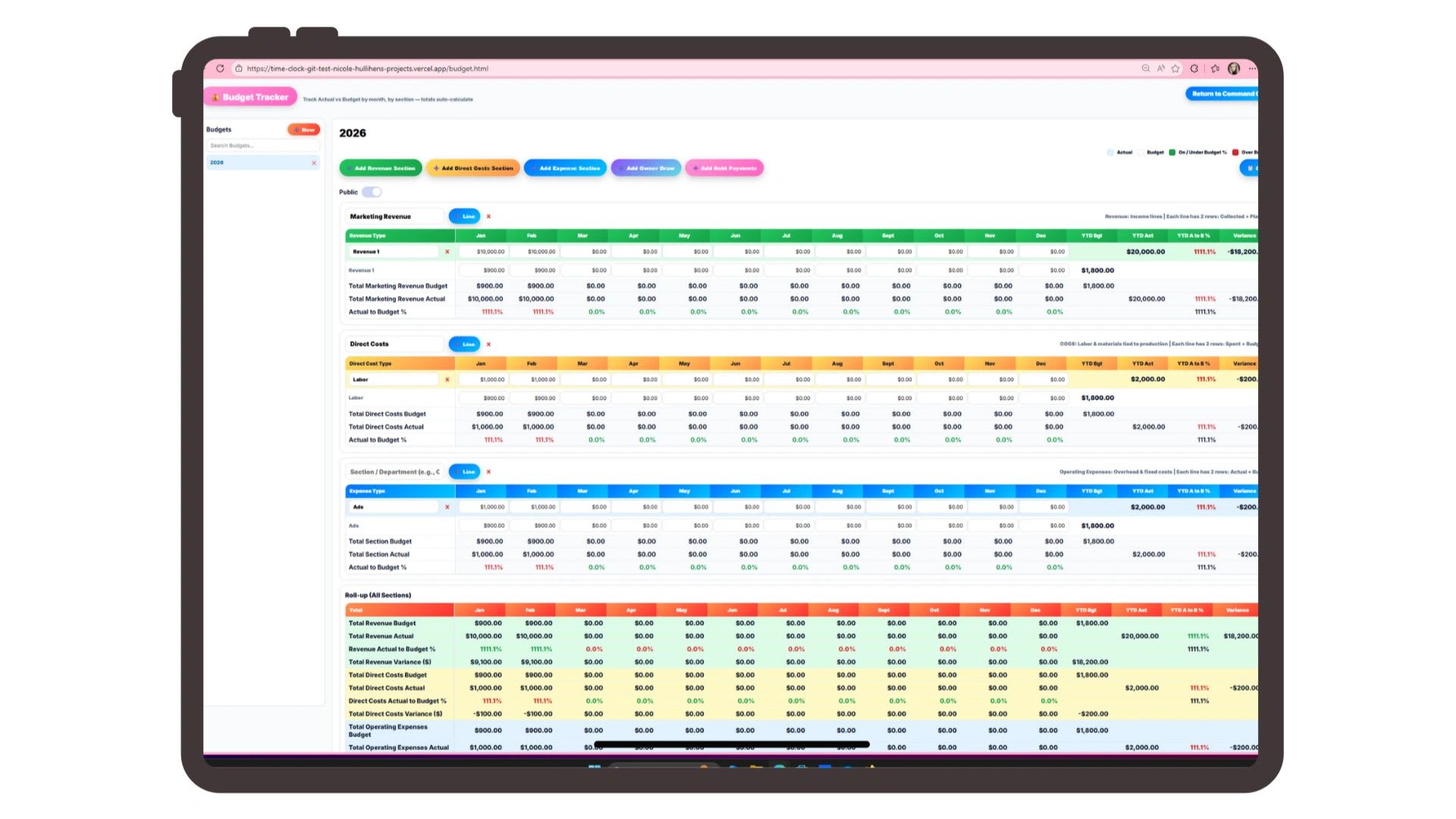
What is in a typical business budget comes down to ten categories: revenue, fixed expenses, variable expenses, cost of goods sold, operating expenses, fringe, capital expenditures, debt payments, taxes, and a contingency reserve. Each category is broken into line items with a budgeted amount, an actual amount, and a variance. This guide defines every category, shows a budget vs. actual template you can paste into Excel or Google Sheets, and includes a free calculator for the line item most owners get wrong: the fully loaded cost of an employee.
What Is a Business Budget?
A business budget is a financial plan that estimates how much money the business will earn and spend over a set period, usually a month, a quarter, or a full fiscal year. It turns goals into numbers. Instead of reacting to bills as they arrive, you decide in advance where money should go and then measure how closely reality follows the plan.
A budget is not just a list of expenses. It is an operating plan that answers four questions:
- What do we expect to earn?
- What do we expect to spend, and on what?
- Where is money leaking?
- Is the business actually profitable, and does it have the cash to stay that way?
What Is a Line Item in a Budget?
A line item is a single, clearly labeled entry that represents one specific source of income or one specific expense. Every line item answers a simple question: exactly what is this money for? A useful line item has four parts:
- Category name, such as Rent or Paid Ads
- Budgeted amount, what you planned
- Actual amount, what really happened
- Variance, the difference between the two
Specific line items give you control. A single row that says "Marketing: $10,000" hides everything. Split it into paid ads, email software, design contractors, and event sponsorships, and you can see which one is over budget and which one is producing leads. Vague budgets hide problems. Detailed line items expose them.
The 10 Categories in a Typical Business Budget
Here is a quick reference before the detailed definitions.
| Category | What It Covers | Example Line Items | Behavior |
|---|---|---|---|
| Revenue | All income the business expects | Product sales, service fees, subscriptions, retainers | Varies with sales |
| Fixed expenses | Costs that do not change with volume | Rent, salaries, insurance, loan payments | Steady |
| Variable expenses | Costs that rise and fall with activity | Commissions, shipping, card fees, freelance labor | Moves with volume |
| Cost of goods sold | Direct costs to deliver what you sell | Materials, inventory, direct labor, packaging | Moves with revenue |
| Operating expenses | Day-to-day costs of running the business | Software, marketing, utilities, admin payroll | Mixed |
| Fringe | Employment costs beyond base pay | Payroll taxes, health insurance, retirement match | Moves with headcount |
| Capital expenditures | Long-term asset purchases | Equipment, vehicles, build-outs | Lumpy, planned |
| Debt payments | Loan and credit line obligations | Principal, interest | Scheduled |
| Taxes | Amounts owed to tax authorities | Income, payroll, sales, property tax | Periodic |
| Contingency | Reserve for the unexpected | Repairs, price increases, legal fees | Set aside monthly |
1. Revenue
Every budget starts with projected revenue: the total income you expect during the period. It can include product sales, service fees, subscription income, retainers, licensing fees, and other operating income. Break revenue into separate lines by stream so you can see which one is growing and which one is slipping. The most common budgeting mistake is overestimating revenue, so project conservatively and adjust as actuals come in. For the difference between top-line figures, see revenue vs. sales.
2. Fixed Expenses
A fixed expense is a cost that stays the same each month regardless of sales volume. Rent, salaried payroll, insurance premiums, software subscriptions, equipment leases, and loan payments are typical examples. Whether you bring in $10,000 or $100,000 this month, these costs arrive on schedule. Fixed expenses matter because they set your break-even point: the higher they are, the more revenue you need before you earn a profit.
3. Variable Expenses
Variable expenses change with business activity. Sales commissions, shipping, credit card processing fees, freelance labor, and raw materials all rise when sales rise and fall when sales fall. Separating fixed and variable costs is what lets you forecast margins at different sales levels and decide whether growth will actually add profit.
4. Cost of Goods Sold (COGS)
COGS is the direct cost of producing your product or delivering your service: materials, wholesale inventory, packaging, and the labor that goes directly into the work. Revenue minus COGS equals gross profit, and gross profit divided by revenue is gross margin, one of the most important numbers in any budget. For a service business, the hours your team spends on client delivery are usually the biggest part of COGS, which is why accurate time tracking feeds directly into this line.
5. Operating Expenses (OpEx)
Operating expenses are what it costs to run the business day to day but are not tied to a specific sale: marketing, office supplies, software, utilities, administrative payroll, travel, and professional services such as legal and accounting. OpEx can include both fixed and variable pieces. Clear categories here make overspending trends easy to spot. If you want to plan OpEx by department, see budgeting revenue and expenses by business function.
6. Fringe
Fringe is the cost of employing someone beyond their base pay. Fringe line items usually include:
- Employer payroll taxes, including the employer share of Social Security and Medicare (FICA)
- Federal and state unemployment taxes
- Health, dental, and vision insurance
- Retirement plan contributions or matches
- Workers' compensation insurance
- Bonuses and other benefits
Paid time off is often counted in fringe as well. You still pay the employee during those days, but you get no productive hours, so the real cost of each hour worked goes up.
How big is fringe? It depends entirely on your benefits. The U.S. Bureau of Labor Statistics Employer Costs for Employee Compensation survey reports that benefits make up roughly 30% of total compensation in private industry, which works out to a larger percentage when measured on top of wages. A small business with no health plan may run far lower, and one with generous insurance may run higher. Instead of borrowing a rule of thumb, calculate your own rate.
Here is the math. If an employee earns $60,000 and your fringe rate is 30%, the fully loaded cost is $60,000 times 1.30, or $78,000 a year. Budget only the $60,000 and your payroll line is short by $18,000 for that one person.
Free Fully Loaded Employee Cost Calculator
Use the calculator to build the fringe line in your budget. The default values are placeholders, so replace them with your actual premiums and rates. Employer FICA defaults to the combined 7.65% employer rate, but the Social Security portion stops at an annual wage base that the IRS updates each year, so check IRS Topic 751 for high earners.
Free Fully Loaded Employee Cost Calculator
Enter a salary and your own benefit costs to see the true annual cost of an employee, your fringe rate, and the cost per productive hour. Every rate is editable because benefit costs vary by business.
| Line Item | Annual Cost | Monthly Budget | % of Salary |
|---|
The cost per productive hour is the number to use when you price services or quote projects. It divides the total cost by the hours the employee is actually available to work after paid days off.
7. Capital Expenditures (CapEx)
Capital expenditures are purchases of long-term assets such as equipment, vehicles, property improvements, and technology infrastructure. They differ from operating expenses because they deliver value over several years and are usually depreciated over time rather than expensed all at once. Plan CapEx in the annual budget so large purchases are funded on purpose instead of draining cash by surprise.
8. Debt Payments
If the business carries loans or lines of credit, the budget needs principal payments, interest payments, and expected credit line usage. Interest is an expense on the income statement, but principal is not, which is why a business can look profitable and still run out of cash. Budget both so you can see profit and cash flow timing side by side.
9. Taxes
Businesses budget for income tax, payroll tax, sales tax, and property tax, depending on structure and location. Taxes are often overlooked in early-stage companies. Setting aside a fixed share of revenue or profit every month in a separate account avoids a painful quarterly or year-end surprise. Your accountant can help you set the percentage.
10. Contingency Reserve
A contingency line covers costs nobody planned for: equipment failure, sudden price increases, legal fees, or emergency repairs. Many businesses set aside a small percentage of total expenses, often in the 5% to 10% range, and adjust it based on how volatile their costs are. If the reserve goes unused, it rolls into cash at the end of the period.
Budget vs. Actual Template
A budget only works if you compare it to what actually happened. Copy the template below and paste it into cell A1 of a blank Excel or Google Sheets file. The formulas calculate variance for every line and net profit at the bottom. For revenue, a positive variance means you earned more than planned. For costs, a positive variance means you spent less than planned.
Category	Line Item	Budget	Actual	Variance	Variance %
Revenue	Service revenue	40000	37500	=D2-C2	=IF(C2=0,0,E2/C2)
Revenue	Subscription income	10000	10400	=D3-C3	=IF(C3=0,0,E3/C3)
COGS	Direct labor	12000	12600	=C4-D4	=IF(C4=0,0,E4/C4)
Fixed	Rent	3500	3500	=C5-D5	=IF(C5=0,0,E5/C5)
Fixed	Salaries	15000	15000	=C6-D6	=IF(C6=0,0,E6/C6)
Fringe	Payroll taxes and benefits	4500	4700	=C7-D7	=IF(C7=0,0,E7/C7)
Variable	Sales commissions	2000	1875	=C8-D8	=IF(C8=0,0,E8/C8)
OpEx	Software subscriptions	900	1050	=C9-D9	=IF(C9=0,0,E9/C9)
OpEx	Paid ads	2500	2300	=C10-D10	=IF(C10=0,0,E10/C10)
Reserve	Contingency	2000	0	=C11-D11	=IF(C11=0,0,E11/C11)
	Net (revenue minus costs)	=SUM(C2:C3)-SUM(C4:C11)	=SUM(D2:D3)-SUM(D4:D11)	=D12-C12
Want a full-year version with monthly tabs? Use the annual budget template for Google Sheets.
Budget vs. Actual Tracking: Where Most Businesses Fail
Creating a budget is step one. Tracking it every month is what separates organized companies from chaotic ones. Review these numbers at least monthly:
| Metric | How to Calculate | Why It Matters |
|---|---|---|
| Revenue variance | Actual revenue minus budgeted revenue | Shows whether your sales assumptions hold up |
| Expense variance by category | Budgeted cost minus actual cost | Finds the lines that are drifting |
| Variance percentage | Variance divided by budgeted amount | Puts big and small lines on the same scale |
| Labor cost as % of revenue | Total loaded payroll divided by revenue | Warns you before hiring outpaces sales |
| Gross margin | (Revenue minus COGS) divided by revenue | Tells you whether each sale is worth making |
When a line misses by more than a set threshold, such as 10%, write down why. Over a few months those notes show whether the problem is the budget or the business.
Common Budgeting Mistakes
- Budgeting salary without fringe. The most common way payroll ends up over budget.
- Lumping costs into vague categories. A single "Miscellaneous" line hides waste.
- Optimistic revenue. Base projections on signed work and historical close rates, not hopes.
- Ignoring cash timing. Annual insurance, quarterly taxes, and CapEx hit cash in lumps.
- Setting it and forgetting it. A budget that is never compared to actuals is just a guess.
Why a Clear Budget Structure Changes Everything
When the budget is structured correctly, you get visibility into profitability, control over spending, data to support hiring decisions, clarity on pricing, and better forecasts. Without structure, decisions become emotional. With structure, they become strategic.
Updoot helps by keeping the numbers that feed a budget in one place. Time tracking, payroll, projects, and expenses live in the same system, so labor cost and project cost are already calculated when you sit down to compare budget to actual. Plans start at $5 per user per month.
Final Thoughts
A typical business budget includes revenue projections, fixed expenses, variable expenses, cost of goods sold, operating expenses, fringe, capital expenditures, debt service, taxes, and a contingency reserve. Define each as specific line items, calculate your real fringe rate instead of guessing, and compare budget to actual every month. That is how a spreadsheet becomes a management tool.
Sources: U.S. Bureau of Labor Statistics, Employer Costs for Employee Compensation; IRS Topic 751, Social Security and Medicare Withholding Rates.
Opens in Google Drive. View and download for free.
Related Reading
Annual Budget Template for Google Sheets →
Frequently Asked Questions About Business Budgets
What is in a typical business budget?
A typical business budget includes revenue, fixed expenses, variable expenses, cost of goods sold, operating expenses, fringe, capital expenditures, debt payments, taxes, and a contingency reserve, each broken into specific line items.
What is a line item in a budget?
A line item is a single labeled entry for one specific source of income or one specific expense, with a budgeted amount, an actual amount, and the variance between them.
What is a fixed expense in a budget?
A fixed expense is a cost that stays the same each month regardless of sales volume, such as rent, salaries, insurance premiums, and loan payments.
What is fringe in a budget?
Fringe is the cost of employing someone beyond base pay, including employer payroll taxes, unemployment taxes, health insurance, retirement contributions, workers' compensation, and other benefits.
How do you calculate the fringe rate?
Add up all employment costs beyond base salary for the year and divide by base salary. If benefits and employer taxes total $18,000 on a $60,000 salary, the fringe rate is 30%.
What is the difference between COGS and operating expenses?
COGS is the direct cost of producing what you sell, such as materials and direct labor. Operating expenses are the costs of running the business that are not tied to a specific sale, such as software, marketing, and admin payroll.
How much should a business keep in a contingency reserve?
Many businesses set aside a small percentage of total expenses, often around 5% to 10%, and adjust it based on how unpredictable their costs are.