
SMART Goals Template and Free Goal Generator
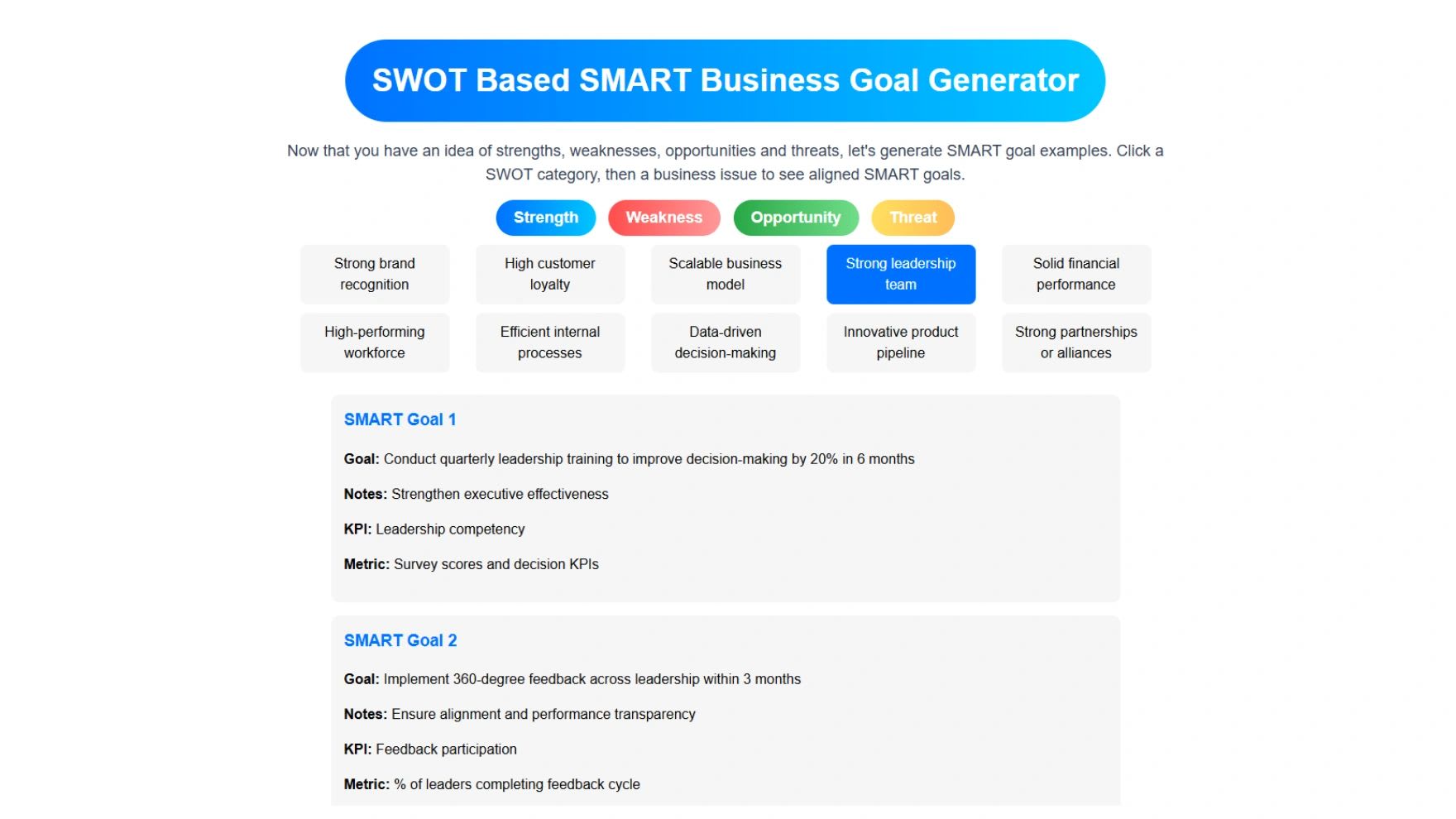
SMART goals turn vague intentions into specific, measurable, achievable, relevant, and time-bound targets your team can actually execute. Write your first one in seconds with the free SMART goal builder below, which checks every criterion for you, then copy the SMART goals templates and examples in this guide.
Setting goals is easy. Achieving them consistently is much harder. "Grow the business" sounds motivating, but nobody knows what to do on Monday morning. A SMART goal defines exactly what success looks like, how it will be measured, who owns it, and when it is due, which is why leaders, managers, and business owners rely on the framework.
Free SMART Goal Builder
Free SMART Goal Builder
Fill in the fields and the builder writes your SMART goal, checks it against all five criteria, and flags anything missing. Copy it into your plan, review, or goal tracker.
| Criterion | Check | Status |
|---|
Want goal ideas written for you? Try the free AI SMART goal generator.
What Are SMART Goals?
SMART is an acronym for the five qualities that make a goal clear and trackable. The framework is widely credited to George T. Doran, who described it in a management journal article, and it has since become a standard in business planning, performance management, and personal development.
| Letter | Stands for | Question it answers |
|---|---|---|
| S | Specific | What exactly will be accomplished, and how? |
| M | Measurable | What number will show progress and success? |
| A | Achievable | Is it realistic with our people, time, and budget? |
| R | Relevant | Does it support our bigger priorities? |
| T | Time-bound | When is it due, and when will we check progress? |
Why SMART Goals Work
Most goals fail because they are too vague. "Increase sales" does not say how much, by when, or through what. SMART goals force those decisions up front. The result is clearer expectations, easier progress tracking, stronger accountability, better execution, and goals that line up with company strategy instead of competing with it.
Breaking Down the SMART Framework
Specific
State exactly what you want to accomplish. Instead of "improve customer service," write "reduce customer support response time." A specific goal tells the team where to focus.
Measurable
Attach a number that shows progress: revenue, customers, conversion rate, response time, costs, or completion rate. Include the starting point as well as the target, so you can see how far you have come.
Achievable
The goal should stretch the team without being impossible. Check it against past results, available people, time, and budget. A goal no one believes in stops motivating anyone.
Relevant
The goal must support a bigger priority. If the company is focused on customer retention, a relevant goal might be "increase customer renewal rate." Goals that do not connect to priorities waste effort.
Time-Bound
Set a deadline, such as the end of the quarter or within six months, and schedule check-ins before it. Without a deadline, goals drift.
How to Write a SMART Goal in Five Steps
- Start with the outcome. Write the result you want in one plain sentence.
- Add the numbers. Find the current level and set the target.
- Reality-check it. Compare the target with past performance and resources, and adjust.
- Connect it to a priority. Name the company or team objective it supports.
- Set the deadline and owner. Pick the due date, the check-in rhythm, and the one person accountable.
SMART Goal Examples
Sales
Vague: "Increase sales." SMART: "Increase monthly sales revenue by 20% within six months by expanding outbound prospecting and improving demo-to-close conversion."
Marketing
Vague: "Get more website traffic." SMART: "Increase organic website traffic by 30% in the next 90 days by publishing two optimized articles per week."
Customer Service
Vague: "Improve customer support." SMART: "Reduce average support response time from 24 hours to 6 hours within 60 days by implementing a ticketing system."
SMART Goal Examples by Role
| Role | SMART goal example |
|---|---|
| Business owner | Raise gross margin from 38% to 42% by the end of the fourth quarter by renegotiating two supplier contracts and raising prices on low-margin services. |
| Manager | Hold a 30-minute one-on-one with each direct report every two weeks for the next quarter, and document one development goal for each person. |
| Operations | Document and publish SOPs for the five most frequent processes within 60 days, each with a named owner. |
| HR | Reduce time to fill hourly roles from 30 days to 18 days by the end of the quarter by building a candidate pipeline and using structured interviews. |
| Finance | Cut days sales outstanding from 45 to 30 within 90 days by invoicing weekly and sending automatic payment reminders. |
| Employee | Complete an advanced Excel course and build an automated weekly report for my team within eight weeks. |
| Customer success | Increase annual renewal rate from 82% to 88% over the next two quarters by adding a 60-day check-in for every account. |
For more ideas, see performance goals for managers and SMART goals for sales reps.
SMART Goals Template (Copy and Paste)
Use this template to work through each part of the goal before writing the final statement.
SMART GOAL TEMPLATE

Goal title:
[Short name for the goal]

Specific: What exactly will be accomplished, and how?

Measurable: What metric shows progress? Current level: ______  Target: ______

Achievable: Why is this realistic with our resources and time?

Relevant: How does this support team or company priorities?

Time-bound: What is the deadline? Check-in dates?

Owner:

Final SMART goal statement:
[Write the complete goal in one sentence]
One-Sentence SMART Goal Template
If you prefer a quick format, fill in the brackets. Example: "Our goal is to grow monthly recurring revenue from $50,000 to $75,000 by the end of the third quarter by launching an annual plan and a referral program, so that we can fund two new hires."
Our goal is to [increase / reduce / complete] [specific result]
from [current level] to [target level]
by [deadline]
by [main actions],
so that [why it matters].
SMART Goals Template for Teams
Managers can use this version for team planning, since it adds a baseline, owner, contributors, action plan, and check-in schedule.
TEAM SMART GOAL TEMPLATE

Objective: What result do we want to achieve?
Key metric: What number shows success?
Current baseline: Where are we today?
Target outcome: Where do we want to be?
Deadline:
Owner:
Contributors:
Action plan:
  1.
  2.
  3.
Check-in schedule (weekly / monthly):
Risks or support needed:
SMART Goals vs. OKRs vs. KPIs
| SMART goals | OKRs | KPIs | |
|---|---|---|---|
| What it is | One well-defined goal | An ambitious objective with three to five measurable key results | An ongoing metric that shows performance |
| Ambition level | Realistic and achievable | Stretch, often with 70% seen as success | Steady-state health |
| Timeframe | Set deadline | Usually quarterly | Tracked continuously |
| Best for | Individual and team goals, performance reviews | Company and team direction | Monitoring the business week to week |
They work well together: KPIs tell you where you stand, OKRs set direction, and SMART goals turn that direction into specific commitments. See how to create a KPI tracker in Excel to track the numbers behind your goals.
Using SMART Goals in Performance Reviews
SMART goals make performance reviews fairer and easier because everyone agreed on what success looked like before the period started. At the start of each review period, set three to five SMART goals with each employee, including at least one development goal. Check progress in regular one-on-ones rather than waiting for the review. At review time, compare the result with the target, discuss what helped or got in the way, and set the next round of goals. Pair this with a consistent performance review template so every employee is evaluated the same way.
SMART Goals for Personal and Career Development
The framework works just as well for individual growth. "Get better at Excel" becomes "Complete an intermediate Excel course and build a pivot table dashboard for my weekly sales report within six weeks." "Be a better leader" becomes "Hold a monthly development conversation with each of my three direct reports for the next two quarters." The more specific the outcome, the easier it is to know when you have achieved it.
SMART Goal Checklist
- The goal names one clear result, not a list of activities.
- It includes a current level and a target number.
- The target is a stretch, but past results suggest it is possible.
- It connects to a named team or company priority.
- It has a deadline and check-in dates.
- One person owns it.
- The main actions to reach it are written down.
Common SMART Goal Mistakes
Setting Activities Instead of Outcomes
"Make 50 calls a week" is an activity. "Book 12 demos a month" is an outcome. Use activities as the how, not the goal.
Too Many Goals
Most teams do best with three to five major goals at a time. More than that splits focus.
No Baseline
Without a starting number, you cannot tell whether the target is ambitious or easy.
Set It and Forget It
Goals written in January and reviewed in December rarely happen. Review progress weekly or monthly.
No Single Owner
Shared goals need one accountable person, or no one drives them.
How to Track SMART Goals
Write every goal where the team can see it, break it into milestones, and review progress on a set rhythm, weekly for team goals and monthly for longer ones. Mark each goal on track, at risk, or off track, and decide what to change when a goal slips. Updoot's goal and vision tracker keeps goals, owners, and quarterly priorities in one place and connects them to your weekly meetings, so progress is reviewed instead of forgotten.
Final Thoughts
The SMART framework is one of the simplest ways to turn ideas into results. When goals are specific, measurable, achievable, relevant, and time-bound, teams know what to do, leaders can track progress, and everyone can see when the goal is met. Build your goal with the tool above, copy the templates, and review progress regularly.
Opens in Google Drive. View and download for free.
Related Reading
Short-Term Goals Examples for Leaders and Employees →
Frequently Asked Questions About SMART Goals
What are SMART goals?
SMART goals are goals that are specific, measurable, achievable, relevant, and time-bound. The framework turns vague intentions into clear targets that are easy to track.
What does SMART stand for?
SMART stands for Specific, Measurable, Achievable, Relevant, and Time-bound. Some versions use Attainable for A or Realistic for R, but the idea is the same.
How do you write a SMART goal?
Start with the outcome you want, add the current level and target number, check that it is realistic, connect it to a bigger priority, and set a deadline and owner.
What is an example of a SMART goal?
Reduce average support response time from 24 hours to 6 hours within 60 days by implementing a ticketing system. It is specific, measurable, realistic, tied to service quality, and has a deadline.
What is the difference between SMART goals and OKRs?
A SMART goal is a single realistic goal with a deadline. An OKR is an ambitious objective paired with three to five measurable key results, usually set quarterly. Many teams use both.
How many SMART goals should a team have?
Most teams do best with three to five major goals at a time, so effort stays focused on what matters most.
How often should SMART goals be reviewed?
Review team goals weekly and longer-term goals at least monthly. Mark each one on track, at risk, or off track and adjust the plan when progress slips.