
Job Management Software for Electricians
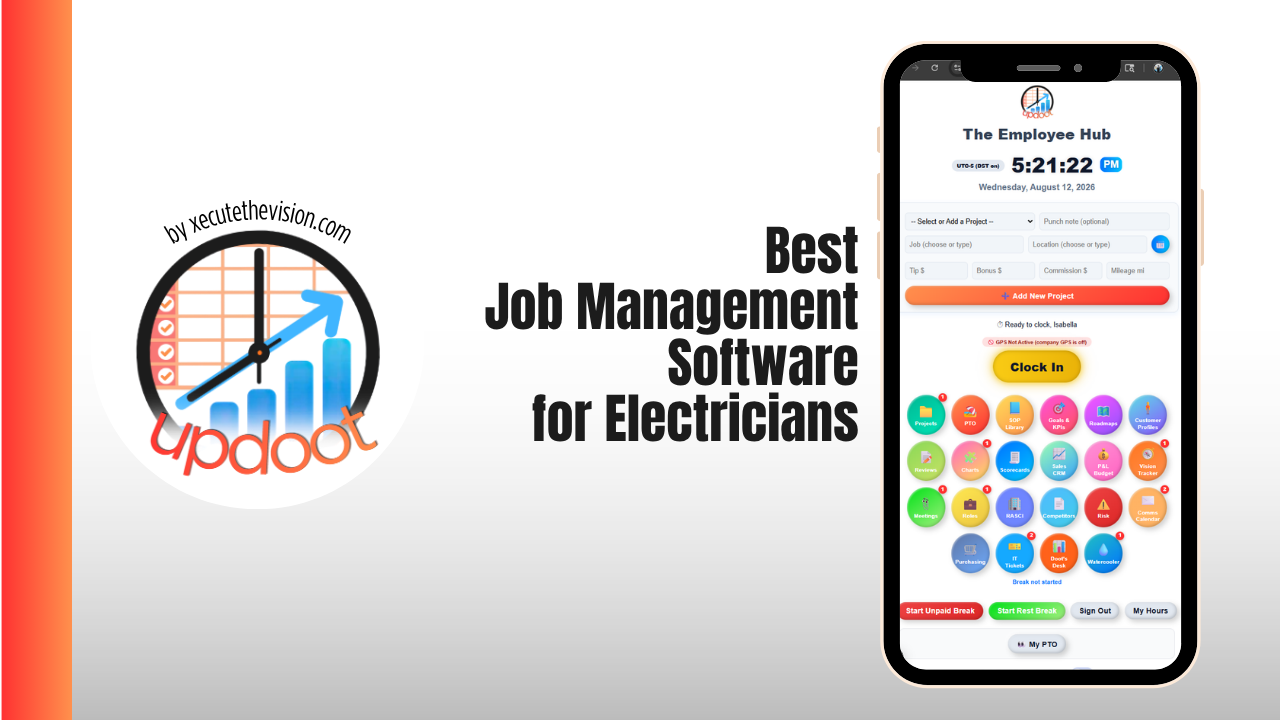
Job management software for electricians has to do everything a general trade platform does and then handle the part that makes electrical work different: the paperwork that proves the installation is safe. Quotes, diary, timesheets, and invoices are table stakes. Certificates, test results, photographs of the board, and a record you can produce three years later are what separate software built for electricians from software an electrician is making do with. This guide covers the features that matter, how the leading platforms compare on price and fit, and includes a free electrical quote builder below that shows your margin before you send the quote rather than after the job is done.
🔗 Part of our job management software guide
- Best Job Management Software — the full category guide and platform comparison
- Job Management Software for Electricians — you are here
- Job Management Software for Tradesmen — the wider trades shortlist, plus GPS time tracking and job costing
- Best Cloud-Based Job Management Software for Restoration Contractors — insurance and carrier work
What Electricians Need That Generic Software Misses
A generic job platform assumes the job ends when the work is finished and the invoice is sent. Electrical work has a fourth stage after that: the record. Test results, certification, and photographic evidence outlive the job by years, and they need to be attached to the job rather than filed separately, because the day you need them is the day someone questions an installation you barely remember.
Four requirements follow from that, and they are the ones most likely to be missing from a platform chosen on price alone:
- Certification attached to the job. Whether that is inspection and testing documentation, minor works records, or the permit and inspection trail your jurisdiction requires, it belongs on the job record.
- A price book of electrical items. Boards, circuits, points, containment, and labour rates as reusable line items, so a rewire quote is assembled rather than composed.
- Materials tracked per job. Electrical work is materials-heavy and margin lives in the markup. Cable and accessories collected from the wholesaler on the way to site have to make it onto the invoice.
- Offline capture. Risers, basements, plant rooms, and new-build shells with the power off. A platform that loses a set of test results captured underground gets abandoned immediately.
Regulatory requirements vary by country, state, and locality, and they change. Check current requirements with your licensing authority or scheme provider rather than relying on what a software vendor's marketing page implies, and in the US confirm the code edition your jurisdiction has adopted through your local authority having jurisdiction and the NFPA.
⚡ Electrical Job Quote Builder
Build the job line by line, set your materials markup and target margin, and see the price, profit, and margin before the quote goes out.
| Task or item | Hours | Materials cost ($) | Line total | |
|---|---|---|---|---|
| $0 | ||||
| $0 | ||||
| $0 | ||||
| $0 | ||||
| Totals | 0 hrs | $0 | $0 |
Two habits show up immediately when you price this way. The first is that labour cost and labour charge-out rate are different numbers, and quoting off the pay rate rather than the true cost of employing someone is how a busy year produces no money. The second is the markup-versus-margin trap: a 30% markup on materials does not produce a 30% margin, it produces about 23%, and on a materials-heavy job like a rewire or a board change that gap is the whole profit. Software that carries a price book applies both consistently instead of leaving them to the evening.
The Features That Matter for Electrical Work
Certificates and test records
The deciding feature for most electricians. Ask whether certification is native or an add-on, which certificate types are covered, whether results can be captured on a phone offline, and whether the finished document attaches to the job record and the customer's site history. If it does not, you are running a second app and reconciling two systems every week.
A price book you actually maintain
Saved line items for common electrical work, with labour hours and materials attached to each. This is what turns a two-hour evening quote into a ten-minute one, and it is what makes pricing consistent between you and anyone else who quotes.
Materials and van stock
Materials collected on the way to site are the most commonly unbilled cost in electrical work. Look for the ability to add materials from a phone at the moment they are used, and for van stock tracking if you carry meaningful inventory across multiple vehicles.
Scheduling for callouts and planned work together
Electrical businesses run two schedules at once: reactive callouts that appear today and periodic inspection or maintenance visits scheduled months ahead. Both need to live in the same diary, and recurring inspections need to generate automatically rather than depend on someone remembering a renewal date.
Photos on the job record
Board before and after, cable routes before they are covered, existing damage before you touch it. Photos end disputes early and they are the only reliable record of what is behind a wall when you return in two years.
Time logged per job
Hours against a job rather than a week are what make job costing possible, and job costing is what tells you whether your rewire price is right. GPS clock in and out also settles travel time and gives you an arrival record when a customer disputes it.
Apprentice and team visibility
Who is where, who is qualified to sign off what, and how apprentice hours are recorded. Growing from one van to three is where informal systems break down first.
Invoicing and payment
Invoices built from the accepted quote plus actual hours and materials, sent from site, with card or bank payment attached. Check processing fees, which typically run around 2.9% plus a fixed per-transaction charge and add up quickly on rewire-sized invoices.
Best Job Management Software for Electricians Compared
Pricing reflects published rates as of August 2026 and changes regularly, so confirm on each vendor's own page. Note that certificate handling is the axis most likely to move your decision, and it frequently sits on a higher tier than the entry plan.
| Platform | Pricing | Certificates | Best For |
|---|---|---|---|
| Updoot Best value | $5 per user / month, everything included | Job records, photos and SOP library; no native certificate templates | Electrical firms that also need HR, payroll reporting and CRM in one place |
| Tradify | About $39-47 per user / month | Native trade certificate support on higher tiers | Sole traders and teams up to about 20 |
| ServiceM8 | From about $29 / month by job volume | Custom form builder, strong offline capture | High-volume small teams on Apple devices |
| Jobber | From about $39 / month (1 user) | Custom fields and forms rather than native certs | Residential service and customer experience |
| Joblogic | Around $45+ per user / month | Deep bespoke certificate workflows | Commercial portfolios and facilities clients |
| Commusoft | Quote-based | Strong certification and asset service history | Growing teams with maintenance contracts |
| simPRO | Quote-based | Forms and compliance within a heavier platform | Larger contractors with stock and projects |
Updoot
$5 per user per month · every tool included · 14-day free trialOnce an electrical business has two or three vans, the software bill stops being one subscription and becomes four: the job platform, the time clock, the CRM, and something for HR. Updoot puts all of it in one place, which means a five-person firm pays $25 a month for the whole back office rather than per-tool pricing that grows every time you hire.
- Quotes built from saved line items that convert straight into live jobs
- GPS time tracking logged per job, feeding both the invoice and the payroll report
- Scheduling that holds callouts, planned inspections, and crew capacity in one diary
- Photos, notes, and full history attached to every job and customer site
- SOP library with version control for testing and safe isolation procedures
- Sales CRM so quotes sent and quotes chased sit in one pipeline instead of an inbox
- HR records, apprentice onboarding, performance reviews, and payroll reporting included
Best for: electrical firms from 1 to 50 people that want the whole business in one subscription. Trade-off: it does not ship native electrical certificate templates, so if you issue certificates daily, plan to pair it with a dedicated certification app or choose a certificate-native platform.
Tradify
Roughly $39 to $47 per user per month depending on tier and region- Strengths: built for trades, quick to learn, equally capable on iOS and Android, with job cards, quoting, timesheets, and invoicing in one clean interface
- Strengths: handles job variations well, which matters on electrical work where scope moves once walls are open
- Watch for: certificate support depends on tier and region, so confirm the specific documents you issue are covered on the plan you are pricing
- Watch for: limited offline capability, a genuine problem in risers and basements, and per-user pricing that scales with hiring
- Best for: sole traders and electrical teams under about 20 who want trade-shaped simplicity
ServiceM8
From about $29 per month · priced by monthly job volume · unlimited staff logins- Strengths: the best mobile experience in this group and genuine offline access, which suits electrical work in places signal does not reach
- Strengths: a custom form builder that many electricians use for test sheets and site checklists, plus a free tier capped at a few jobs a month for testing
- Watch for: pricing rises with job volume, so a busy quarter costs more, and some features are gated to higher tiers
- Watch for: iOS-first, with a weaker Android experience for mixed-device teams
- Best for: one-van and small operations doing a high volume of short jobs and callouts
Jobber
From about $39 per month (1 user) · team plans in the hundreds- Strengths: the strongest customer-facing experience here, with online booking, a client portal, and automated quote follow-up that wins residential work
- Watch for: compliance documentation is handled through custom fields and forms rather than native certificates
- Watch for: job costing and two-way texting sit above the entry plan, and team pricing climbs beyond the included seats
- Best for: residential electrical service businesses where booking experience and follow-up drive revenue
Joblogic and Commusoft
Around $45+ per user per month, or quote-based- Strengths: the deepest certificate workflows in the category, alongside asset-level service history and planned maintenance scheduling
- Strengths: offline mobile apps pairing office and field engineers, built for portfolios rather than one-off jobs
- Watch for: priced and designed for roughly six-plus engineer operations, so a two-van business will pay for depth it never uses
- Watch for: implementation is a project measured in weeks
- Best for: electrical contractors serving facilities management clients or commercial maintenance portfolios
simPRO
Quote-based- Strengths: genuine stock control, purchase orders, project tracking, and financial depth for larger electrical contractors
- Watch for: heavy for a small business, with implementation and configuration that need an internal owner
- Best for: contractors running multiple crews, real inventory, and project work alongside service
Choosing by the Work You Actually Do
Domestic and residential service
Speed and customer experience decide it. Quoting on the driveway, automated follow-up, online booking, and paying by card on completion matter more than deep asset management. Certificates matter, but the volume is manageable.
Commercial and facilities contracts
Asset-level service history, planned maintenance schedules, and certificate workflows become the core requirement. You are not managing jobs so much as managing a portfolio of sites over years, and the software needs to hold that history.
New build and contracting
Longer programmes, staged payments, variations, and materials at volume. This looks more like construction project management than service work, so check how the platform handles budgets over months and variations against an original contract sum. The wider trades guide covers the project-shaped options.
Solar, EV charging and specialist installs
Documentation and commissioning records are heavier than standard install work, and jobs often involve scheme paperwork and manufacturer registration. Prioritise custom forms and photo evidence, and confirm the platform can produce the specific handover pack your scheme requires.
What It Costs
- Per-user pricing scales with hiring. $45 per user is $45 at one van and $225 at five. Price it where you expect to be in a year.
- Certificates are often a tier or an add-on. The single most common source of a higher-than-expected bill for electricians specifically.
- Card processing. Roughly 2.9% plus a per-transaction fee, which on rewire-sized invoices is a real line item.
- Job-volume pricing cuts both ways. Cheap in a quiet January, more expensive in a busy summer.
- Your own changeover time. Usually a week of evenings to import customers and build a usable price book, and it is the step that determines whether the platform pays off.
To compare total cost across your whole stack rather than one subscription at a time, the calculator in the main job management software guide adds admin hours to the software line, which is usually where the real number is hiding.
Common Mistakes Electricians Make Choosing Software
- Assuming certificates are included. Check the specific documents you issue against the specific plan you are pricing, not the feature page.
- Not testing offline. Put the phone in airplane mode during the trial and try to complete a job with photos and readings.
- Quoting off the pay rate. Labour cost includes on-costs, van, tools, insurance, and unbillable time. Charge-out rate and cost rate are different numbers.
- Confusing markup with margin on materials. A 30% markup is roughly a 23% margin, and on materials-heavy work that gap is the profit.
- Buying the commercial platform for domestic work. Asset registers and maintenance portfolios are expensive features to own and never use.
- Leaving the price book empty. A platform without saved line items is just a prettier blank page, and quoting stays an evening job.
How Updoot Works for an Electrical Business
- Quote → job. Saved line items build the quote, and acceptance converts it into a live job rather than a retyped task list
- Job → diary. Callouts and planned inspections in one calendar with crew capacity visible
- Job → hours. GPS time tracking logged against the job, so quoted hours and actual hours sit side by side
- Job → evidence. Photos, notes, and documents attached to the job and the customer's site history
- Hours → invoice and payroll. The same logged hours produce the invoice and the payroll report
- Procedures → SOPs. Testing and safe isolation procedures written once, versioned, and available to every apprentice
$5 per user per month with no tiers or feature gates. Pair it with a dedicated certification app if you issue certificates daily.
Related Reading
Best Job Management Software: The Complete Guide →
Job Management Software for Tradesmen →
Best Cloud-Based Job Management Software for Restoration Contractors →
Job Quoting Software: The Complete Guide for Service Businesses →
Frequently Asked Questions
Final Takeaway
For most electricians the decision comes down to two questions. How many certificates do you issue, and how many people will be using this in a year? Heavy certification and a growing commercial portfolio point to Joblogic or Commusoft. A one-van domestic business points to ServiceM8 or Tradify. A firm that has outgrown one tool and is now paying for four points to consolidating everything into a single platform. Whatever you shortlist, build your five most common jobs into the price book during the trial and price one of them with the calculator above. If the margin surprises you, that is the software already earning its keep.