
Best HR Software for Nonprofits
Use the free calculator below to see what reconstructing staff time allocations actually costs your organization. Nonprofits carry an administrative burden that for-profit companies do not: every hour of payroll may need to be attributed to a grant, a program, or general operations, and when that attribution is rebuilt from memory at month end, it costs staff time and creates audit exposure at the same time. Below is a free generator that estimates that cost across a year, plus how the leading tools compare.
Free Nonprofit Time Allocation Cost Calculator
What Is Reconstructing Time Allocations Costing Your Nonprofit?
Enter your staff count and funding structure. Leave a field at 0 if it doesn't apply to your organization.
What Nonprofits Actually Need from HR Software
A nonprofit needs staff time attributed to the funding source that pays for it, captured as the work happens. This is the requirement that separates nonprofit HR from everything else, and it is the one most general-purpose platforms handle poorly, because they were built to answer how many hours someone worked, not which grant paid for them.
Documentation matters as much as accuracy. Funders and auditors do not just want the number, they want a record showing how it was arrived at and who approved it. A timekeeping record created at the time, approved by a supervisor, and unchanged since is defensible. A spreadsheet assembled in the week before a report is not.
The third requirement is handling people who do not fit one box. Nonprofit staff are routinely split across two grants and general operations, part-time, seasonal, or paid for a portion of their role by a specific award. A platform that assumes one person equals one cost center forces the split to happen in a spreadsheet afterward, which is exactly where the error rate lives.
Finally, it has to be affordable enough to justify to a board. Administrative overhead is scrutinized in this sector in a way it is not elsewhere, and software that consumes a visible share of the operating budget is a hard conversation regardless of how much staff time it saves.
Program Staff vs. Administrative and Development Staff
These two groups have genuinely different needs, and the split matters when choosing a platform. Program staff often work in the field or across sites, may need mobile or kiosk clock-in, and their hours usually need to land against a specific program or grant. Administrative, finance, and development staff are more likely salaried, work across everything, and their time is often the hardest to allocate cleanly because it genuinely is shared.
A tool that only serves one group well pushes the other into a manual process. The practical test is whether a mobile program worker and a salaried development director can both be handled in the same system without either being an afterthought.
Common HR Mistakes in Nonprofits
The most common mistake is allocating payroll by budget rather than by actual work. A grant budget says a coordinator is 60% funded by that award, so 60% of their salary is charged to it every month regardless of what they actually did. This is one of the most frequent audit findings in the sector, and it is entirely a timekeeping problem.
The second is treating documentation as a reporting task rather than a daily one. If the record is built at report time, it is a reconstruction, and reconstructions do not survive scrutiny well.
The third is under-investing in the people side because every dollar feels like it belongs to the mission. Nonprofit turnover is expensive and the sector runs on committed staff who burn out quietly. Skipping reviews, skipping engagement measurement, and skipping clear role definitions saves money on paper and costs more in practice.
Allocating Staff Time Across Grants and Programs
This is the operational core of nonprofit HR, and it breaks down into three distinct problems that behave differently.
Restricted grant funding
Restricted funds can only pay for what the award covers, and the burden of proof sits with the organization. Hours need to be logged against the specific grant as the work happens, with supervisor approval attached. Done that way, the report is a query. Done any other way, the report is a project.
Split and shared roles
Most nonprofit staff are split, and the splits change. A program manager funded across two grants plus general operations should be able to switch which one their time is going to during the day, in a few taps, rather than estimating percentages at month end. When switching is hard, staff batch their entries, and batched entries are estimates wearing a timestamp.
Administrative and indirect time
Time that genuinely belongs to general operations needs its own code rather than being spread across grants to make budgets work. Clean separation here is what lets you see your true administrative load, which is both an audit matter and a strategic one, since most organizations underestimate it and then wonder why the team is stretched.
Audit Trails and Funder Documentation
The difference between a smooth audit and a painful one is usually not whether the organization did the right thing. It is whether it can show that it did.
What makes a record defensible is that it was created contemporaneously, approved by someone with knowledge of the work, and has a visible revision history. If a correction was made, the record should show what changed and who changed it, rather than simply presenting a clean final number with no history behind it. Systems that allow silent edits to past time entries are a liability in a sector where after-the-fact adjustment is exactly what auditors probe for.
Practically, this means looking for timecard approvals, logged changes, and exports that can be handed to a funder or auditor without reformatting. When a program officer asks for backup on a line item, the answer should be a report, not a week of work.
Volunteers, Seasonal Staff, and Part-Time Roles
Nonprofit workforces have shapes that HR software often does not anticipate. Seasonal program staff arrive for a summer and leave, part-time roles are common, and many organizations track volunteer hours for board reporting, in-kind match requirements, or grant deliverables.
Two practical questions follow. The first is what happens to a seat when a seasonal worker leaves, because paying for inactive seats until renewal is a real cost on a lean budget. The second is whether non-payroll people can be tracked at all without paying full price for them, since volunteer hours frequently need to be recorded even though no wage is attached.
Questions to Ask Before You Sign Up
- Can staff switch between grants or programs during a shift? If splitting time requires clocking out and back in, staff will estimate at the end of the week and your allocation data becomes an approximation.
- Is there an audit trail on time entries? Ask specifically whether edits to past entries are logged and whether approvals are recorded, because that is what a funder will ask about.
- Can you report labor cost by grant without exporting to a spreadsheet? If every funder report requires a manual rebuild, the software has not solved the problem the calculator above is measuring.
- Is there a minimum charge? Several HR platforms charge a flat monthly floor that a 12-person nonprofit pays in full, which can be several times what per-user pricing would cost at that size.
- What happens to seasonal seats? Find out whether you can deactivate staff between seasons or keep paying through the contract term.
- Is a nonprofit rate available, and what does it actually change? Discounts in this category are often applied to a base tier while the modules you need stay full price.
How We Evaluated These Tools
A note on where we stand: Updoot publishes this site and appears in the comparison below. Pricing and features for every tool here, Updoot included, were verified against each vendor's live pricing page or independent third-party sources in August 2026, and Updoot's own limitations are listed in the same column as everyone else's.
For nonprofits specifically, we weighted five things: the ability to attribute hours to a specific grant or program as work happens, audit-ready approvals and revision history, budget reporting that shows labor against program funding, breadth of HR functions included rather than sold as modules, and total cost at the small headcounts most nonprofits actually run.
How the Top HR Tools Compare for Nonprofits
| Tool | Starting Price | Best For | Where It's Limited |
|---|---|---|---|
| Updoot ⭐ Best Overall | $5/user/month, all features included | Nonprofits that need every hour attributed to a grant or program, with budgets, approvals, HR records, PTO, reviews, and reporting included on one platform at a board-friendly cost | Not a payroll processor; produces payroll-ready reports and exports rather than filing payroll taxes or Form 990 |
| Gusto | From ~$49/month plus ~$6/employee/month | Small 501(c)(3)s that need payroll processing, tax filing, and basic HR in one place | Time tracking is basic for restricted-fund work; program-level budget reporting and grant cost allocation are not native |
| Paylocity | Quote only | Larger multi-program nonprofits wanting grant allocation inside a full HCM suite | Enterprise pricing and implementation; heavy and expensive for organizations under roughly 50 staff |
| BambooHR | ~$10-25/employee/month; flat ~$250/mo minimum at 25 employees or fewer | Nonprofits wanting a polished HRIS focused on records and reviews | No native grant or program cost allocation; time tracking and payroll are add-ons, and the flat minimum hits small nonprofits hardest |
Editor's Pick
Why Updoot Tops This List for Nonprofits
The nonprofit problem is specific: hours have to land against the grant that funds them, and the tools that do that well are priced for organizations with far bigger budgets. Paylocity handles grant allocation but is quote-only enterprise software. BambooHR has no native program allocation and charges a flat floor that a 14-person nonprofit pays in full. Gusto is strong at payroll and tax filing but its time tracking was not built for restricted-fund reporting. Updoot lets staff log every hour against a specific program or grant, switch between them during the day, and see labor cost against each program's budget in real time, with approvals and revision history for the audit file, plus HR records, PTO, reviews, eNPS, SOPs, and hiring included at a flat $5 per user per month. At typical nonprofit headcounts that is a fraction of what the alternatives cost, and it is the only one here that answers the grant question without a spreadsheet.
The right pick depends on whether you need payroll filed or payroll costed. Organizations that want a processor to file taxes should pair that function with a platform that handles allocation, since the two jobs are rarely done well by the same product at a small-nonprofit price.
How Updoot Handles Grant and Program Cost Tracking
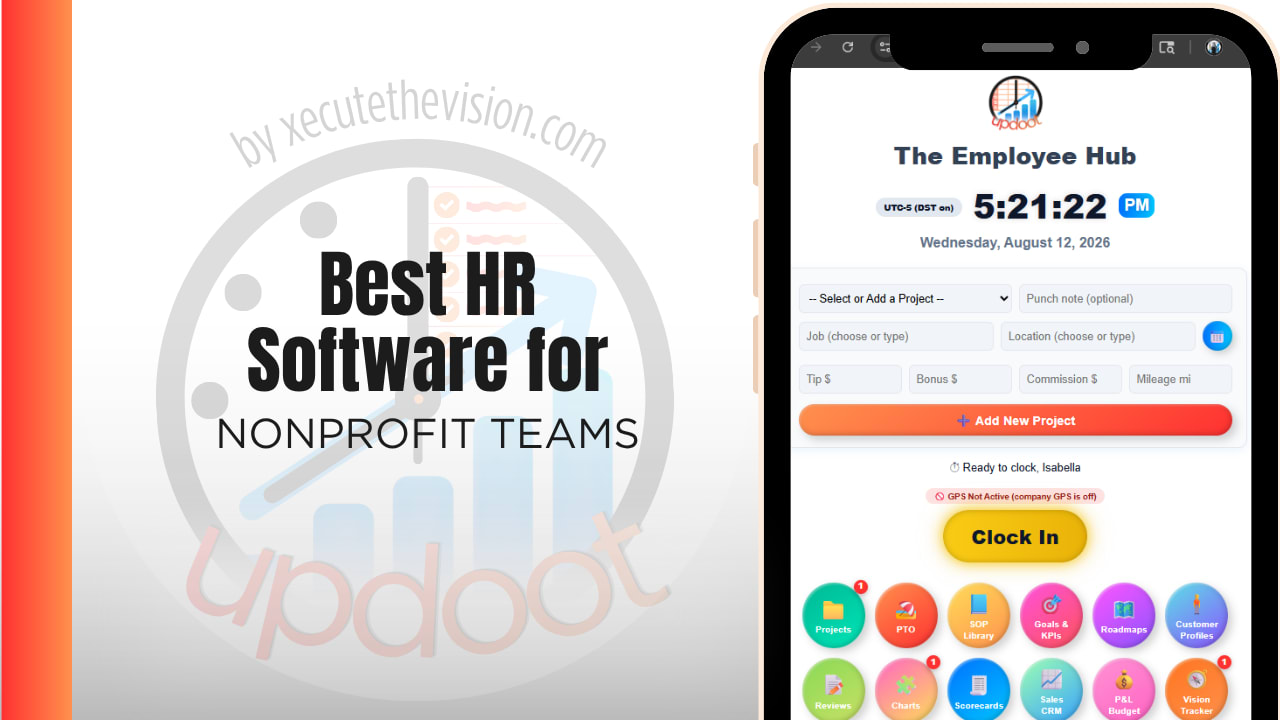
In Updoot, every punch is logged against a project, which can represent a grant, a program, or a funded initiative, and staff can switch between them during the day in a few taps rather than estimating splits later. Time tracking runs on desktop, mobile, or a shared kiosk, so field program staff and office staff are on the same system.
Each project carries its own budget, so labor cost against a grant is visible in real time rather than discovered after the reporting period closes, with over and under budget flags on each. Timecard approvals and revision history give you the supervisor sign-off and change record an auditor asks for, and every report copies to Excel or Google Sheets in one click for funder reporting or for whoever files your payroll.
The rest of the HR function comes with it: the employee vault for records and reviews, PTO and scheduling, eNPS surveys, an SOP library so program knowledge survives staff turnover, and hiring tools for filling roles. All at $5 per user per month, with no modules and no minimum.
Rolling Out New HR Software on a Nonprofit Budget
Set up your grants and programs as projects before anyone logs a single hour, because a missing code is the most common reason staff default to guessing. Include a general operations code from day one so administrative time has somewhere legitimate to go rather than being distributed across grants to make the numbers work.
Pilot with one program team for a pay period before rolling out, then compare that period's allocation against what your old method would have produced. That comparison is usually the most persuasive thing you can bring to a board or finance committee, because it shows the gap between estimated and actual allocation in your own numbers rather than in a vendor's case study.
Connecting HR Data to Program Budgets and Board Reporting
Time data that stops at payroll is doing half a job in a nonprofit. The same hours should reach three places: the payroll file, the grant report, and the program budget that tells leadership whether a program is operating within its funding.
When those are separate systems, someone reconciles them, and reconciliation is where errors enter. Staff log hours one way, the grant report is built from a spreadsheet maintained by the finance director, and the program budget is a third document updated monthly. When the three disagree, the usual response is to trust the one that is easiest to defend, which is not the same as trusting the one that is right.
The question to ask a vendor is not whether they integrate but what actually moves. Does an approved timecard update the program's budget position, or only the payroll export? Can you produce labor cost by grant without rebuilding it? A platform that keeps hours, approvals, and program budgets on one record removes the reconciliation step rather than automating it, which is a meaningfully different outcome.
Pricing and ROI for Nonprofits
HR pricing splits two ways here, and one of them is actively hostile to small organizations. Flat monthly minimums mean a 12-person nonprofit pays the same as a 25-person one, which at typical nonprofit headcounts can be several times the equivalent per-user cost. Per-user pricing scales with you, but confirm that time tracking, budgets, performance, and hiring are included rather than quoted as modules, because that is where the difference between the pricing page and the invoice lives.
The return shows up in three places. Administrative hours stop going into rebuilding allocations, which is what the calculator above measures directly. Audit preparation gets shorter because the documentation already exists. And grant reporting becomes accurate rather than approximate, which matters most for the organizations that depend on renewals, since a funder relationship is easier to keep when the numbers have always held up.
Signs You've Outgrown Spreadsheets
The tipping point usually announces itself the same way: the week before a grant report disappears into rebuilding hours, staff are asked to estimate what percentage of last month went to which program, an auditor asks for backup and the answer takes days to assemble, and nobody can say whether a program is running over its labor budget until the period closes. When your allocation record is a spreadsheet that one person maintains and everyone else estimates into, you have already outgrown it, and the exposure grows with every award you win.
Frequently Asked Questions
The best option is whichever one lets staff attribute hours to a specific grant or program as the work happens, with supervisor approvals and revision history behind it, since grant-based labor allocation is the requirement that separates nonprofit HR from everything else.
Hours should be logged against the specific grant or program as work happens, with a separate code for general operations. Charging payroll to awards based on budgeted percentages rather than actual work performed is one of the most common audit findings in the sector.
Most do once they hold more than one restricted grant. Federal award rules generally require that charges reflect actual work performed, and records created at the time hold up far better than allocations reconstructed from memory before a report is due.
Some platforms can, which matters for board reporting, in-kind match requirements, and grant deliverables. It is worth asking specifically whether non-payroll people can be tracked and what, if anything, they cost per seat.
It varies widely. Some platforms charge a flat monthly minimum that a small nonprofit pays in full regardless of headcount, and enterprise HCM suites are quote-only. Updoot is a flat $5 per user per month with all features included, which at typical nonprofit headcounts is well below the alternatives.
Generally, records created at the time the work was performed, approved by someone with knowledge of that work, with a visible history of any changes. Systems that allow silent edits to past entries are a liability, since after-the-fact adjustment is exactly what auditors look for.
A free tier can cover basic records and clock-in for a very small team. Once grant allocation, budget reporting, and audit-ready approvals matter, most free tiers stop being enough, and the gap tends to surface at the worst possible moment, during an audit or a renewal.
Final Takeaway
The best HR software for nonprofits is the one that ties every hour to the grant or program that funds it, captured as the work happens and documented well enough to hand to an auditor. Use the calculator above to see what rebuilding those allocations is costing your organization right now, and if the number surprises you, that's usually the clearest sign it's time for a change.