
Best CRM Software for Insurance Companies
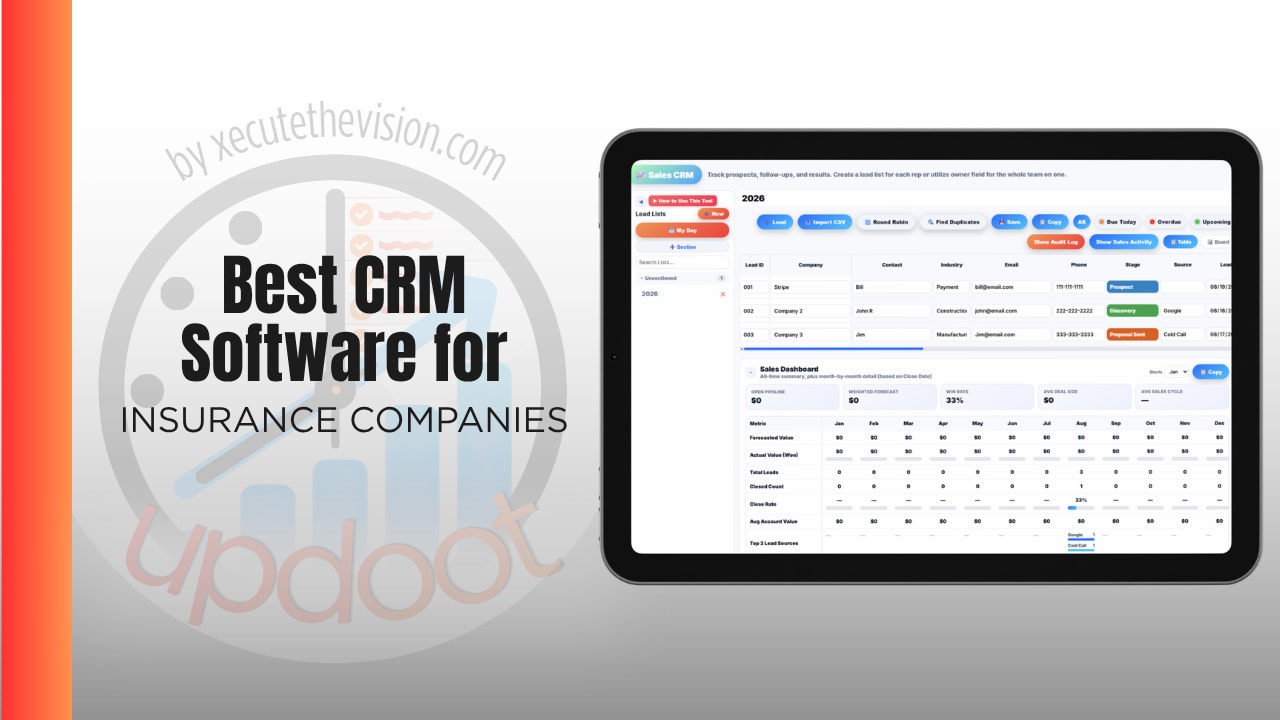
What an insurance agency loses without the right system almost never appears on a report. It is the renewal that lapsed because the follow-up lived in one producer's head. The cross-sell nobody made because the auto client's home policy sat with a competitor and no one flagged it. The lead that went cold while a producer was on another call. And it is the stack of subscriptions holding your CRM, your marketing, your task management, and your reporting separately, reconciled by a service team that should be servicing clients. Use the calculator below to size renewal and follow-up leakage, then see how the leading options compare.
Free Renewal Leakage Calculator
What Are Missed Follow-Ups Costing Your Book?
Estimate your policy count and how many renewals slip for follow-up reasons rather than price.
What an Agency Actually Needs from a CRM
The first requirement is that renewals are driven by the system rather than by memory. Retention is the economic engine of an agency, and a renewal calendar that lives in a producer's head is a single point of failure with a direct revenue cost.
The second is pipeline discipline for new business. Leads need owners, statuses, and next actions with dates, because insurance shopping is comparative and fast, and the agency that responds first is materially more likely to write the policy.
The third is visibility by producer. Which producer converts best, which loses at quote stage, and who is actually contributing are questions a principal should be able to answer from a screen rather than a spreadsheet built the night before a meeting.
The fourth is running the agency itself: staff, licensing renewals, goals, budgets, procedures, and the internal work that every agency has and no CRM addresses.
CRM vs. Agency Management System
This distinction decides what you should buy, and conflating the two wastes a lot of money.
An agency management system is the system of record for policies. Carrier downloads, policy details, endorsements, commission reconciliation, and compliance documentation live there. Applied Epic, EZLynx, HawkSoft, and AgencyBloc sit in this category, and if you need carrier downloads and commission processing, no general CRM replaces that.
A CRM is the sales and relationship layer. It standardizes how a lead becomes a client and how renewals get worked, so growth does not depend on one producer's personal habits. Many agencies run both deliberately: an AMS for policy administration and a CRM for pipeline and retention.
The mistake is buying a second expensive AMS-class product when the actual gap is pipeline, follow-up, and agency operations. That gap is real and much cheaper to close.
Where the Admin Hours Go
Renewal follow-up
Most agencies work renewals from a list someone exports monthly. It works until it does not, usually during a busy stretch, and the policies that slip are invisible because nothing flags them.
Duplicate data entry
Client details typed into the AMS, then again into a marketing tool, then again into a spreadsheet for reporting. Every duplicate entry is both wasted time and a future inconsistency someone has to resolve.
Report building
Producer performance, retention rates, and book growth get assembled by hand because the systems holding the data do not produce the view a principal wants. That is the admin figure in the calculator above.
Cross-sell identification
Monoline clients are the cheapest growth available to an agency, and finding them requires the client record to make gaps visible rather than requiring a producer to notice.
The Tool Stack Problem
Agencies accumulate software fast: the AMS, a CRM or sales layer, a marketing automation tool, a texting service, a task manager, and spreadsheets for goals and producer reporting.
Pricing varies enough that comparison is difficult. AgencyBloc is reported from around $59 per user per month for Standard and $79 for Professional, with data migration commonly quoted at $500 to $2,000. AgencyZoom is reported at roughly $149 to $299 per agency per month. HawkSoft is reported around $99 per user per month. Applied Epic and Vertafore AMS360 do not publish pricing at all, and every quote is negotiated on seats, modules, and integrations.
What none of them cover is the agency as a business: staff records, licensing and CE tracking, goals with targets and actuals, budgets, and documented procedures. Those end up in spreadsheets, and the spreadsheets end up being the principal's evening work.
Questions to Ask Before You Sign Up
- Is pricing per user or per agency? Flat agency pricing favours larger teams; per-seat favours small shops. Model both against your headcount in 24 months, not today.
- Does the system drive renewals or just store dates? Storing a renewal date is not the same as surfacing it and assigning it.
- Can you see conversion by producer? Agency-level dashboards hide exactly the differences you need for coaching.
- What is data migration going to cost? Commonly quoted at $500 to $2,000 as a one-time fee in this category.
- What is quote-only? Enterprise platforms publish nothing, so budget for a sales cycle before you can even compare.
- What covers the agency itself? Ask where staff records, goals, and procedures live, because the answer is usually a spreadsheet.
How We Evaluated These Tools
A note on where we stand: Updoot publishes this site and appears in the comparison below. Pricing and features for every tool here, Updoot included, were verified against each vendor's live pricing page or independent third-party sources in August 2026, and Updoot's own limitations are listed in the same column as everyone else's.
For insurance agencies specifically, we weighted five things: renewal and follow-up management, pipeline visibility by producer, whether the platform also runs the agency, pricing transparency including migration costs, and total cost per seat at realistic team sizes.
How the Top Options Compare for Insurance Agencies
| Tool | Starting Price | Best For | Where It's Limited |
|---|---|---|---|
| Updoot ⭐ Best Overall for Pipeline and Agency Operations | $5/user/month, all features included | Agencies wanting producer pipeline, lead scoring and routing, renewal task management, goals and KPI tracking, staff records, and time tracking on one platform | Not an agency management system: no carrier downloads, policy administration, commission processing, or comparative rating |
| AgencyBloc | Reported from ~$59/user/month (Standard); ~$79 (Professional); Enterprise quoted | Life, health, and Medicare agencies wanting policies, carriers, and commissions as first-class objects | Data migration commonly quoted at $500-$2,000, and advanced automation and reporting sit on the higher tier |
| AgencyZoom | Reported ~$149-$299 per agency per month | P&C agencies wanting a sales-first layer with onboarding and retention workflows | Sales layer rather than a full system of record; solo and two-person shops often overpay on flat-fee pricing |
| HawkSoft | Reported around ~$99/user/month | Independent agencies wanting a transparent, all-in-one management system | Per-seat cost adds up across a service team, and it is operations-first rather than sales-first |
| Applied Epic | Quote only | Larger P&C and benefits agencies needing the widest operational surface | No published pricing, substantial implementation, and migration effort that makes switching a multi-month project |
Editor's Pick
Why Updoot Tops This List
Every platform above solves policy administration or the sales layer, at $59 to $299 a seat or agency, or quote-only if you go enterprise. None of them runs the agency. Staff records, licensing renewals, producer goals with targets and actuals, budgets, documented procedures, and the hours your service team actually spends all end up in spreadsheets alongside whatever you bought. Updoot covers the pipeline with lead scoring, status, round-robin routing, call logging, custom fields for policy data, and AI win and loss summaries, then adds KPI dashboards with percent-to-goal and at-risk flags for producer targets, performance reviews connected to those goals, time tracking so you know what servicing actually costs by client segment, PTO and scheduling, an SOP library, and budgets, at a flat $5 per user per month. A ten-person agency pays about $600 a year for the layer that currently lives in spreadsheets and evenings.
To be direct about the tradeoff: if you need carrier downloads, policy administration, or commission reconciliation, that is an agency management system and Updoot does not replace it. The pattern that works is keeping your AMS for the policy record and using Updoot for pipeline, retention workflows, producer performance, and running the agency, which at $5 a seat costs less than the gap between two tiers of most AMS platforms.
How Updoot Handles Pipeline, Producers, and Renewals
In Updoot, the CRM and pipeline tracks prospects and clients with lead scoring, status, call logging, document attachments, and custom fields for the policy data your agency needs visible, plus round-robin routing so new enquiries reach an available producer rather than a shared inbox. Due, upcoming, and overdue flags are what turn a renewal date into a renewal task somebody owns.
The KPI and goals tool holds agency, team, or individual targets alongside actuals with percent-to-goal, at-risk and on-track flags, and previous-period comparison, so producer performance is a screen rather than a spreadsheet. Performance reviews connect to those same goals in real time, with 360 support, revision history, and signatures.
Time tracking attributes service hours to clients or projects, which is how you find out that a segment of your book consumes more service time than it generates commission. Around that, the SOP library documents procedures so service is consistent across producers, and PTO, scheduling, HR records, and budgets cover the agency itself. All at $5 per user per month.
Signs You've Outgrown Your Current Setup
The tipping point usually announces itself the same way: a renewal lapses and nobody knew it was coming, a monoline client is discovered by accident rather than by flag, producer performance requires a spreadsheet built the night before, client details get typed into three systems, and everything about running the agency lives outside the software you pay the most for. When your system stores policies but does not drive activity, you have a record rather than an operating system.
Related Reading
Best CRM for Financial Advisors →
Sales Rep Evaluation Checklist for Small Business →
Frequently Asked Questions
It depends on whether your gap is policy administration or growth. If you need carrier downloads and commission processing, that is an agency management system. If policies are handled and what is missing is renewal follow-up, producer visibility, and running the agency, that is a different and much cheaper purchase.
An agency management system is the system of record for policies: carrier downloads, endorsements, commission reconciliation, and compliance documentation. A CRM is the sales and relationship layer that standardizes how a lead becomes a client and how renewals get worked. Many agencies run both deliberately.
AgencyBloc is reported from around $59 per user per month for Standard and $79 for Professional, AgencyZoom at roughly $149 to $299 per agency per month, and HawkSoft around $99 per user per month. Applied Epic and Vertafore AMS360 publish no pricing, so every quote is negotiated.
Make the system drive them rather than storing dates. A renewal calendar that lives in a producer's head is a single point of failure with a direct revenue cost, and the policies that slip during a busy stretch are invisible unless something flags them.
Flat agency pricing favours larger teams and per-seat favours small shops, so model both against your headcount 12 to 24 months out rather than today. A solo or two-person agency frequently overpays on a flat-fee plan built for a team.
Make monoline clients visible on the record rather than relying on a producer to notice. Existing clients holding one policy are the cheapest growth available to an agency, and identifying them should be a report rather than an act of memory.
Commonly $500 to $2,000 as a one-time fee in this category, and the larger cost is usually staff hours for cleanup and retraining. Enterprise platform migrations are multi-month projects, which is why switching an agency management system is a higher-stakes decision than switching a CRM.
Final Takeaway
The best CRM software for an insurance agency depends on whether your gap is policy administration or growth. If you need carrier downloads and commission processing, that is an agency management system. If your policies are handled and what is missing is renewal follow-up, producer visibility, and running the agency itself, that is a cheaper and more immediate fix. Use the calculator above to size what missed follow-ups are costing, since that number usually settles the decision.