
The Ultimate Guide to Understanding a Fractional COO

A fractional COO is an experienced operations executive who works with your business part time, on contract, or for a defined project, instead of as a full-time employee. It is a flexible way to get chief operating officer expertise when you need it, without the cost and commitment of a full-time executive hire.
Businesses of every size run into operational challenges that call for senior-level guidance. For many small and mid-sized companies, though, a full-time COO is out of reach, either because of the salary or because the need is not a full-time job yet. A fractional COO fills that gap.
This guide explains what a fractional COO is, the services they provide, the impact they can have, the benefits and trade-offs, when to consider one, and how to choose the right person. It also includes a free readiness check and cost comparison you can fill in for your own business.
What Is a Fractional COO?
A fractional COO brings the same skills as a full-time chief operating officer, but works with your business for a fraction of the time. That might mean a set number of hours each month, a few days a week, a retainer, or a project with a defined scope and end date.
Unlike a traditional COO who is fully embedded in the company, a fractional COO usually works as an outside advisor who also rolls up their sleeves. They focus on specific operational goals or challenges, and the level of support can grow or shrink as your needs change.
The role is different from a traditional consultant. A consultant typically diagnoses problems and delivers recommendations. A fractional COO also takes ownership of implementing them, leading people, running meetings, and being accountable for results, much like an executive on your team.
Fractional COO vs. Full-Time COO vs. Consultant
The table compares the three options on the points that matter most when you are deciding.
| Factor | Fractional COO | Full-time COO | Consultant |
|---|---|---|---|
| Time commitment | Part time or project based | Full time | Project based |
| Cost | A share of an executive's cost, paid monthly or by project | Full salary, benefits, bonus, and often equity | Project fees |
| Role | Leads and implements | Leads and implements | Advises and recommends |
| Accountability | Owns agreed outcomes | Owns operations fully | Owns the recommendations |
| Flexibility | Scale up or down as needed | Fixed | Ends with the project |
| Best for | Growing businesses that need senior leadership without a full-time hire | Larger or complex companies with a full-time need | A specific problem that needs an outside diagnosis |
Services a Fractional COO Provides
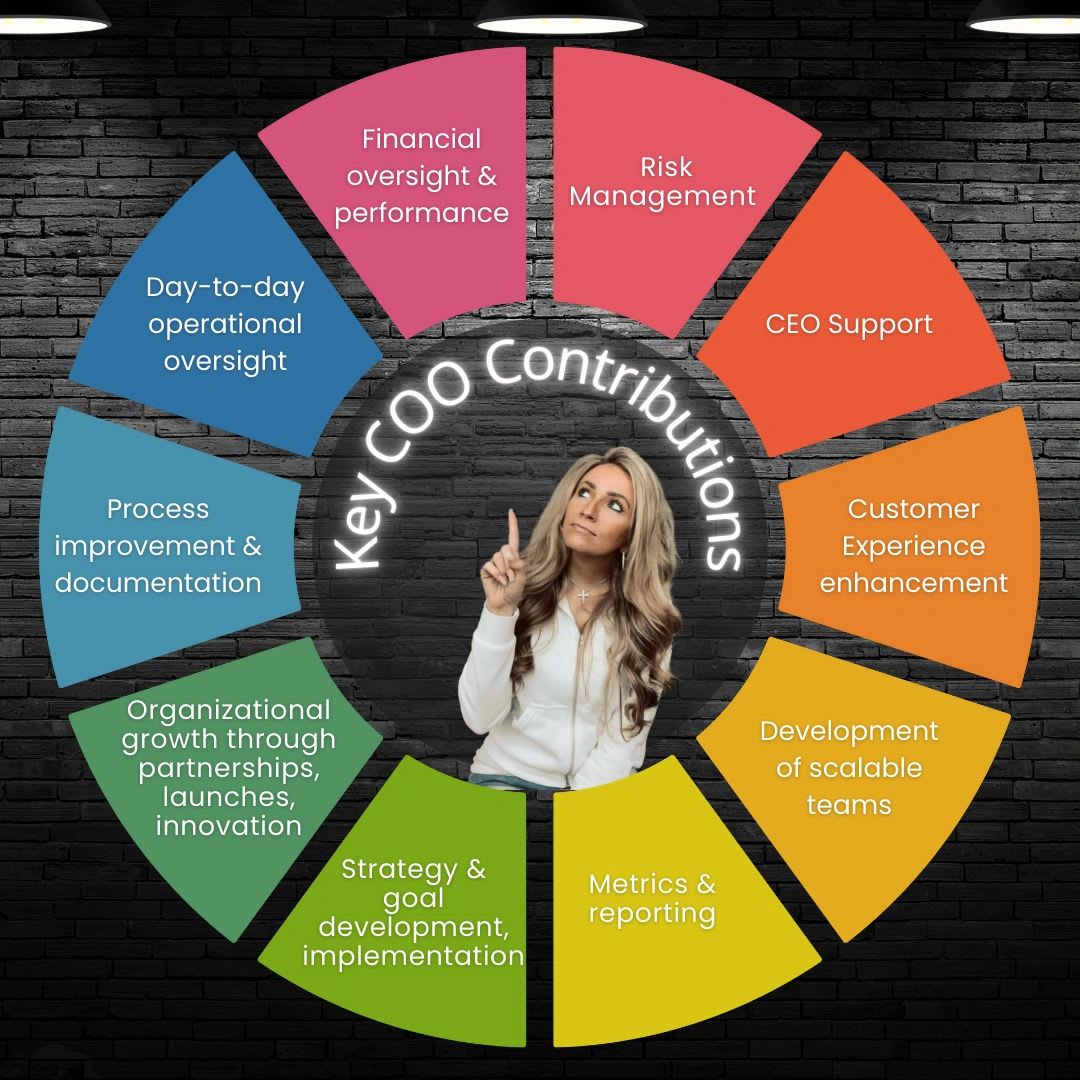
Whether full time or fractional, a COO provides a wide range of services tailored to the needs of your business. Most engagements focus on a few of these areas at a time.
Strategy and Goal Development
A fractional COO starts by assessing how the business currently operates, then develops and carries out strategies to improve efficiency. They make sure operations support the company's goals, and they help leadership set clear, measurable targets for the months ahead.
Process Optimization
Streamlining workflows is often the first big win. That means documenting how work actually gets done, removing unnecessary steps, introducing tools and automation that cut manual effort, and improving how departments hand work to each other. Written standard operating procedures are usually part of the result.
Team Building and Leadership Development
Scalable teams need clear structure. A fractional COO helps recruit and develop leaders, defines roles and responsibilities so every important task has an owner, and builds a culture of accountability and engagement.
Financial Oversight and Performance
Operations and finances are closely linked. A fractional COO evaluates financial metrics and KPIs, supports budgeting and forecasting, and finds ways to manage costs and improve profitability.
Change Management
When the business goes through a major transition, such as a merger, an acquisition, a new system, or rapid scaling, a fractional COO guides the change and makes sure new processes and tools are actually adopted.
Customer Experience and Market Insights
Good operations serve customers. A fractional COO helps develop customer profiles and case studies, aligns operations with what customers need, and improves the overall customer experience.
Organizational Growth
For growth initiatives, a fractional COO plans and carries out strategies to enter new markets or launch new products, and builds strategic partnerships and supplier relationships that support them.
CEO Support
Many founders find this the most valuable part of the role. A fractional COO is a trusted partner who offers insight on business decisions, takes day-to-day operations off the CEO's plate, and frees them to focus on vision, sales, and relationships.
Metrics and Reporting
A fractional COO makes sure results are measured, puts feedback loops in place, and keeps progress on every project and process visible and clearly communicated. Our guide to business-critical metrics shows the kinds of numbers they track.
Risk Management
Finally, a fractional COO helps make sure compliance requirements are met and works with legal advisors on contracts, agreements, and policies, reducing operational risk as the business grows.
What a Fractional COO Does for Your Business
In practice, a fractional COO acts as a trusted partner and operational strategist who helps the business get past its obstacles and reach its goals. Their impact usually shows up in four ways.
They find and fix pain points. By analyzing current operations, they identify the inefficiencies and bottlenecks that cost the most time and money, and they fix those first.
They set and achieve goals. Working from the company's vision, they help set SMART goals and build actionable plans, then hold the team to them.
They bridge leadership gaps. During growth, transition, or crisis, they provide stability and executive experience that the business may not have in-house.
They improve team productivity. By clarifying priorities, roles, and communication, they help everyone work toward shared objectives instead of competing ones.
Benefits of Hiring a Fractional COO
Cost-effective expertise. You gain access to C-suite skills without paying a full-time executive salary and benefits package.
Flexibility. You can engage a fractional COO for a specific project, a set number of hours, or a critical growth phase. It is also a practical way to test the role, and sometimes the person, before committing to a full-time hire.
A fresh perspective. An outside expert brings unbiased insight and ideas from other companies and industries, and is not tied to "the way we have always done it."
Scalability. Support can increase during a big push and scale back once systems are running, so you pay for what you need.
Faster results. Experienced fractional COOs have solved similar problems before, so they can identify issues and put solutions in place quickly.
The Trade-Offs to Consider
A fractional COO is not the right answer for every situation. Because they work part time, they are not available every day, and they may split their time across several clients. Knowledge can walk out the door when the engagement ends unless processes are documented along the way. And a business with a genuinely full-time operational workload may eventually need a full-time COO. A good fractional COO will tell you when that point arrives.
When Should You Consider a Fractional COO?
The clearest sign is that the business is growing faster than its operations can handle. Orders, clients, or headcount are rising, and the processes that worked at a smaller size are starting to break.
Other common triggers include recurring operational inefficiencies or bottlenecks, an owner who is stuck running day-to-day operations instead of leading, and a major change such as a merger, acquisition, new location, or product launch. And if you need executive-level operational support but do not have the budget for a full-time COO, a fractional arrangement is often the best way to get it. Our article on common challenges to scaling a business describes these situations in more detail.
Free Fractional COO Readiness Check and Cost Comparison
Use the tool below to test your own situation. The eight readiness questions reflect the most common reasons businesses bring in a fractional COO. The more you answer yes, the stronger the fit.
The cost comparison lets you weigh a fractional engagement against a full-time hire. The dollar figures are illustrative examples, not market data, because executive pay and fractional rates vary widely by location, industry, and experience. Replace them with real salary information and the quotes you receive, then copy the comparison to Excel or print it for a decision conversation.
Fractional COO Readiness Check and Cost Comparison
Answer eight questions to see whether your business is ready for a fractional COO, then compare the yearly cost of a fractional engagement with a full-time hire. The dollar amounts are illustrative examples only, so replace them with real salary data and the quotes you receive. Nothing you enter is saved or sent anywhere.
Part 1: Readiness
| Is this true for your business? | Answer |
|---|---|
| Revenue or headcount is growing faster than your processes can keep up. | |
| The owner or CEO spends most of the week on day-to-day operations instead of strategy. | |
| The same problems, such as missed deadlines or rework, keep coming back. | |
| Key processes live in people's heads rather than in written procedures. | |
| Roles and responsibilities overlap, or nobody clearly owns important work. | |
| You do not have reliable weekly metrics on how the business is performing. | |
| A major change is coming, such as a new location, product, system, or acquisition. | |
| A full-time COO salary is not in the budget yet. |
Part 2: Cost comparison (example figures)
How to Find the Right Fractional COO
Choosing the right person matters more than the arrangement itself. Look for proven experience in your industry or with similar challenges, and ask for specific examples of results they have delivered, ideally with numbers.
Strong leadership and communication skills are essential, because a fractional COO has to earn the trust of your team quickly. Look for someone who can turn strategy into execution, not just produce plans, and who is an excellent problem solver who can find the root cause of an issue and fix it rather than treating symptoms.
Broad operational and business experience across several industries is a plus, since it brings a wider range of solutions. Finally, make sure they fit your company culture and share your vision, because you will be working closely together.
When you interview candidates, ask how they would approach your first 90 days, how they measure success, how they document their work so it outlasts the engagement, and how they handle disagreements with the owner. Our guide on how to hire a fractional COO walks through the full hiring process.
Setting Up a Successful Engagement
Start with a clear scope. Agree on the two or three outcomes that matter most, the time commitment, how you will measure success, and how often you will review progress. A defined first phase of three to six months is a common way to begin.
Give the fractional COO the access and authority they need to act, and introduce them to the team as a leader, not an outside observer. And make sure they work inside your systems. When tasks, SOPs, metrics, and meetings live in one place, their work stays with the business after the engagement ends. Updoot is business management software built for exactly that, with projects, SOPs, meetings, goals, and performance tracking in one platform for $5 per user per month. You can start a free trial anytime.
Final Thoughts
A fractional COO offers a powerful way for businesses to get high-level operational expertise without committing to a full-time hire. Whether you need to streamline processes, improve team productivity, or navigate a period of growth or change, the right fractional COO provides the strategic guidance and hands-on support to carry out your vision.
If you are ready to take the next step, reach out to us to learn how a fractional COO can help your business grow.
Opens in Google Drive. View and download for free.
Related Reading
How to Hire a Fractional COO: The Complete Guide →
Frequently Asked Questions About Fractional COOs
What is a fractional COO?
A fractional COO is an experienced operations executive who works with a business part time, on contract, or for a defined project, providing the same leadership as a full-time chief operating officer without a full-time commitment.
What does a fractional COO do?
They assess operations, streamline processes, build and develop teams, oversee metrics and budgets, lead change, support the CEO, and take ownership of implementing improvements, not just recommending them.
How is a fractional COO different from a consultant?
A consultant usually diagnoses problems and delivers recommendations. A fractional COO also leads the work, manages people, and is accountable for results, much like a member of the executive team.
When should a business hire a fractional COO?
Common triggers are rapid growth that outpaces processes, recurring bottlenecks, an owner stuck in day-to-day operations, a major change such as an acquisition or new location, and a need for executive support without the budget for a full-time COO.
How much does a fractional COO cost?
It varies widely with experience, industry, location, and the time commitment. Most work on an hourly, monthly retainer, or project basis. Compare real quotes against the full cost of a full-time hire, including benefits, bonus, and recruiting.
How long does a fractional COO engagement last?
Many start with a defined phase of three to six months focused on specific outcomes, then continue, scale down, or transition to a full-time hire depending on the results and the business's needs.
What should I look for in a fractional COO?
Proven results in similar situations, strong leadership and communication, the ability to turn strategy into execution, excellent problem-solving, broad operational experience, and a good fit with your company culture.