
Survey Questions for Employees Template
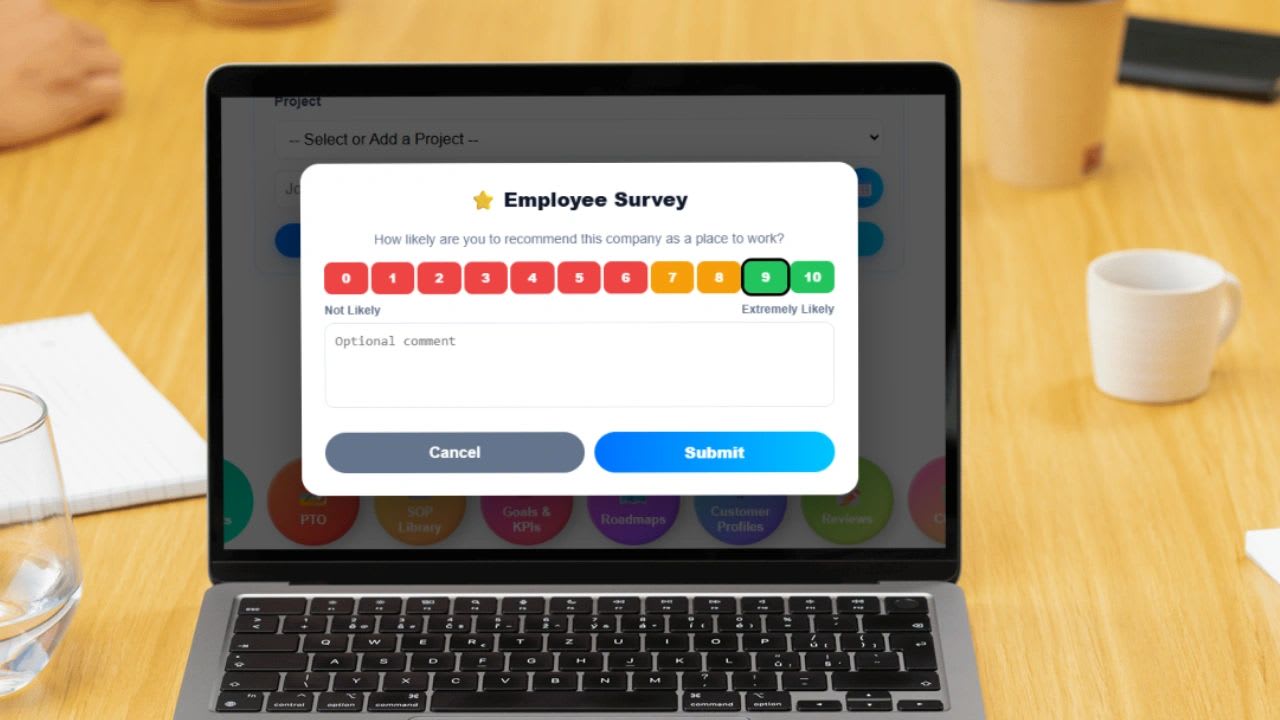
Survey questions for employees should measure job satisfaction, leadership, culture, communication, growth, and wellbeing, and include one eNPS question you can track over time. This page gives you 33 proven questions organized by category, explains what each one reveals, and includes a free builder to assemble your survey plus an eNPS calculator to score the results.
Employee surveys are one of the most useful tools a company has for improving culture, productivity, and retention. Yet many businesses skip them or ask vague questions that produce nothing actionable. A well-designed survey tells leadership what is working, what is not, and where to act first. Just as important, it gives employees a voice, and people who feel heard are more engaged and more likely to stay.
Why Employee Surveys Matter
Leaders often assume they know how employees feel. Assumptions rarely match reality. Regular surveys help you:
- Spot workplace issues early, before they become resignations
- Improve morale and team relationships
- Measure whether management is effective
- Find process problems that cost productivity
- Build trust through visible follow-through
Types of Employee Surveys
| Survey Type | Length | How Often | Best For |
|---|---|---|---|
| Engagement survey | 20 to 40 questions | Once or twice a year | A full picture across every category |
| Pulse survey | 3 to 10 questions | Monthly or quarterly | Tracking trends and testing changes |
| eNPS survey | 1 to 2 questions | Quarterly | A single score to compare over time |
| Onboarding survey | 5 to 10 questions | Day 30 and day 90 | Improving the new hire experience |
| Exit survey | 5 to 10 questions | At departure | Understanding why people leave |
Employee Survey Questions by Category
Use a 1 to 5 agreement scale (strongly disagree to strongly agree) for the statements, and keep open-ended questions to two or three per survey so people actually answer them.
Job Satisfaction Questions
| Question | What It Reveals |
|---|---|
| How satisfied are you with your current role? | A quick read on overall happiness. A downward trend is a signal to dig deeper. |
| Do you feel your work is meaningful? | People who cannot see the impact of their work lose motivation. |
| Do you have the tools and resources you need to do your job well? | Low scores often point to missing systems, training, or equipment rather than effort. |
| Is your workload manageable most weeks? | Overwork is a leading driver of burnout and turnover. |
| Do you know what is expected of you in your role? | Unclear expectations cause more frustration than hard work does. |
| Do you see yourself working here two years from now? | A simple forward-looking retention signal. |
Leadership and Management Questions
| Question | What It Reveals |
|---|---|
| Does your manager support your success? | People rarely leave companies. They leave managers. |
| Do you receive useful feedback from your manager? | Regular feedback improves performance and builds trust. |
| Does leadership communicate company goals clearly? | Employees perform better when they understand direction. |
| Do you trust leadership to make good decisions for the company? | Trust in leadership strongly shapes morale. |
| Does your manager treat everyone on the team fairly? | Perceived unfairness damages a whole team, not just one person. |
| Do you have regular one-on-one time with your manager? | Shows whether coaching is actually happening. |
Workplace Culture Questions
| Question | What It Reveals |
|---|---|
| Do you feel respected at work? | Respect is the foundation of a healthy workplace. |
| Do you feel comfortable sharing ideas or concerns? | Measures psychological safety, which drives openness and problem solving. |
| Do teams collaborate effectively across departments? | Poor collaboration creates delays and frustration. |
| Do you feel recognized for your contributions? | Recognition is one of the cheapest ways to raise motivation. |
| Do our company values match how people actually behave? | Reveals the gap between stated and real culture. |
Communication Questions
| Question | What It Reveals |
|---|---|
| Do you feel informed about important company updates? | Employees want transparency about decisions and changes. |
| Is communication between teams effective? | Cross-team communication often breaks down as companies grow. |
| Do you feel comfortable asking questions or asking for clarification? | People should be able to ask without fear of judgment. |
| Can you easily find the information you need to do your job? | Scattered documents and processes waste hours every week. |
Growth and Development Questions
| Question | What It Reveals |
|---|---|
| Do you see opportunities for career growth here? | Without a visible future, strong employees look elsewhere. |
| Do you receive enough training and development? | Skill growth benefits both the employee and the business. |
| Do you understand what it takes to advance in your role? | Clear criteria motivate improvement. |
| Has someone talked with you about your career goals in the last six months? | Shows whether development conversations actually happen. |
Wellbeing and Balance Questions
| Question | What It Reveals |
|---|---|
| Are you able to disconnect from work outside working hours? | Constant availability is an early burnout signal. |
| Do you have enough flexibility to manage personal responsibilities? | Flexibility is one of the most valued workplace benefits. |
| How often do you feel stressed about work? | Track the trend over time rather than one reading. |
Open-Ended Questions
| Question | What It Reveals |
|---|---|
| What is one thing we should start doing? | Surfaces ideas leadership has not considered. |
| What is one thing we should stop doing? | Finds waste and frustration quickly. |
| What would make you consider leaving? | Names the risks before they become resignations. |
| What is the best part of working here? | Tells you what to protect as the company changes. |
The Most Important Question: eNPS
One question stands above the rest: "On a scale of 0 to 10, how likely are you to recommend this company as a place to work?" This is the employee Net Promoter Score, or eNPS. If someone would recommend their workplace to a friend, they usually trust leadership, feel supported, and believe they are treated well.
Responses fall into three groups:
- Promoters (9 to 10): highly engaged and enthusiastic
- Passives (7 to 8): satisfied but not highly engaged
- Detractors (0 to 6): unhappy and more likely to leave or discourage others
eNPS equals the percentage of promoters minus the percentage of detractors, so it ranges from -100 to +100. If 60% of employees are promoters and 20% are detractors, eNPS is +40. Passives count toward the total but not the score. Any positive score means you have more promoters than detractors. The trend over time matters more than any single number.
Free Employee Survey Builder and eNPS Calculator
Free Employee Survey Builder and eNPS Calculator
Check the questions you want, then copy your survey into Excel, Google Forms, or your survey tool. The eNPS question is always included. Below the builder, enter your 0 to 10 responses to calculate eNPS.
Job Satisfaction
Leadership and Management
Workplace Culture
Communication
Growth and Development
Wellbeing and Balance
Open-Ended
eNPS Calculator
The copied survey pastes into Excel or Google Sheets with question numbers, categories, and response types, ready to load into Google Forms or any survey tool.
How to Write Good Survey Questions
- Ask one thing per question. "Is your manager supportive and communicative?" is two questions.
- Use neutral wording. "How would you rate communication?" instead of "How great is our communication?"
- Keep the scale consistent. Mixing 1 to 5 and 1 to 10 scales confuses people and complicates analysis.
- Ask about things you can change. If you cannot act on the answer, do not ask the question.
- Reuse core questions. Keeping the same wording lets you compare results from survey to survey.
Best Practices for Running Employee Surveys
- Keep it short. A pulse survey should take under five minutes. Completion drops as length grows.
- Protect anonymity. Do not report results for groups so small that individuals can be identified. Many companies use a minimum of five responses per group.
- Explain the purpose. Tell employees why you are asking and when they will see results.
- Survey on a rhythm. Quarterly pulses plus a deeper annual survey is a common pattern.
- Share results quickly. Within a few weeks, share what you learned and what you will do.
Turning Survey Results Into Action
- Find the themes. Look for the lowest-scoring categories and recurring comments.
- Compare groups. Break results down by team or tenure where the group is large enough to stay anonymous.
- Pick one to three priorities. Trying to fix everything means fixing nothing.
- Assign owners and dates. Every action needs a person responsible and a deadline.
- Close the loop. Tell employees what changed because of their feedback, then measure again next cycle.
Employees quickly lose trust when surveys are collected and nothing changes. Visible follow-through is what keeps participation high. For a broader framework, see employee experience management.
Common Employee Survey Mistakes
- Surveys that are too long, which leads to rushed or skipped answers
- Leading questions that push people toward a positive answer
- Promising anonymity and then reporting on tiny groups
- Changing question wording every time, so trends cannot be compared
- Collecting feedback and never sharing results or actions
Track Employee Sentiment With Updoot
Updoot includes a built-in eNPS survey system that runs recurring employee surveys, calculates the score automatically, and shows the trend across survey cycles next to your team and performance data. Plans start at $5 per user per month. To compare options, see the best eNPS and employee survey software.
Final Thoughts
Employee surveys are not a checkbox exercise. Ask focused questions across satisfaction, leadership, culture, communication, growth, and wellbeing, track eNPS over time, and act on what you learn. Businesses that listen and follow through build workplaces where people feel valued and want to stay.
Opens in Google Drive. View and download for free.
Related Reading
Best eNPS and Employee Survey Software →
Frequently Asked Questions About Employee Survey Questions
What are good survey questions for employees?
Good employee survey questions cover job satisfaction, leadership, culture, communication, growth, and wellbeing, plus the eNPS question: how likely are you to recommend this company as a place to work?
How many questions should an employee survey have?
Pulse surveys usually have 3 to 10 questions and take under five minutes. Full engagement surveys often have 20 to 40 questions and run once or twice a year.
How do you calculate eNPS?
Ask employees to rate from 0 to 10 how likely they are to recommend the company as a place to work. Subtract the percentage of detractors (0 to 6) from the percentage of promoters (9 to 10). The result ranges from -100 to +100.
How often should employee surveys be conducted?
Many companies run short pulse or eNPS surveys quarterly and a deeper engagement survey once or twice a year.
Should employee surveys be anonymous?
Yes, in most cases. Anonymity produces more honest answers. Avoid reporting results for groups so small that individuals could be identified.
How do you use employee survey results?
Identify the lowest-scoring themes, choose one to three priorities, assign owners and deadlines, tell employees what will change, and measure again in the next survey.