
COSO Framework Risk Management Software
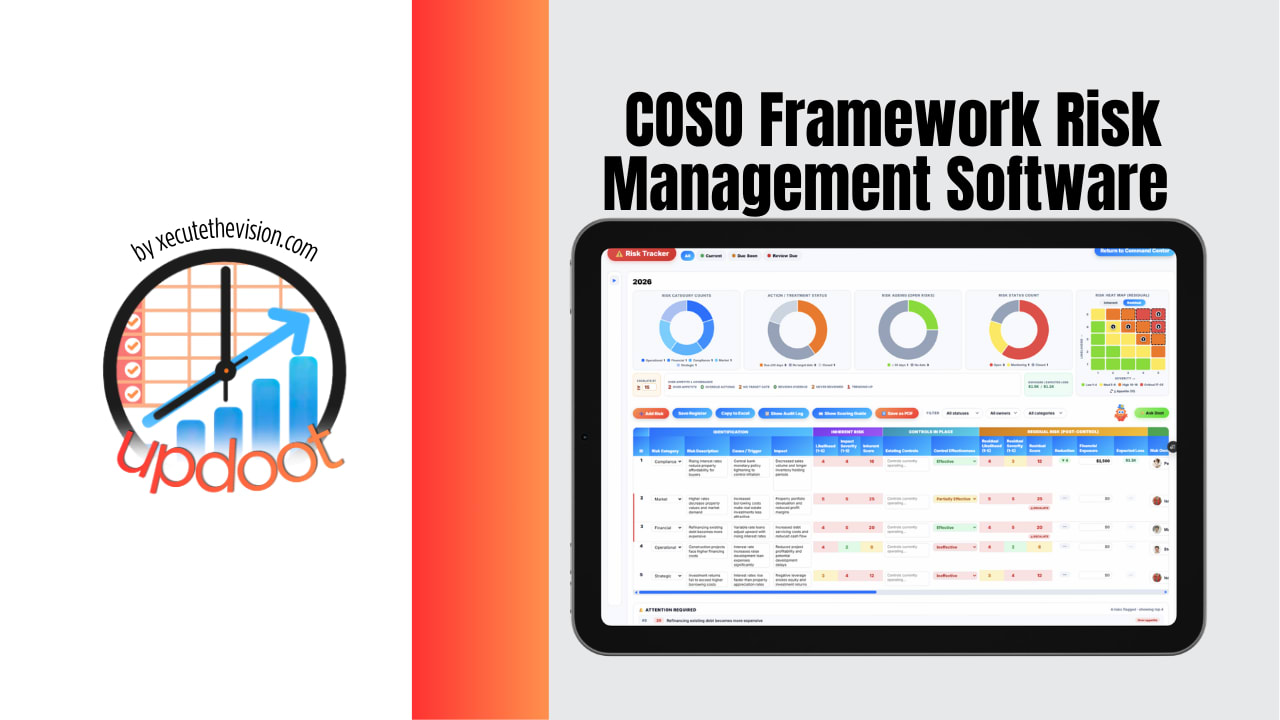
Try our free internal controls starter below, and use the rest of this guide to learn what the COSO framework actually requires. Most companies that go looking for COSO have a specific trigger: an auditor mentioned it, a customer's security questionnaire asked about it, or Sarbanes-Oxley obligations just became real. COSO did not start as a general risk management guideline. It came out of a wave of accounting fraud scandals in the 1970s and 1980s, and it has stayed anchored to that origin ever since, control activities, evidence, and audit trails, even as later updates broadened its scope toward strategy and enterprise risk. This guide covers what the COSO framework is, its five components and seventeen principles, how it differs from ISO 31000, what risk management software should actually do to support it, the pitfalls that undermine most implementations, and a free tool to start mapping your own controls.
Quick Answer
The COSO framework is guidance for internal control and enterprise risk management published by the Committee of Sponsoring Organizations of the Treadway Commission. Its main document, the Internal Control-Integrated Framework, organizes internal control into five components, control environment, risk assessment, control activities, information and communication, and monitoring, broken into seventeen principles, and is the standard basis for Sarbanes-Oxley compliance. A separate COSO Enterprise Risk Management framework takes a broader, strategy-level view closer to ISO 31000's scope. Software supporting COSO needs to document controls against each component, assign an owner to every one, rate design and operating effectiveness, and keep evidence of when each control was actually tested.
What the COSO Framework Is
The Committee of Sponsoring Organizations of the Treadway Commission is a private-sector group formed by five accounting and finance bodies, and COSO is the guidance it publishes. COSO's Internal Control-Integrated Framework was first released in 1992 and substantially updated in 2013, and the update kept the same five components while adding seventeen explicit principles describing what each one requires in practice. The Sarbanes-Oxley Act of 2002 is what turned COSO from one option among several into the default: SOX requires public companies to maintain internal controls over financial reporting and have those controls independently assessed, and COSO's framework became the model nearly every company uses to satisfy that requirement.
COSO is not one document. The Internal Control-Integrated Framework anchors most SOX 404 programs, while a separate COSO Enterprise Risk Management framework, updated in 2017, takes a broader, strategy-aligned view of risk across the whole enterprise with its own five components and twenty principles. COSO has also published supplemental guidance beyond the core two frameworks: sustainability reporting in 2023, robotic process automation in 2024, and, most recently, internal control over generative AI in February 2026. The 2013 Internal Control-Integrated Framework remains the umbrella; the newer guidance layers onto it rather than replacing it.
The Five Components and Seventeen Principles
The Internal Control-Integrated Framework is organized around five components, and COSO is explicit that all five have to be present and functioning together for a system of internal control to count as effective. None of them work in isolation.
Control Environment
The foundation. This is the tone leadership sets, the organization's commitment to integrity and ethical values, and the structure, authority, and accountability that everything else is built on. A weak control environment undermines every other component regardless of how well-documented the procedures are.
Risk Assessment
Identifying and analyzing the risks to achieving the organization's objectives, then deciding how those risks should be managed. This component is where COSO's scope overlaps most directly with a general risk register: risks get identified, scored, and prioritized.
Control Activities
The actual policies and procedures that address the risks identified above: approvals, authorizations, verifications, reconciliations, segregation of duties. This is COSO's center of gravity and the component that distinguishes it from a lighter-touch standard like ISO 31000, which is guidance on managing risk generally rather than a library of specific control types.
Information and Communication
The data and reporting that let the other four components function: information has to reach the people who need it, internally and externally, in a form and timeframe that supports control responsibilities.
Monitoring Activities
Ongoing evaluations, separate evaluations, or some combination, to check whether the other four components are actually present and functioning, not just designed on paper. Deficiencies get evaluated and reported to whoever is responsible for corrective action.
Each of the five components breaks down into seventeen principles total that describe implementation considerations and how the controls should work in practice. Auditors and internal control teams generally map each principle to specific control activities within the organization, then assess whether that principle is present and functioning as part of a SOX 404 evaluation.
The COSO Cube
COSO visualizes the framework as a cube with three dimensions. One face lists the three categories of objectives the framework supports: operations, reporting, and compliance. The second face lists the five components above. The third dimension is the organization's own structure, entity level down through division, operating unit, and function. The point of the cube is that internal control has to be evaluated at the intersection of all three: a specific component, applied to a specific objective, within a specific part of the organization, not as one flat checklist applied uniformly everywhere.
COSO vs ISO 31000
These two get confused constantly because both are labeled "risk management frameworks," but they answer different questions. COSO's Internal Control-Integrated Framework is built around control activities and evidence, and it exists to support an audit opinion on whether financial reporting controls are working. ISO 31000 is a general-purpose guideline for managing any kind of risk to any kind of objective, with no regulatory hook and no audit requirement attached to it.
The overlap is real but narrower than it looks. COSO's separate Enterprise Risk Management framework covers ground much closer to ISO 31000's scope, both take a company-wide, objectives-based view of risk. But the Internal Control-Integrated Framework, the version most companies actually mean when they say "COSO," stays anchored to control design, segregation of duties, and audit evidence in a way ISO 31000 never attempts.
In practice: a company with SOX obligations needs COSO, full stop, because that is what auditors are testing against. A small business without those obligations that wants a working risk process without an audit requirement attached usually gets more direct value from ISO 31000's simpler assessment-treatment-review cycle. Read the ISO 31000 guide for how that process works.
What COSO-Aligned Risk Management Software Should Do
Watch for this claim: COSO, like ISO 31000, is guidance rather than a certifiable standard, so no software product is "COSO certified." A company can design its controls using the COSO framework, and an external auditor can issue an opinion on whether those controls operate effectively as part of a SOX audit, but that is an audit finding on the company's controls, not a certification of a piece of software.
Because COSO's center of gravity is control activities and evidence, software supporting it needs to do more than hold a list of risks. At minimum it should let an organization document each control against the component it belongs to, assign a named owner, rate whether the control is designed appropriately and operating as intended, link each control back to the risk it addresses, and keep a dated record of when it was last tested and by whom. The evidence trail is not optional; it is most of what an auditor is actually looking for.
Mapping the Framework to Software Features
| COSO component | What the software needs to support |
|---|---|
| Control Environment | A record of policies, org structure, and named accountability for oversight |
| Risk Assessment | A risk register with scoring tied to specific objectives, not a generic list |
| Control Activities | Documented controls linked to risks, with an owner and an effectiveness rating |
| Information and Communication | Reporting that reaches the right people, and an audit trail of changes |
| Monitoring Activities | A test date and re-test cadence for every control, with overdue visibility |
Build Your Internal Controls Starter
Use the tool below to draft your first pass at mapping controls to the five components. Give every control an owner and an effectiveness rating, then bring it into whatever system your audit team already uses.
Internal Controls Starter
Add each control, which component it belongs to, its owner, and how effective it is. Print it or copy it as text.
Register Details
Controls
Common Pitfalls to Avoid
Treating It as a Financial-Only Exercise
COSO's origin is financial reporting, but the framework itself covers operations and compliance objectives too. Limiting the control environment to accounting controls and ignoring operational and compliance risk means the SOX audit passes while the rest of the business runs uncontrolled.
Documenting Controls That Do Not Actually Run
A control written in a policy document and a control operating in practice are two different things, and COSO's Monitoring Activities component exists specifically because that gap is so common. If nobody can produce evidence a control was tested, it does not count as functioning, regardless of how well it reads on paper.
No Owner, No Accountability
A control environment fails at exactly the point where nobody specific is responsible for a given control. Every control needs a named owner, not a department, the same failure mode that undermines risk registers generally.
Skipping the Risk Link
Controls that do not map back to a specific identified risk tend to accumulate for reasons nobody remembers, while genuine gaps go unaddressed. Every control activity should trace to the risk assessment that justified it.
Confusing COSO With ISO 31000
Adopting ISO 31000's simpler process when an auditor is expecting COSO's control-activity evidence, or building a heavy COSO-style control library when a small business without SOX obligations just needed a working risk register, both waste real effort. Match the framework to the actual regulatory requirement, not to whichever one came up first in a search.
Treating a 2013 Update as the Whole Story
COSO has kept extending guidance well past the 2013 core update, including generative AI-specific guidance released in February 2026. Teams that built their control library once in 2013 and never revisited it are missing coverage for risks the framework itself has since addressed.
Where Updoot Fits In
Updoot is not COSO compliant, not COSO certified, and not COSO audit-ready, because none of those things exist as something a piece of software can claim. There is no compliance status to achieve and no certifying body to award it. What Updoot's risk register does is align with pieces of how COSO thinks about control, which is a narrower and more honest claim than compliance would be.
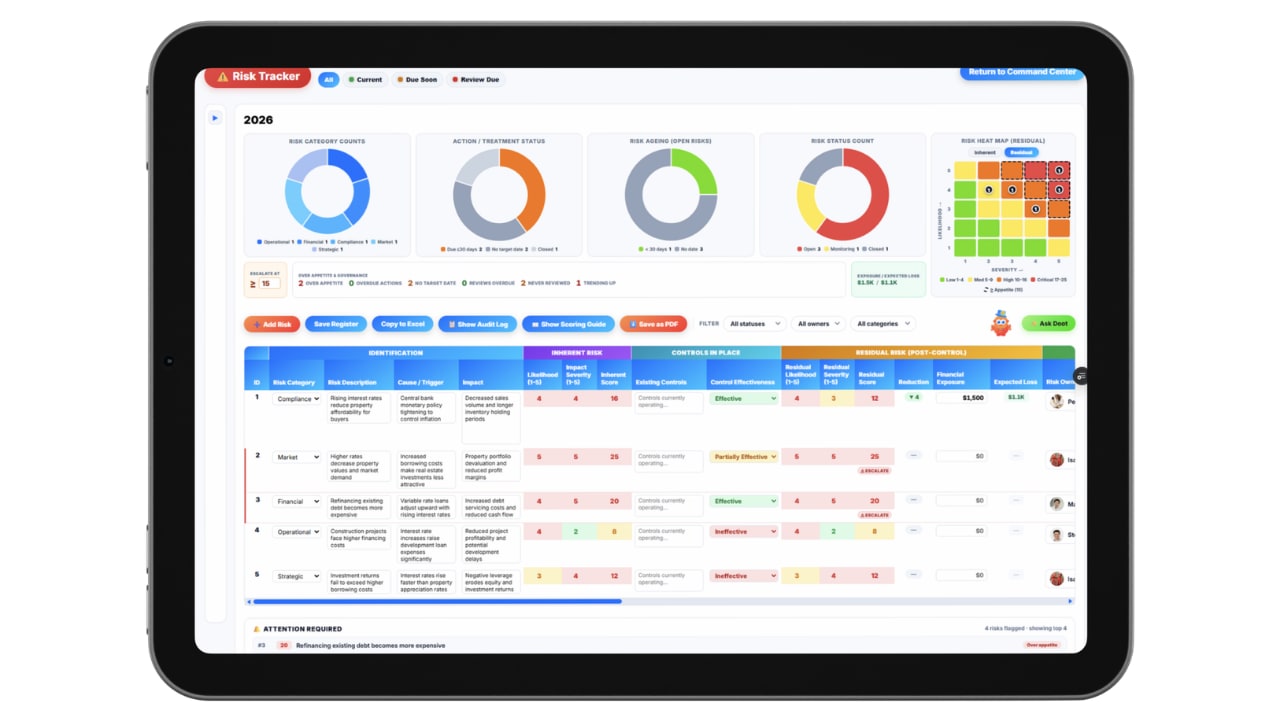
Where it aligns: every risk carries a documented control with a control effectiveness rating from effective to ineffective, which is the same evidence COSO's Control Activities and Monitoring Activities components ask for, does a control exist, is it rated, and does the rating hold up against the residual risk left over. Every control and treatment has a named owner separate from the risk owner, addressing the accountability gap that COSO's Control Environment component is largely about. Review dates with automatic overdue flags, and owner plus executive sign-off through digital signature, give Monitoring Activities something to point to: a dated record of who reviewed a control and when, not just a policy that was written once.
Where it does not, and this matters more than the alignment does: Updoot's register does not model segregation of duties across financial transaction systems, does not map to the full seventeen COSO principles individually, and is not built as a SOX 404 audit-evidence system. A company under active SOX obligations needs a control library built specifically against COSO's Internal Control-Integrated Framework, likely with dedicated internal audit software and an external auditor's involvement, not a general risk register bought off a website. For a small business without those obligations that wants the discipline COSO points at, named ownership, documented controls, rated effectiveness, enforced review, without building a SOX-grade control system it does not need, the register covers real ground. For a business that does have SOX obligations, treat this as a starting point for organizing risk thinking, not a substitute for a COSO-specific control assessment or the auditor conversation that determines actual compliance.
Frequently Asked Questions
The COSO framework is a set of guidance documents for internal control and enterprise risk management published by the Committee of Sponsoring Organizations of the Treadway Commission. The main document, the Internal Control-Integrated Framework, organizes internal control into five components and seventeen principles and is the basis most public companies use to satisfy Sarbanes-Oxley Section 404. A separate document, the COSO Enterprise Risk Management Framework, takes a broader view of risk across strategy and performance.
The five components are Control Environment, Risk Assessment, Control Activities, Information and Communication, and Monitoring Activities. Control Environment covers the tone, ethics, and structure leadership sets. Risk Assessment covers identifying and analyzing risks to objectives. Control Activities are the policies and procedures that address those risks. Information and Communication covers the data and reporting that support control. Monitoring Activities covers ongoing and separate evaluations of whether controls are still working.
No. Like ISO 31000, COSO is guidance rather than a certifiable standard, so there is no COSO certification for organizations or software products. A company can state that its internal controls are designed using the COSO framework, and an external auditor can assess whether those controls are operating effectively as part of a SOX audit, but that is an audit opinion on the controls, not a certification of the framework itself.
COSO's Internal Control-Integrated Framework is built around control activities and is the standard basis for SOX compliance and financial reporting assurance, while ISO 31000 is a general-purpose risk management guideline not tied to any specific regulation. COSO also publishes a separate Enterprise Risk Management framework that overlaps more closely with ISO 31000's scope. A company under SOX obligations typically needs COSO; most small businesses without those obligations get more direct use out of ISO 31000's simpler risk process.
Software supporting COSO should let an organization document controls against each of the five components, assign an owner to every control, rate whether each control is designed and operating effectively, link risks to the controls meant to address them, and keep a record of when each control was last tested and by whom. The core requirement is evidence: COSO assessments depend on being able to show a control existed, who owned it, and that it was actually checked, not just that a policy was written down once.
Final Thoughts
COSO is heavier than ISO 31000 for a reason: it was built to support an audit opinion, not just to organize thinking about risk. If SOX obligations are the reason you are here, the framework is not optional and the five components, seventeen principles, and evidence trail are what an auditor will actually test against, so treat this guide as an orientation and build the real control library with people who do SOX work for a living. If you landed here without a SOX requirement attached, the honest move is usually to borrow COSO's discipline, named ownership, rated control effectiveness, enforced testing cadence, without building the full apparatus a public company needs. Either way, the framework only does its job when a control is documented, owned, tested on a real schedule, and revisited as the framework itself keeps being extended. Written once and never checked again, it is a binder. Tested, owned, and current, it is what it was designed to be.