
Risk Manager Software and ISO 31000: What Alignment Actually Means
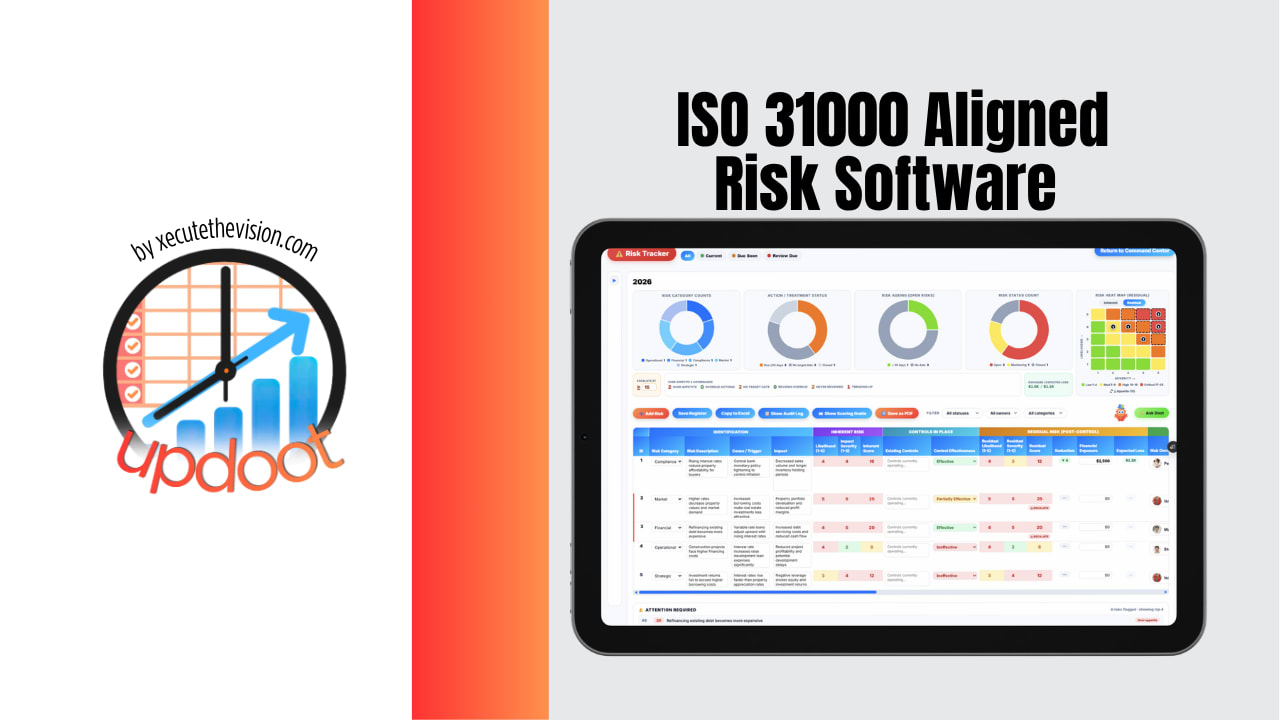
Try our free risk register tool below, and use the rest of this guide to learn what the ISO 31000 guidelines actually say. Risk is not something small companies ignore, it is something they manage informally: in someone's head, in a hallway conversation, or in a spreadsheet one person updates when they remember. That works right up until the day it does not, when a key supplier disappears, a client relationship that everyone assumed was safe quietly ends, or a compliance gap surfaces in the middle of a deal. ISO 31000 exists because organizations kept discovering the same thing: the problem is rarely that nobody saw the risk, it is that nobody owned it, nobody reviewed it, and nobody connected it to a decision. This guide covers what ISO 31000 is, what its principles, framework, and process actually say, what risk manager software is supposed to do, what it means for a tool to be aligned with the standard, the pitfalls that make risk registers useless, and a free builder to draft yours.
Quick Answer
ISO 31000 is the international standard giving guidelines for risk management, built on eight principles, a governance framework, and a repeatable process of identifying, analyzing, evaluating, treating, monitoring, and reporting risk. It is guidance rather than a set of auditable requirements, so no company and no software can be certified to it. Risk manager software supports the standard by holding a live risk register with owners, scores, treatments, and review dates. A tool aligned with ISO 31000 ties risks to objectives, names an owner for each one, and forces regular review, rather than storing a list nobody reads.
What ISO 31000 Is
ISO 31000 is the International Organization for Standardization's guidance on managing risk. The current edition is ISO 31000:2018, published in February 2018 as the second edition, and it was reviewed and confirmed in 2023, so it remains the current version. A revision is in development and has reached the committee draft stage, but no new edition has been published, which means the 2018 text is the one to work from today.
The standard defines risk as the effect of uncertainty on objectives. That definition does more work than it first appears. It means risk is not a synonym for danger, because uncertainty can push results in either direction, and it means risk only exists in relation to something you are trying to achieve. A company with no stated objectives cannot really have a risk register, only a list of things that make people nervous. This is why the first practical step in adopting the standard is usually not writing down risks at all, it is writing down what the business is actually trying to do.
The other thing worth understanding early is scope. ISO 31000 is a guidance document rather than a certifiable standard, and it is written so that any organization can adopt it regardless of size, sector, or industry. It is deliberately generic. It does not tell a construction firm which safety controls to use or a software company how to handle a data breach. It describes how to build a system for making those decisions consistently. Two companion documents fill in the gaps: ISO Guide 73 covers the vocabulary of risk management, and IEC 31010 covers specific risk assessment techniques for teams that want structured methods rather than a group discussion.
The Three Parts of ISO 31000
The standard organizes everything into three connected components. Skipping any one of them is the most common reason risk management stalls: principles without a framework produce good intentions, a framework without a process produces policy documents, and a process without principles produces a compliance exercise nobody believes in.
The Eight Principles
The 2018 edition sets out eight principles describing what effective risk management looks like. Risk management should be integrated into normal activity rather than run as a parallel exercise. It should be structured and comprehensive so results are consistent and comparable. It should be customized to the organization's context, size, and objectives rather than copied from a template. It should be inclusive, bringing in the people who actually see the risk and the people affected by it. It should be dynamic, changing as circumstances change instead of being locked in at the start of the year. It should rest on the best available information, with clear acknowledgment of where that information is thin. It should account for human and cultural factors, since the way people behave under pressure often determines the outcome. And it should be continually improved through learning and experience.
Every one of those points at the same purpose, which the standard states plainly: risk management exists to create and protect value. A register that consumes hours and changes no decision is failing the principles even if it is beautifully formatted.
The Framework
The framework is the governance layer, and it answers the question of how risk management gets built into the way the organization runs. Leadership and commitment sit at its center, because a risk process that leadership treats as paperwork will be treated that way everywhere else. Around that sit integration, which means embedding risk into existing governance and decision-making rather than bolting it on; design, which means defining context, roles, resources, and communication; implementation, which means actually rolling it out on a plan; evaluation, which means periodically checking whether the framework itself is working; and improvement, which means adapting it over time.
For a small business, the framework does not need to be elaborate. It can amount to a short written statement of who owns risk overall, which meeting reviews it, how often, and what happens when something crosses a threshold. What matters is that it exists in writing and is followed, not that it fills a binder.
The Risk Management Process
The process is the repeatable loop teams run. It starts with communication and consultation, which runs through everything rather than sitting at the front, and with establishing scope, context, and criteria, meaning deciding what part of the business you are assessing, what external and internal conditions apply, and how you will decide whether a risk is acceptable.
Then comes risk assessment, which the standard splits into three steps. Identification is finding and describing risks. Analysis is understanding likelihood, consequence, and how risks interact. Evaluation is comparing the analysis against your criteria to decide what needs action and in what order.
Risk treatment follows, selecting and implementing options. Treatment is broader than most people assume: avoiding the activity, taking on more risk deliberately to pursue an opportunity, removing the source, changing likelihood, changing consequence, sharing the risk through contract or insurance, or making an informed decision to retain it. Retaining a risk knowingly is a legitimate treatment. Retaining it because nobody looked is not.
Finally, monitoring and review plus recording and reporting close the loop, keeping the register current and making sure the results reach the people who make decisions. These last two are where most implementations quietly fail, and they are also the two that software is best positioned to fix.
What "Aligned With ISO 31000" Means, and What It Does Not
Watch for this claim: no software product is ISO 31000 certified, because ISO 31000 has no certification scheme. The standard gives guidance and good practice, and organizations are not certified against it, although individuals can earn credentials based on it. A vendor advertising certification is either confusing it with a certifiable standard such as ISO 9001 or ISO 27001, or hoping you will not check.
So what does alignment legitimately mean? It means the tool is built around the same assumptions the standard makes. Concretely, an aligned tool supports risks that connect to stated objectives, a named owner for every risk, likelihood and consequence recorded in a consistent way, treatment documented as a decision rather than an intention, a review cadence that is enforced rather than hoped for, and a record of how the picture changed over time.
What alignment does not mean is that installing software makes an organization compliant. ISO 31000 is mostly about behavior: leadership attention, honest conversation about uncertainty, and the willingness to revisit assumptions. Software makes those behaviors easier to sustain and much harder to skip. It cannot supply them.
What Risk Manager Software Does
Strip away the marketing and risk manager software does a small number of concrete jobs.
It holds the register. One place where every identified risk lives, described in plain language, so the list is not scattered across a spreadsheet, a slide deck, and someone's notes.
It scores consistently. Likelihood and impact recorded on the same scale by everyone, so two risks entered by two departments can actually be compared and prioritized.
It assigns ownership. Every risk gets a named person accountable for its treatment. This is the single biggest difference between a register that changes outcomes and one that does not.
It tracks treatment. The chosen response is recorded along with the actions that implement it, so treatment becomes work with a due date rather than a sentence in a column.
It enforces review. Risks come back around on a schedule, and anything overdue is visible. Without this, a register becomes a snapshot of what worried the company at the moment it was written.
It reports upward. Leadership gets a current view without asking anyone to assemble it, which is what keeps risk in front of the people who can act on it.
Mapping the Standard to Software Features
When evaluating tools, it helps to check them against the process rather than against a feature list. Here is what each step of the ISO 31000 process needs from software.
| ISO 31000 process step | What the software needs to support |
|---|---|
| Scope, context, and criteria | A place to record objectives and the thresholds that define an acceptable risk |
| Risk identification | Easy entry from anyone in the business, not just an admin, with categories |
| Risk analysis | Consistent likelihood and impact scales applied the same way across teams |
| Risk evaluation | Sorting and prioritization so the top risks are obvious without manual ranking |
| Risk treatment | Actions with owners and due dates linked directly to the risk they address |
| Monitoring and review | Review dates, overdue flags, and a visible history of changes |
| Recording and reporting | A leadership view and an export that does not require rebuilding the data |
| Communication and consultation | Shared access, comments, and a meeting cadence where risk is a standing item |
A tool that covers the middle of that table and nothing at the ends will produce a well-scored list that never reaches a decision. The ends matter more than the scoring math.
Build Your Risk Register
If you have nothing written down yet, start here. The builder below gets your first list of risks, owners, and treatments out of people's heads and onto paper. Understand what it is though: a snapshot. It has no review dates that fire, no history, no connection to your objectives, and it will be out of date the moment something changes. That is the honest limit of any printable register, which is exactly the gap a real system fills.
Free Risk Register Starter
Add each risk with its likelihood, impact, treatment, and owner. Print it or copy it as text to bring to your next leadership meeting, then move it somewhere it will actually stay current.
Register Details
Risks
Common Pitfalls to Avoid
Treating It as a Compliance Exercise
The fastest way to waste the effort is to build the register because someone asked for one, file it, and move on. ISO 31000 is explicit that risk management should be integrated into normal decision-making. If the register is not consulted before a hiring decision, a big contract, or a new product line, it is documentation rather than management.
Writing Risks That Are Not Risks
Registers fill up with entries like "cash flow" or "competition," which are topics, not risks. A usable risk names an event, a cause, and a consequence tied to an objective, such as the loss of the largest client causing a revenue shortfall against the annual target. Vague entries cannot be scored, owned, or treated, so they sit there permanently.
Scoring Theater
Elaborate scoring models create an illusion of precision from numbers that were guesses. Likelihood and impact scales exist to force comparison and prioritization, not to produce an exact figure. Keep the scale simple, apply it consistently, and spend the saved time on treatment.
No Owner, or an Owner Who Does Not Know
A risk assigned to a department is assigned to nobody. Assign it to a person, tell them, and make sure the treatment actions appear in their normal work rather than only in the register. The standard's emphasis on human and cultural factors is partly about exactly this: risk management fails at the point where accountability becomes ambiguous.
Set It and Forget It
The standard calls risk management dynamic for a reason. A register written in January describes January's world. Without a review cadence, the entries that were once urgent stay open forever while the risk that actually materialized was never on the list. Put the review on a recurring meeting agenda so it happens without anyone having to remember.
Only Looking Down
Because risk sounds negative, most registers list only threats. The standard's definition covers uncertainty in both directions, and evaluating opportunities with the same discipline is part of the point. A structured look at what could go unexpectedly well often surfaces decisions worth making.
Buying Enterprise Governance Software for a Fifteen-Person Company
Full governance, risk, and compliance platforms are built for regulated enterprises with dedicated risk teams and priced accordingly. A small business usually needs a live register, clear ownership, and a review rhythm. Overbuying tends to produce a long implementation and a tool nobody uses, which is a worse outcome than a simple register that is actually maintained.
Where Updoot Fits In
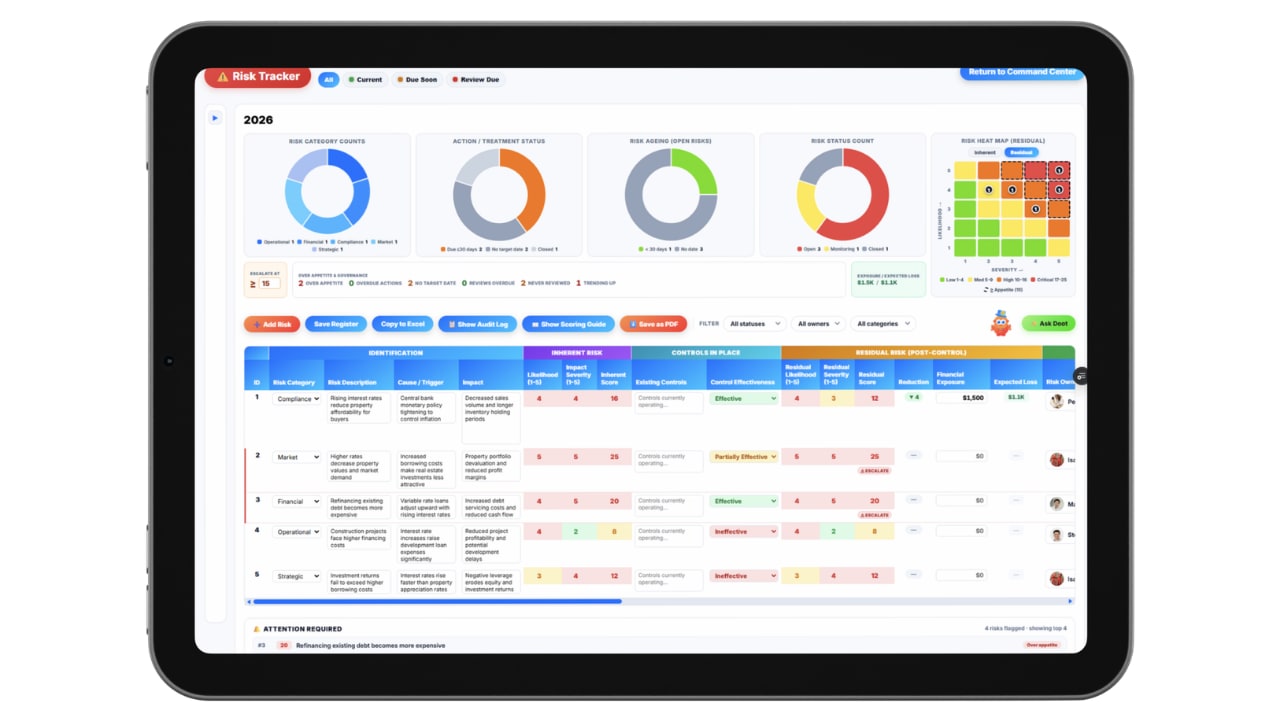
Updoot is not certified to ISO 31000, and no product can be, but its risk register is built directly around the process the standard describes rather than a generic list of rows. Every risk carries an inherent score, likelihood times severity before any control is applied, and a separate residual score scored again after controls are accounted for, with the reduction between the two calculated automatically. That split is the standard's risk assessment step made concrete: inherent is what analysis looks like before treatment, residual is what evaluation is actually judged against.
The gap between those two numbers has to be justified, so each risk also carries a documented existing controls field and a control effectiveness rating from effective to ineffective. A residual score that sits far below inherent with no controls listed is a sign the scoring is wrong, not that the risk is handled, and the register is built to surface that inconsistency rather than hide it.
Treatment follows the same four options ISO 31000 sets out: Avoid, Reduce/Mitigate, Transfer, and Accept, so the response to a risk is a documented decision rather than a sentence in a notes field. Each treatment has its own owner, separate from the risk owner, with a target resolution date that flags automatically when it passes without the risk moving to mitigated or closed. A financial exposure figure and a calculated expected loss give the evaluation step something concrete to weigh, and a configurable risk appetite threshold auto-flags any residual score that crosses it for escalation.
Monitoring and review, the two steps that decay fastest in most registers, are enforced rather than optional. Every risk has a last-reviewed and next-review date, and the register flags anything overdue or coming due, so a risk cannot quietly sit unreviewed for a year. A trend field records whether each risk is rising, stable, or falling since its last review, independent of the current score, so a stable 20 and a rising 12 don't get treated the same way. For accountability, both the risk owner and an executive can sign off on a risk digitally, drawn or typed, creating a record of who acknowledged what and when.
For reporting, a 5x5 heat map plots every risk by likelihood and severity and toggles between inherent and residual views, alongside category, owner, and status breakdowns that update as the register changes, so leadership sees the current picture without anyone assembling it by hand. The whole register exports to Excel or PDF in the format an auditor or board would expect. For a small business that wants to run risk management the way ISO 31000 actually describes, inherent and residual scoring, documented treatment options, enforced review cadence, and sign-off accountability in one register, is most of the way there without a dedicated risk team or an enterprise governance suite.
Frequently Asked Questions
ISO 31000 is the international standard that sets out guidelines for managing risk. It defines risk as the effect of uncertainty on objectives and organizes risk management into three connected parts: a set of principles describing what good risk management looks like, a framework describing how an organization builds risk management into its governance, and a process describing the repeatable steps of identifying, analyzing, evaluating, treating, monitoring, and reporting risk. The current edition is ISO 31000:2018, and it applies to organizations of any size in any sector.
No. ISO 31000 is written as guidance rather than as a set of auditable requirements, so there is no certification for organizations or for software products against it. Individuals can earn training credentials based on the standard, and organizations can align their practices with it, but any vendor claiming their product is ISO 31000 certified is describing something that does not exist. Certifiable standards such as ISO 9001 or ISO 27001 work differently because they contain requirements an auditor can test against.
The 2018 edition sets out eight principles for effective risk management. Risk management should be integrated into normal activity rather than run as a separate exercise, structured and comprehensive, customized to the organization, inclusive of the people affected, dynamic enough to respond as circumstances change, based on the best information available, attentive to human and cultural factors, and continually improved. All eight point at the same purpose, which is creating and protecting value.
Risk manager software gives an organization one place to record identified risks, score their likelihood and impact, assign an owner to each one, document the treatment being applied, and track whether that treatment is actually happening. Good tools also keep a history of changes, surface risks that are overdue for review, and produce reporting for leadership. The core job is turning risk from a document someone updates once a year into a live register with named accountability.
Updoot is not a certified product, because ISO 31000 has no certification, but its risk register scores every risk inherent and residual, requires documented controls and a control effectiveness rating, uses the same four treatment options the standard describes (avoid, reduce, transfer, accept), and enforces a review cadence with automatic overdue flags and owner and executive sign-off. That combination covers the standard's assessment, treatment, and monitoring steps directly rather than as an afterthought.
Final Thoughts
ISO 31000 is shorter and less bureaucratic than its reputation suggests. Underneath the structure, it makes a simple argument: decide what you are trying to achieve, be honest about what could change the outcome, give each of those things to a named person, agree what you are going to do about it, and come back to the list on a schedule. Everything else in the standard is scaffolding around those five moves. That is why alignment is not something a purchase confers. Software cannot decide your objectives or hold the conversation about what might go wrong, but it can make sure the register stays current, that owners are visible, that reviews actually happen, and that leadership sees the picture without asking. Start with the objectives, keep the register short enough that people read it, put the review on a recurring agenda, and let the tool carry the parts that otherwise get dropped. Done that way, risk management stops being an annual document and becomes something the business genuinely runs on.