
360 Performance Reviews: Process, Benefits, Pros & Cons
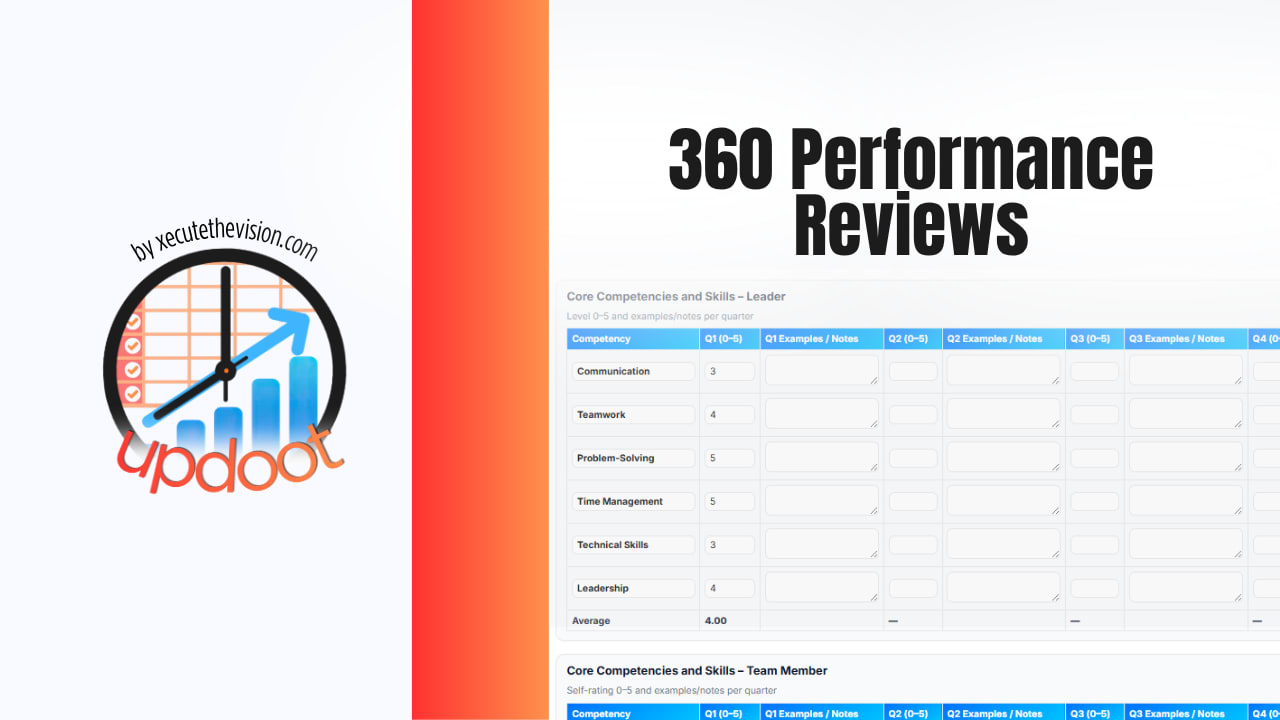
A 360 performance review, sometimes called 360-degree feedback or multi-rater feedback, collects structured input about an employee from the full circle of people they work with: their manager, their peers, their direct reports, themselves, and sometimes customers or vendors. Instead of one person's opinion deciding the story, the review shows how an employee is actually experienced from every direction. This guide walks through what a 360 review is, how the process works step by step, the benefits, the honest pros and cons, the pitfalls that sink most 360 programs, and how to decide whether it's the right format for your team.
Quick Answer
A 360 performance review gathers feedback on one employee from 6 to 12 raters, manager, peers, direct reports, and a self-assessment, using a mix of rating-scale and open-ended questions, then compiles the results into a single report discussed in a development-focused conversation. It's most valuable for developing managers and surfacing blind spots, and it works best when feedback stays anonymous for peers and reports and isn't tied directly to pay decisions.
What Is a 360 Performance Review?
A traditional performance review is a one-way mirror: the manager evaluates the employee, and that single perspective becomes the official record. The problem is that managers only see a slice of anyone's work. They see the deliverables and the meetings they attend, but not how the employee treats the junior analyst, responds to a peer's request at 4:55 on a Friday, or communicates when the manager isn't in the room.
A 360 review fixes that by design. Each participant is reviewed by a set of raters chosen to cover every working relationship:
- Manager feedback, the traditional top-down evaluation, still included and usually attributed.
- Self-assessment, the employee rates themselves on the same questions, which makes gaps between self-perception and how others experience them immediately visible.
- Peer feedback, typically 3 to 5 colleagues who work with the person regularly, usually anonymous.
- Direct report feedback, for anyone who manages people, 2 to 4 of their reports rate them upward, almost always anonymous.
- External feedback, optionally, customers, vendors, or cross-functional partners for client-facing roles.
Everyone answers the same structured questionnaire, usually a mix of rating-scale items tied to competencies (communication, collaboration, reliability, leadership) and a few open-ended questions. The responses are aggregated into a single report that shows patterns across rater groups, which is where the format earns its name: the employee sees themselves from all 360 degrees.
The 360 Review Process, Step by Step
Step 1: Define the Purpose and Set Expectations
Decide up front whether the review is for development, for evaluation, or both, and tell everyone. This single decision shapes how honest the feedback will be. When raters believe their answers affect a colleague's raise, scores inflate; when they know the goal is growth, they get candid. Communicate the confidentiality rules clearly before a single survey goes out: who sees what, whether responses are anonymous, and how the results will be used.
Step 2: Choose Competencies and Write the Questions
Pick 5 to 8 competencies that actually matter for the role, then write questions about observable behavior, not personality. "Communicates priorities clearly to the team" is answerable; "Is a good person" is not. A solid questionnaire is 15 to 25 rating-scale items on a 1-to-5 scale plus two or three open-ended prompts like "What should this person keep doing?" and "What is one thing they could do differently?" Anything longer than about 20 minutes to complete will tank your response rates.
Step 3: Select the Raters
Aim for 6 to 12 raters per employee: the manager, the self-assessment, 3 to 5 peers, and for managers, 2 to 4 direct reports. A common approach is letting the employee nominate raters and having the manager approve the list, which balances buy-in against cherry-picking. Fewer than 4 or 5 anonymous raters makes anonymity fragile, one harsh comment becomes easy to trace, and lets a single outlier distort the averages.
Step 4: Collect the Feedback
Give raters one to two weeks with a clear deadline, and send reminders, response rates below about 70 percent leave holes in the picture. Collecting through software rather than email or spreadsheets matters more here than in almost any other HR process, because anonymity has to be real, not just promised.
Step 5: Compile and Review the Report
Aggregate scores by rater group so patterns are visible: where the manager, peers, and reports agree, where they diverge, and where self-ratings differ sharply from everyone else's. Those self-versus-others gaps are usually the most valuable finding in the entire exercise. Someone, usually the manager or HR, should review the report before the employee sees it and screen out any comments that are abusive or identifying.
Step 6: Deliver the Feedback in a Conversation
Never just email the report. Sit down, walk through the themes, celebrate the consistent strengths first, then explore the gaps with curiosity rather than accusation. The goal of the conversation is for the employee to leave understanding two or three specific things to work on, not to relitigate individual comments or guess who said what.
Step 7: Turn It Into a Development Plan and Follow Up
A 360 without follow-through is just an expensive way to hurt feelings. Convert the findings into two or three concrete goals with check-ins, and revisit them in the next cycle so employees can see their own trend lines. Pairing the review with goal tracking software is the easiest way to keep those commitments from evaporating a week later.
Benefits of 360 Performance Reviews
A Fuller, Fairer Picture
One rater means one set of biases. Eight raters don't eliminate bias, but they dilute any single person's, including a manager who barely sees the employee's day-to-day work. Employees consistently rate multi-source feedback as fairer than manager-only reviews for exactly this reason.
Blind Spots Become Visible
The single most common 360 finding is a gap: the employee rates themselves a 5 on communication and everyone else rates them a 3, or the reverse, a chronically self-critical high performer discovers their peers think they're excellent. Neither insight is available from a manager-only review.
Upward Feedback on Managers
360s are one of the only structured channels through which direct reports can safely tell a manager how their management actually lands. For developing leaders, this is frequently the most valuable output of the whole program, and often the reason companies adopt it in the first place.
Better Data for Development
Because the feedback is tied to specific competencies and behaviors, it converts naturally into development goals, coaching topics, and training plans instead of a vague "communicate better" note in a file.
A Culture of Feedback
Teams that run 360s regularly get more comfortable giving and receiving feedback in general. The formal cycle normalizes the informal conversations that should be happening year-round anyway.
Pros and Cons at a Glance
| Pros | Cons |
|---|---|
| Multiple perspectives reduce single-rater bias | Time-intensive: every employee generates 6 to 12 surveys |
| Surfaces blind spots and self-perception gaps | Anonymous feedback can be vague, or occasionally weaponized |
| Gives direct reports a safe upward-feedback channel | Results can be skewed by office politics or popularity |
| Produces concrete, behavior-based development data | Poorly delivered results damage trust and morale |
| Perceived as fairer by employees | Hard to run well without dedicated software |
| Builds a broader feedback culture over time | Loses honesty fast if tied directly to pay decisions |
Common Pitfalls That Sink 360 Programs
Tying Results Directly to Compensation
This is the fastest way to kill a 360 program. The moment raters know their scores affect a colleague's raise, two things happen: friends inflate, rivals deflate, and the data stops meaning anything. Keep 360s development-focused, or at most one input among several in evaluation decisions, never the deciding one.
Breaking Anonymity, Even Once
If a manager ever hints that they figured out who wrote a critical comment, candor in the next cycle drops to zero and never fully recovers. Protect anonymity structurally: minimum rater counts before results display, aggregated scores only, and comment screening.
Collecting Feedback and Doing Nothing With It
Employees who pour thirty minutes into thoughtful feedback and then watch nothing change learn that the exercise is theater. Every cycle needs visible follow-through, even if it's just each participant sharing one goal they took from their report.
Overloading Raters
If one person is asked to complete ten 25-minute surveys in the same week, the tenth survey is straight 4s with no comments. Stagger cycles, cap how many reviews any one rater is assigned, and keep questionnaires short.
Skipping the Delivery Conversation
Raw multi-rater feedback with no context is genuinely hard to receive. Emailing the report and moving on turns a development tool into an anonymous pile-on. The conversation is not optional.
Try the 360 Review Time & Cost Calculator
Estimate how much time and money a 360 review cycle costs your organization based on your headcount and rater setup.
360 Cycle Time & Cost Estimator
Enter your numbers below. This is a planning estimate, not a guarantee of results.
When a 360 Review Is (and Isn't) the Right Choice
360s shine when you're developing managers and leaders, when an employee works with far more people than just their boss, when you suspect blind spots that a manager-only performance review can't catch, or when you want a structured upward-feedback channel. They're a poor fit for very small teams where anonymity is impossible, for brand-new employees who haven't worked with enough people yet, and for organizations in the middle of a trust crisis, a 360 amplifies whatever culture you already have, good or bad. If you're still deciding among formats, our complete guide to performance review types, topics, and scoring compares 360s against the alternatives.
How Updoot Makes 360 Reviews Painless
Updoot handles the part of 360 reviews that kills most programs: the logistics. Instead of chasing spreadsheets and mail-merged survey links, you build the review once, choose the rater groups, manager, self, peers, direct reports, and Updoot sends every survey, tracks who has responded, and nudges the stragglers automatically.
Peer and direct-report responses stay genuinely anonymous, and the results roll up into one clean report per employee that shows scores by rater group side by side, so self-versus-others gaps and manager-versus-peer differences jump off the page instead of hiding in a spreadsheet. From there, the feedback flows straight into goal tracking, so the development plan that comes out of the review conversation lives in the same system where progress on it gets measured, right alongside scheduling, time tracking, HR, and payroll.
The goal isn't more paperwork around performance. It's making the multi-rater format light enough that small businesses, not just enterprises with an HR department of twelve, can actually run it.
Frequently Asked Questions
A 360 performance review collects structured feedback about an employee from multiple perspectives, typically their manager, peers, direct reports, a self-assessment, and sometimes customers or vendors, instead of relying on the manager's view alone. The results are compiled into a single report that shows how the employee is experienced by the people around them.
Most organizations use 6 to 12 raters per employee: the manager, a self-assessment, 3 to 5 peers, and, for managers being reviewed, 2 to 4 direct reports. Fewer than 4 or 5 raters makes anonymity fragile and lets one outlier skew results, while more than a dozen adds survey fatigue without adding much signal.
Peer and direct-report feedback is usually collected anonymously or confidentially, because raters are more candid when they don't fear retaliation, especially when reviewing their own manager. Manager feedback is typically attributed since it's part of the normal reporting relationship. Whatever you choose, state the confidentiality rules clearly before anyone submits feedback.
Most practitioners recommend using 360 feedback primarily for development rather than as a direct input into raises or promotions. When raters know their answers affect a colleague's pay, scores tend to inflate or become weapons in office politics, which destroys the honesty that makes the process valuable. If it does inform decisions, it should be one input among several, not the deciding factor.
Once or twice a year is typical. Annual cycles work for most teams; every six months suits fast-changing organizations or employees working through specific development plans. Running them more often than that usually produces survey fatigue and declining response quality rather than better feedback.
Focus on observable behaviors tied to competencies like communication, collaboration, reliability, leadership, and problem-solving. A good format combines rating-scale questions (for example, "Communicates priorities clearly" on a 1 to 5 scale) with two or three open-ended prompts such as "What should this person keep doing?" and "What is one thing they could do differently?" Avoid questions that ask raters to speculate about intent or personality.
Final Thoughts
A 360 performance review is one of the highest-signal feedback tools available, and one of the easiest to run badly. Done well, it gives employees a picture of themselves no single manager could provide, gives managers upward feedback they'd never otherwise hear, and produces development plans built on real patterns instead of one person's impressions. Done carelessly, without anonymity, without a delivery conversation, without follow-through, it burns trust and survey goodwill you won't easily get back. The difference comes down to purpose, process, and follow-up: decide what the review is for, protect the honesty of the people giving feedback, and make sure something visibly changes because of it.