
What Is a 9/80 Work Schedule? Guide and Template
A 9/80 work schedule lets employees work 80 hours in nine days instead of ten, so they get every other Friday off without losing pay. Build your schedule with the free 9/80 generator below, then use this guide to understand how the split workweek keeps payroll accurate and whether a 9/80 fits your team.
The traditional five-day, 40-hour week is not the only way to structure work. Many companies, especially in engineering, operations, and project-based roles, use alternative schedules to improve productivity, satisfaction, and retention. The 9/80 is one of the most popular, and also one of the most misunderstood. Set it up without the right time tracking and it creates overtime and payroll errors fast.
Free 9/80 Schedule Generator
Free 9/80 Schedule Generator
Pick the Monday that starts your first 9/80 cycle, your day off, and daily start time. The generator builds the two-week schedule, shows where the workweek splits so each week totals 40 hours, and lists your upcoming days off.
| Day | Date | Hours | Shift | Payroll Workweek |
|---|
Your next days off:
What Is a 9/80 Work Schedule?
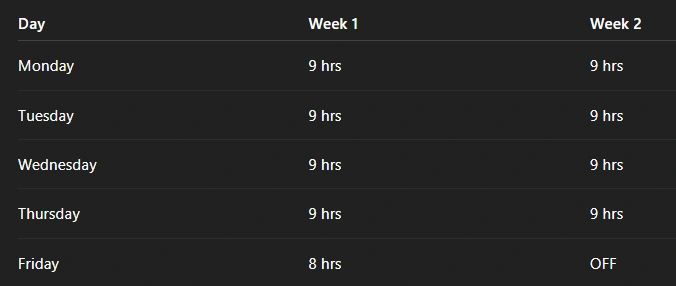
A 9/80 schedule spreads 80 hours of work across nine working days in a two-week period. Employees work eight 9-hour days and one 8-hour day, then take the tenth day off. The day off is usually every other Friday, although some companies use Mondays or stagger days off across the team to keep coverage.
How the Two Weeks Break Down
In the first week, employees work four 9-hour days and one 8-hour day, which is 44 hours on the calendar. In the second week, they work four 9-hour days, 36 hours, and take the fifth day off. Across both weeks, that is 80 hours, the same as a standard schedule.
The Split Workweek: The Detail Most People Miss
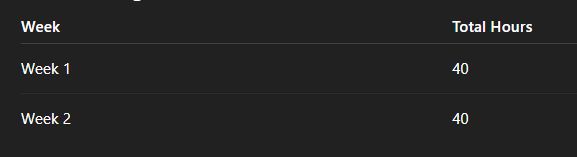
Federal overtime rules are based on a fixed, recurring seven-day workweek, and non-exempt employees must be paid overtime for hours over 40 in that workweek. If your workweek runs Monday to Sunday, the 44-hour first week would create 4 hours of overtime every cycle.
To avoid that, many employers set the official workweek to begin halfway through the 8-hour day, for example at noon on the 8-hour Friday. Four hours of that day fall in the first workweek and four fall in the second, so each workweek totals exactly 40 hours. The workweek must be set in advance and kept consistent, not changed to dodge overtime week by week. Read the U.S. Department of Labor overtime guidance, and check with your state labor department, since some states have their own daily overtime or alternative schedule rules.
| Workweek | Days included | Hours |
|---|---|---|
| Workweek 1 | Friday afternoon (4 hrs) through Thursday, four 9-hour days, plus Friday morning (4 hrs) | 40 |
| Workweek 2 | Friday afternoon (4 hrs), then four 9-hour days, and the next Friday off | 40 |
If this is not set up correctly, the result is accidental overtime, compliance risk, and payroll errors, which is where most companies run into trouble.
How to Calculate a 9/80 Schedule
The math is simple: eight days at 9 hours is 72 hours, plus one day at 8 hours is 80 hours over two weeks. With the split day, each payroll workweek is 36 hours from the four 9-hour days plus 4 hours from the split day, for 40 hours.
Example: Employee Time Tracking
An employee works 9 hours Monday through Thursday in week one (36 hours) and 8 hours on Friday, split 4 and 4. In week two, they work 9 hours Monday through Thursday (36 hours) and have Friday off. Each workweek shows 40 hours and no overtime.
9/80 vs. Other Alternative Schedules
| Schedule | How it works | Days off | Daily hours |
|---|---|---|---|
| Standard 5/40 | Five 8-hour days per week | Weekends only | 8 |
| 9/80 | 80 hours in nine days over two weeks | One extra day every two weeks | 9 (one 8-hour day) |
| 4/10 | Four 10-hour days per week | One extra day every week | 10 |
| 4/9 plus a half day | Four 9-hour days and a 4-hour day | Half day every week | 9 and 4 |
The 9/80 is a middle ground: less of a daily stretch than a 4/10, with a longer weekend twice a month. See the 4/10 schedule guide and compressed work schedule types for comparisons.
Benefits of a 9/80 Schedule
Higher Employee Satisfaction
A regular three-day weekend every two weeks improves work-life balance, and flexible schedules are a meaningful factor in retention.
More Focused Work
Longer days can mean fewer start-up and wind-down periods and more time for deep work, especially in engineering, operations, and project roles.
Fewer Commutes
One less commute every two weeks saves time, stress, and money.
A Hiring Advantage
Offering a 9/80 helps you stand out to candidates comparing traditional employers.
Downsides of a 9/80 Schedule
Longer Days
Nine-hour days can cause fatigue and lower focus late in the day if workloads are not managed.
Coverage Gaps
If everyone is off the same Friday, customers and partners may go without support. Many companies split the team into two groups with alternating Fridays off.
Payroll and Time Tracking Complexity
The split workweek, holidays, and PTO all need clear rules, or overtime gets miscalculated.
Not Right for Every Role
Customer-facing roles that need daily coverage, retail, and shift-based work usually fit other schedules better.
How to Handle Holidays and PTO on a 9/80
Decide your rules before the schedule starts. Holidays: if a paid holiday lands on a 9-hour day, many employers pay 8 hours of holiday pay and let employees cover the extra hour with PTO or by working it elsewhere in the same workweek. If a holiday lands on a scheduled day off, some employers give a floating holiday. PTO: a full day off on a 9-hour day typically uses 9 hours of PTO, and the split Friday uses 8. Write these rules into your policy so every employee is treated the same. For more on holiday pay, see overtime and holiday pay in the same week.
How to Implement a 9/80 Schedule
- Decide which roles are eligible and whether exempt, non-exempt, or both will participate.
- Choose the day off and whether teams will alternate days off for coverage.
- Set the official payroll workweek to split the 8-hour day, and document it.
- Write rules for holidays, PTO, sick days, and swapping days off.
- Configure your time tracking and payroll system for the split workweek.
- Pilot with one team for two or three cycles, check payroll, then expand.
Is a 9/80 Right for Your Team?
A 9/80 works best when work is project-based, employees manage their own time, you can cover the days off, and you have systems that track time accurately. It is a strong fit for engineering, operations, office, and knowledge work. It is usually a poor fit for retail, support teams that need daily coverage, and hourly shift work.
Managing a 9/80 in Excel vs. Software
You can track a 9/80 in Excel, but it takes custom formulas to detect the split Friday, allocate hours to the right workweek, cap weekly hours, and apply overtime rules. One copied formula in the wrong row and payroll is off. Updoot's time clock lets employees clock in normally while hours, workweeks, and overtime are calculated automatically, and Updoot scheduling keeps alternating days off visible on one calendar so coverage never slips.
Common 9/80 Mistakes to Avoid
- Using the calendar week as the workweek. If the workweek is not moved to split the alternating Friday, nonexempt employees can hit 44 hours in one calendar week and owe overtime under federal rules.
- Changing the workweek back and forth. The FLSA workweek must be a fixed, recurring 168-hour period. Set it once and document it rather than shifting it to avoid overtime.
- Forgetting holiday math. When a holiday lands on a 9-hour day, an 8-hour holiday credit leaves the employee an hour short. Decide in advance whether they use PTO, make up the hour, or receive a 9-hour holiday.
- No coverage plan. If everyone takes the same Friday off, customers notice. Split the team into two groups with alternating Fridays.
- Tracking time by hand. Split Fridays and alternating schedules are easy to miscount on paper. Software that knows the workweek start time prevents payroll errors.
Every item on this list is easier to avoid when the schedule, the workweek definition, and time tracking live in the same system, so the rules are applied automatically each pay period.
Final Thought
A 9/80 schedule is a powerful perk when it is run correctly. Companies rarely fail because of the schedule itself. They fail because time tracking and payroll do not follow the split workweek. Set the rules first, track time accurately, and the 9/80 becomes a retention advantage instead of a payroll headache.
Opens in Google Drive. View and download for free.
Related Reading
The 4/10 Work Schedule: A Practical Guide and Template →
Frequently Asked Questions About 9/80 Schedules
What is a 9/80 work schedule?
A 9/80 schedule is 80 hours of work over nine days in a two-week period: eight 9-hour days and one 8-hour day, with the tenth day off, usually every other Friday.
How does overtime work on a 9/80 schedule?
Overtime is based on hours over 40 in a fixed workweek. Many employers start the workweek halfway through the 8-hour day so each workweek totals 40 hours. Check federal guidance and your state's rules before setting it up.
Why is the Friday split on a 9/80 schedule?
Splitting the 8-hour day, with 4 hours in each workweek, keeps both workweeks at 40 hours so the 44-hour calendar week does not create overtime.
How do holidays work on a 9/80 schedule?
Rules vary by employer. A common approach is 8 hours of holiday pay with PTO or an extra hour of work covering the ninth hour, and a floating holiday when a holiday falls on a scheduled day off.
What is the difference between a 9/80 and a 4/10 schedule?
A 9/80 gives one extra day off every two weeks with mostly 9-hour days. A 4/10 gives one extra day off every week with four 10-hour days.
Can hourly employees work a 9/80 schedule?
Yes, as long as the workweek is set up so hours are tracked and overtime is paid correctly. Check federal and state rules first.
How do you keep coverage on a 9/80 schedule?
Split the team into two groups with alternating days off, so half the team is working on every Friday.