
Direct Costs vs Indirect Costs: Definitions and Examples
Quick Answer
Direct costs can be traced to a specific product, service or project, such as raw materials, direct labor, and shipping or commissions tied to a specific order or sale. Indirect costs support the whole business and can't be traced to one product, such as rent, utilities, administrative salaries, insurance, accounting fees, software and marketing. The difference matters for pricing, budgeting, taxes and knowing which work is actually profitable.
Direct costs vs indirect costs explained in detail with real examples for pricing, budgeting, and business taxes. If you've ever tried to price a product, prepare a budget, or file a business tax return, you've run into this distinction. It sounds straightforward until you're staring at a specific expense and genuinely unsure which category it belongs to.
Getting this wrong is not just an accounting inconvenience. Misclassifying your costs affects how you price your products, how you report your income, how you apply for grants or government contracts, and how clearly you understand whether your business is actually profitable. This guide breaks down the difference between direct costs and indirect costs, walks through real examples of each, and explains how to use this distinction to make better business decisions.
What Are Direct Costs?
Direct costs are expenses that can be traced directly to a specific product, service, project, or department. The defining characteristic is traceability. You can draw a straight line from the expense to the thing it produced.
If you manufacture furniture and you buy wood to build a table, that wood is a direct cost of that table. If you hire a seamstress who spends her entire workday sewing a specific garment, her wages for that day are a direct cost of that garment. The cost exists because the product exists, and it would not have been incurred if the product had not been produced.
Direct costs are also sometimes called direct expenses or product costs. In manufacturing and retail contexts they often overlap with the cost of goods sold, though those two terms are not perfectly interchangeable in every accounting context.
Common examples of direct costs include raw materials used in production, direct labor wages for employees whose time is tied to a specific product or project, manufacturing supplies consumed during production, shipping costs tied to a specific order, and sales commissions earned on a specific sale.
One important nuance: direct costs are most often variable costs, meaning they tend to increase as production volume increases and decrease when production slows. If you produce more units you need more raw materials. But there are exceptions. A machine operator on a fixed salary who works exclusively on one product line is still a direct cost even though the expense does not fluctuate with output.
What Are Indirect Costs?
Indirect costs are expenses that cannot be cleanly traced to a single product, service, or project. They support the overall operation of the business rather than any one specific activity.
Your monthly office rent is a classic example. The rent keeps the business running, but you cannot say that $200 of this month's rent was spent producing Product A and $150 was spent on Product B. The expense benefits the entire organization, not any specific cost object. That is what makes it indirect.
Indirect costs are also commonly called overhead costs or overhead expenses. They are the costs of doing business in general rather than the costs of producing anything in particular.
Common examples of indirect costs include rent and utilities for shared office or production space, salaries for administrative staff who support the business as a whole, accounting and legal fees, insurance premiums, depreciation on equipment used across multiple projects, IT infrastructure and software subscriptions, marketing and advertising, and management salaries.
Indirect costs can be either fixed or variable. Rent is typically fixed, meaning it does not change based on how much you produce. Utility costs might vary somewhat with production volume, making them a variable indirect cost. The fixed or variable distinction is separate from the direct or indirect distinction, even though they often get confused.
Direct Costs vs Indirect Costs: The Core Difference
The clearest way to think about this distinction is to ask one question: can this expense be tied to a specific cost object?
A cost object is anything for which you are measuring costs. That could be a product, a service, a project, a customer, a department, or a contract. If the answer is yes, the expense can be traced to that specific thing, it is a direct cost. If the answer is no, the expense supports the business broadly rather than any one specific thing, it is an indirect cost.
Here is a side by side comparison to make this concrete:
Direct costs: Raw materials, direct labor, production supplies, sales commissions on specific deals, packaging for a specific product line, shipping for a specific order.
Indirect costs: Office rent, administrative salaries, accounting fees, general insurance, utilities for shared space, IT support, executive compensation, marketing campaigns.
One thing that trips people up is that the same type of expense can be direct in one context and indirect in another. Electricity is a good example. If you run a factory and the electricity powering a specific production line can be metered and traced to that line, it might be classified as a direct cost. If the electricity powers shared office space and common areas, it is an indirect cost. Classification depends on whether you can trace the expense to a specific cost object, not on what kind of expense it is.
Why This Distinction Matters
Understanding the difference between direct and indirect costs is not just an accounting formality. It has real practical implications for how you run your business.
Pricing your products and services accurately. At a minimum, the price of every product you sell needs to cover its direct costs or you lose money on every sale. But pricing that only accounts for direct costs ignores the overhead that keeps your business running. To price for long-term profitability you need to understand both your direct costs and your allocated share of indirect costs. A business that prices based only on what materials and labor cost without factoring in rent, insurance, and administrative overhead is underpricing and often does not realize it until the books do not balance.
Calculating gross profit and net income. Gross profit is calculated by subtracting direct costs from revenue. Net income is calculated by then subtracting indirect costs. If your direct costs are miscategorized, your gross profit number is wrong, which means your entire understanding of your product's profitability is wrong. Getting the categories right is the foundation of understanding whether individual products or services are actually making money.
Tax filing and deductions. The IRS requires businesses to separate their costs of goods sold from their operating expenses and to report them in different sections of their returns. Direct costs typically fall into cost of goods sold. Many indirect costs are deductible as operating expenses. Getting these categories right matters for accurate tax filing and for maximizing legitimate deductions.
Grant funding and government contracts. If you are applying for a small business grant or bidding on a government contract, the distinction between direct and indirect costs becomes a formal requirement. Federal contracting rules under the Federal Acquisition Regulation require contractors to separate direct and indirect costs clearly and apply consistent allocation methods. Misclassifying costs in a government contract context can trigger audit findings, rejected invoices, and compliance problems that go well beyond an accounting inconvenience.
Identifying inefficiencies. When you track direct and indirect costs separately you can start to see where inefficiencies are hiding. If your indirect costs are growing faster than your revenue, that is a signal that your overhead is getting out of hand relative to your output. If your direct costs on a specific product line are higher than expected, that might point to waste in the production process, supplier pricing issues, or labor inefficiency.
How to Allocate Indirect Costs
Because indirect costs cannot be traced to specific products or projects, they need to be allocated using a consistent method. Allocation is the process of distributing shared costs across the products, services, or departments that benefit from them.
The most common allocation bases include direct labor hours, direct labor costs, machine hours, and total direct costs. The idea is to choose a base that has a logical relationship to the indirect costs you are distributing. If most of your overhead is driven by how long your production equipment runs, machine hours is a reasonable allocation base. If your overhead is more closely related to labor activity, direct labor hours or dollars might make more sense.
The formula is straightforward. Divide your total indirect cost pool by your chosen allocation base to get an indirect cost rate. Then apply that rate to each cost object based on how much of the allocation base it consumed.
For example, if your total indirect costs for the month are $50,000 and your total direct labor hours are 2,500, your indirect cost rate is $20 per direct labor hour. A project that consumed 100 direct labor hours would be allocated $2,000 in indirect costs for the month.
The most important thing about your allocation method is consistency. Switching methods between periods without clear justification creates confusion in your financial reporting and, in regulated contexts like government contracting, can generate compliance problems.
Real World Examples Across Different Business Types
Manufacturing company. Direct costs include raw materials, production line labor, and manufacturing supplies. Indirect costs include plant manager salary, factory rent, equipment depreciation, and quality control staff who work across all product lines.
Professional services firm. Direct costs include the billable hours of professionals working on a specific client engagement and any travel expenses tied to that client. Indirect costs include office rent, administrative staff, marketing, and partner compensation not tied to specific clients.
Restaurant. Direct costs include food ingredients and the labor of kitchen staff working a specific shift. Indirect costs include rent, utilities, management salaries, marketing, and point of sale system subscriptions.
Software company. Direct costs include developer time spent building a specific feature or product and any third party tools purchased exclusively for that product. Indirect costs include office space, customer support staff serving all customers, general administrative costs, and sales team compensation not tied to specific deals.
Construction contractor. Direct costs include materials for a specific job, subcontractor fees for that job, and labor hours worked on that project. Indirect costs include equipment that moves between job sites, project management overhead, insurance, and office administration.
Common Mistakes When Classifying Costs
Assuming fixed costs are always indirect. Fixed costs do not change with volume but they can still be direct. A machine dedicated exclusively to producing one product has depreciation that is a direct cost of that product even though it is fixed.
Treating all labor as direct. Payroll is the most commonly miscategorized cost. Only labor that can be traced to a specific product or project is a direct cost. A production worker on the floor producing a specific item is a direct cost. A supervisor overseeing multiple production lines is an indirect cost.
Ignoring indirect costs when pricing. This is one of the most common and most damaging mistakes small businesses make. Pricing based only on direct costs looks profitable on paper and loses money in practice because the overhead never gets covered.
Inconsistent classification over time. Changing how you classify a particular cost from one period to the next makes it impossible to compare financial results across time and creates problems in any context where your financials are reviewed externally.
Underestimating indirect costs. Many small businesses focus intensely on their direct costs because those feel controllable and obvious. Indirect costs often accumulate quietly. Rent, subscriptions, insurance, and administrative overhead can represent a significant portion of total costs that never gets the same scrutiny.
Tracking Direct and Indirect Costs in Practice
Understanding the theory is useful. Actually tracking your costs accurately is what produces the financial clarity that improves decisions.
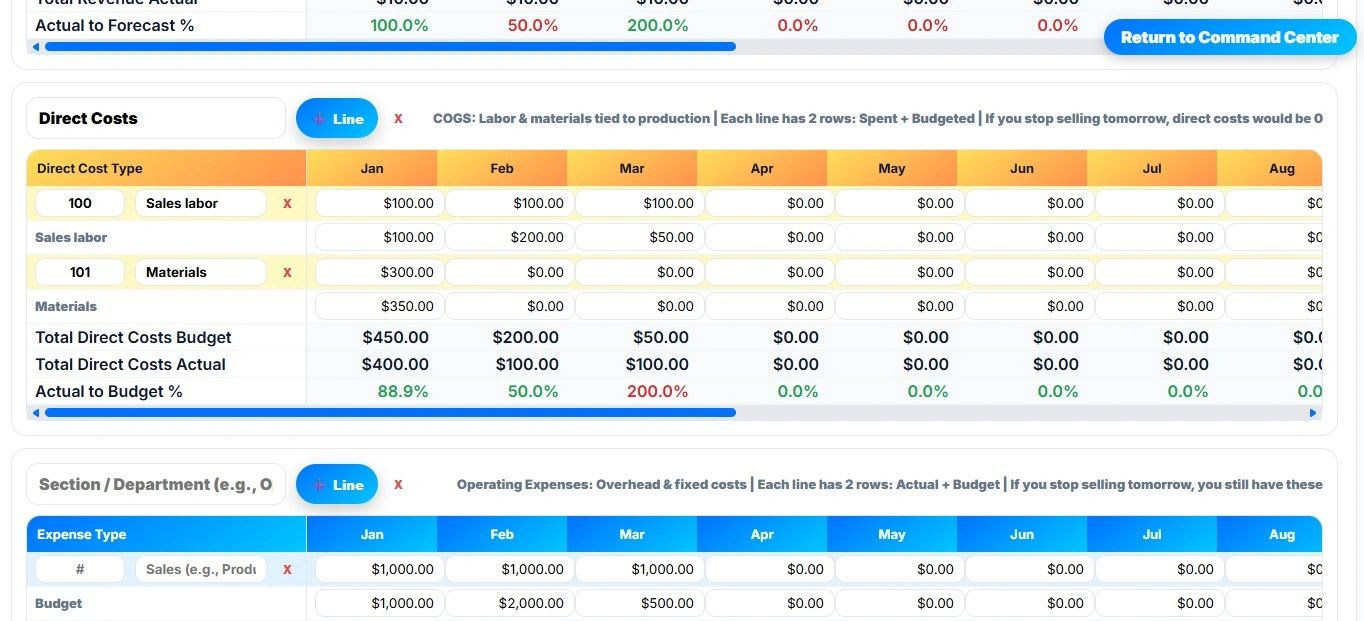
For small businesses just starting out, a simple spreadsheet with consistent category definitions can work. Label every expense as direct or indirect when you record it, choose an allocation method for indirect costs and apply it consistently, and review the breakdown monthly.
As your business grows, manual tracking creates risk. Expenses get miscategorized, allocations do not get applied, and the picture of true profitability gets blurry. Project-based businesses are especially vulnerable because direct costs need to be tracked at the project level across teams and time periods.
Updoot is built for exactly this kind of operational complexity. When you are managing multiple projects simultaneously, tracking which costs belong to which project and making sure indirect overhead is being allocated correctly requires a system that keeps everything visible in one place. Updoot connects project tracking, time tracking, and team accountability so that the data you need to understand your true cost structure is always current and always accessible. Whether you are a small team managing your first few projects or a growing business with complex multi-project operations, having that visibility is what separates businesses that understand their margins from those that are always surprised by their numbers.
Key Takeaways
Direct costs can be traced directly to a specific product, service, project, or department. Indirect costs support the business as a whole and cannot be traced to a single cost object.
Direct costs are most often variable and include raw materials, direct labor, and production supplies. Indirect costs are often fixed and include rent, utilities, administrative salaries, and insurance.
The same type of expense can be direct in one context and indirect in another depending on whether it can be traced to a specific cost object.
Accurate cost classification is essential for pricing products correctly, filing taxes accurately, applying for grants and contracts, and understanding true business profitability.
Indirect costs must be allocated to cost objects using a consistent method such as direct labor hours, machine hours, or total direct costs.
The most common mistakes are treating all labor as direct, ignoring indirect costs when pricing, and inconsistent classification over time.
Frequently Asked Questions
What is the simplest way to tell if a cost is direct or indirect?Ask whether the expense can be tied to a specific product, service, project, or customer. If yes, it is a direct cost. If it supports the business overall without being traceable to one specific thing, it is an indirect cost.
Are indirect costs the same as fixed costs?No. These are separate classifications. A fixed cost does not change with production volume. An indirect cost cannot be traced to a specific cost object. Many indirect costs are fixed, like rent, but some are variable. And some direct costs are fixed, like a dedicated machine's depreciation. The two frameworks overlap but they are not the same.
Can the same expense be both direct and indirect?Not for the same cost object at the same time, but the classification can vary by context. Electricity that powers a dedicated production line might be direct. Electricity for shared office space is indirect. Classification depends on whether the expense can be traced to a specific thing.
Why do indirect costs matter for pricing?Because indirect costs are real costs of doing business. If you only include direct costs in your pricing, your price may cover what it costs to make the product but not what it costs to run the business. Over time, that gap shows up as losses even when it looked like every sale was profitable.
What is cost allocation and why does it matter?Cost allocation is the process of distributing indirect costs across products, projects, or departments using a consistent method. It matters because indirect costs are real and need to be covered by revenue. Without allocation, you cannot accurately understand the true cost of any individual product or project.
Do small businesses need to track both types of costs?Yes. Even a one-person service business has both direct costs, the time and materials that go into a specific client engagement, and indirect costs, the software, insurance, and administrative overhead that keep the business running. Understanding both is what makes it possible to price services profitably and plan for growth.
Managing project costs, tracking team time, and keeping your operations organized across multiple workstreams? Updoot gives you one connected system to track what is happening, who owns what, and where your time and resources are actually going. Learn more at updoot.com.
Related articles on Finance
Owners Draw: What It Is, How It Works
Revenue vs Sales: What Is the Difference
How to Lower Customer Acquisition Costs for Small Businesses
Annual Budget Template Google Sheets
What is a P&L Statement and How to Create One