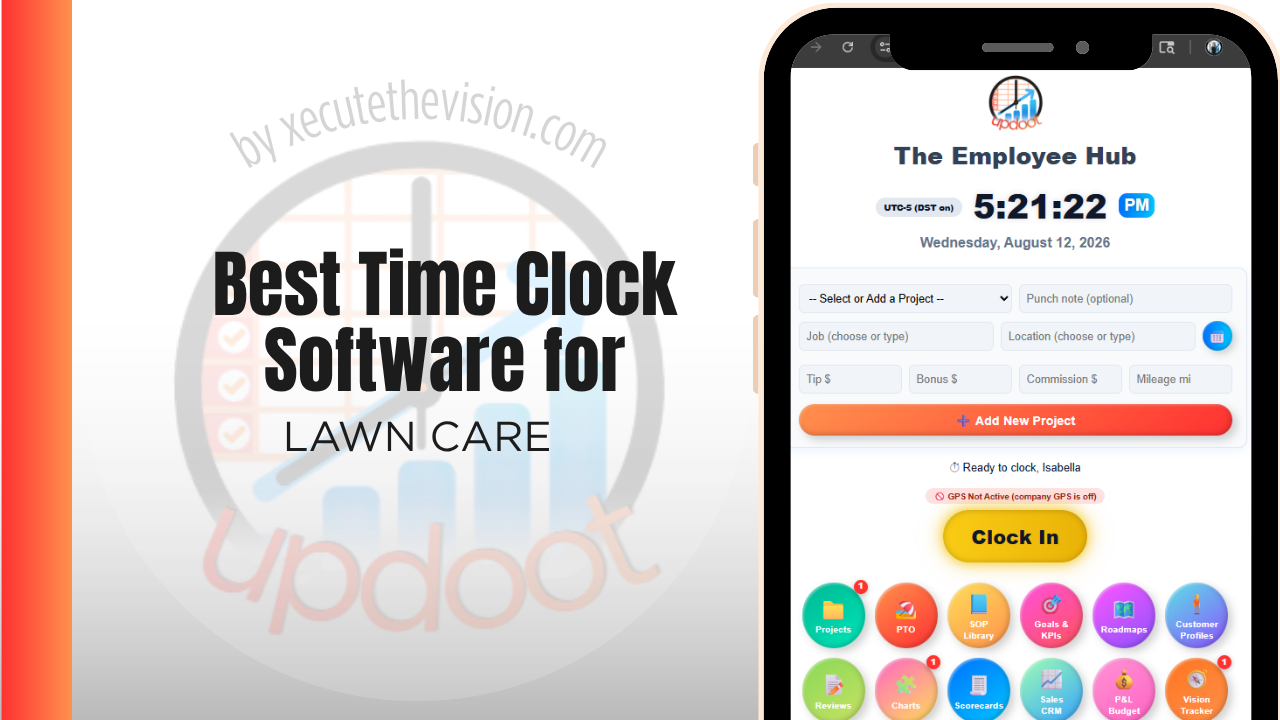
Best Time Clock Software for Lawn Care
Use the free calculator below to see what timesheet rounding actually costs your lawn care business. Lawn care crews run a route of properties in a single shift, often ten or more stops a day, and payroll accuracy depends on knowing how long a crew actually spent at each property, not just a total for the day. Below is a free generator that estimates what rounding and missed punches cost across a year of route-based staffing, plus how the leading tools compare.
Free Crew Hour Loss Calculator
What Are Rounded Crew Hours Costing You Per Season?
Enter your crew size and average wage. Leave a field at 0 if it doesn't apply to your operation.
What Lawn Care Businesses Actually Need from Time Clock Software
A lawn care business needs GPS-verified clock-in and out at each property on the route, since that data is what confirms a job was actually completed and how long it took, which matters for both payroll and for pricing future jobs of similar size accurately.
Per-property or per-route labor cost also matters. Every stop needs to roll up under a specific client or route, so an owner can see which types of properties or which crews are actually efficient, instead of one lump total for the week.
The third requirement is handling crews rather than individuals. Lawn care work is done in twos and threes, and a system that requires each crew member to punch separately on their own phone will be worked around within a week. Crew-level clock-in with individual attribution is the pattern that actually survives contact with a ten-property day.
The fourth is surviving the season. A platform that fits a five-person winter crew has to absorb a twelve-person summer without repricing the whole subscription, and it has to let you deactivate those seats when the season ends.
Recurring Route Clients vs. One-Off Jobs
Recurring weekly or bi-weekly mowing clients follow a predictable route, while one-off jobs like cleanups, mulching, or landscaping installs are booked individually. A system that only handles the fixed recurring route well makes it harder to slot in one-off jobs without disrupting the day's schedule.
Common Time Tracking Mistakes in Lawn Care
The most common mistake is tracking total hours for the day instead of time spent at each property, which makes it impossible to know which properties or job types are actually profitable against what was quoted.
The second is not verifying arrival and departure at each stop, relying on a crew lead's memory of the route, which becomes unreliable once a route grows past a handful of properties.
The third is not tracking drive time between properties separately, which either gets absorbed as unpaid time creating wage claims, or inflates the apparent time spent on individual jobs.
Route Density and the Real Cost of Drive Time
The profitability of a lawn care business is decided less by mowing speed than by how tightly the route is packed. A crew that spends four hours mowing and two and a half hours driving is running at a very different cost per property than one spending five hours mowing and ninety minutes driving, and on a weekly route sheet those two days look nearly identical.
Time clock software makes that difference visible in two ways. Clocking in and out per property produces an actual on-site time per stop, which is the number to compare against the price you charge. The gaps between those stops are drive time, and once you can see them totalled by route, decisions that were guesswork become arithmetic: whether an outlying property is worth keeping, whether a route should be resequenced, and whether that one client forty minutes out needs a premium or needs to go.
Most operations discover the same thing when they first look: one or two stops on each route are absorbing an outsized share of drive time, and the properties themselves are priced as though they sat in the middle of the cluster. Repricing or dropping those stops is usually the fastest margin improvement available to a lawn care business, and it requires nothing but accurate per-stop hours.
Seasonal Crews, Turnover, and Getting People Clocked In on Day One
Lawn care runs on seasonal labor, and high turnover changes what "easy to use" means. A platform that takes twenty minutes of training per person is fine for an office of six and expensive for a business that onboards fifteen people every spring and replaces a third of them by August.
The practical test is whether a new crew member can be added, shown the app once, and be clocking in correctly on their first property without supervision. Look for clock-in that works without an account setup ritual, a kiosk or crew-lead mode where one person punches the whole crew in, and a language option if your crews need one, since a mistranslated punch is a payroll dispute.
Deactivation matters just as much as onboarding. Ask what happens to a seat when a seasonal employee leaves in October: whether you keep paying for it, whether their historical hours stay accessible for payroll records, and how quickly a returning employee can be reactivated next spring without losing their history. Businesses that skip this question end up paying through the winter for a crew that is not working.
How to Test a Time Clock During One Route Week
- Run one full route, not one day. A single day hides the pattern. A week shows you which properties consistently run long.
- Pick your busiest crew, not your most cooperative one. If the system survives the crew that does eleven stops, it will survive the rest.
- Test clock-in with no signal. Rural properties and dead zones are normal in this work. Put a phone in airplane mode at a stop and confirm the punch survives.
- Compare recorded on-site time against the price of three properties. This is the whole point of the trial. If any stop is underwater, you have already recovered the subscription.
- Check what a crew lead can and cannot edit. Someone has to be able to fix a missed punch, but you want an audit trail showing who changed what.
- Confirm the payroll export matches your pay period. Weekly, biweekly, and semi-monthly are not interchangeable, and reformatting an export by hand every period defeats the purpose.
How We Evaluated These Tools
Where we stand, up front: Updoot publishes this site and is one of the tools compared below. Every price and feature claim here, ours included, was checked against the vendor's live pricing page or verified third-party sources in August 2026, and where another tool is the better answer for a given crew size we say so.
For lawn care businesses specifically, we weighted five things: GPS-verified clock-in and out at each property, ease of tracking a multi-stop route in one shift, per-property or per-client labor cost reporting against quoted time, support for both recurring routes and one-off jobs, and pricing that scales sensibly as crews and routes grow.
How the Top Time Clock Tools Compare for Lawn Care
| Tool | Starting Price | Best For | Where It's Limited |
|---|---|---|---|
| Updoot ⭐ Best Overall | $5/user/month | Lawn care businesses wanting every stop tied to a client account with budgeting and invoicing on the same platform | No dedicated route optimization or mapping module |
| ClockShark | From ~$20/mo base + ~$6-8/user/mo | Crews wanting strong GPS tracking and job costing built specifically for field service | Cost climbs quickly as crew size grows; invoicing is a separate add-on |
| Buddy Punch | From ~$4.49-5.49/user/mo plus a ~$19/mo base fee | Businesses wanting job codes, GPS tracking, and overtime alerts with a straightforward setup | No native job-level budget tracking or client billback |
| busybusy | Free (basic); paid plans from ~$8-12/user/mo | Businesses wanting equipment tracking alongside GPS time tracking | Reporting and invoicing are less developed than all-in-one alternatives |
Editor's Pick
Why Updoot Tops This List for Lawn Care
ClockShark handles GPS and job costing well but the per-user cost adds up fast and invoicing is a separate step. Buddy Punch covers job codes but has no real budget tracking. busybusy is strong on equipment tracking but lighter on reporting. Updoot ties every stop to a client account with budgeting and invoicing built on the same time data, at a flat $5 per user per month regardless of crew size or route length.
The right pick depends on how seasonal you are: a small year-round crew fits a leaner free tier comfortably, while an operation that doubles for the growing season needs pricing and reporting that absorb that swing without penalty.
How Updoot Handles Per-Property Job Costing
In Updoot, every punch is logged against a project, which represents a specific property or client, and a customer record for the client. Labor cost rolls up automatically under the right property as hours are logged, so an owner can see which properties and job types are profitable without waiting for the month to close.
Each client account carries its own budget, based on the time originally quoted, so overruns are visible in real time instead of discovered after the invoice goes out. When it's time to bill, invoicing pulls directly from logged hours, all included at $5 per user per month.
Rolling Out a New Time Clock to a Lawn Care Crew
Start with one crew and one route as a pilot for a week before rolling out to the full team, so any client-code setup issues surface early. Make sure every active client on the route has a code in the system before go-live, since a missing client code is the most common reason a crew reverts to guessing at the end of the day. Keep the app simple enough that a crew member can switch clients in a few taps between stops.
Rain Days, Partial Routes, and Rescheduled Stops
Weather is a structural feature of lawn care scheduling, not an exception, and it complicates timekeeping in a specific way. A crew that gets rained off after four stops has completed part of a route, and those four properties still need accurate on-site times while the remaining stops move to another day.
Two things to check. First, whether a partially completed route can be closed out cleanly without the unvisited properties recording zero-minute visits that pollute your per-property averages. Second, how paid standby time is handled when a crew is sent home or waits out a storm, because that time is real payroll cost that belongs somewhere other than a property's job cost.
The reporting consequence matters more than it sounds. If rain-day standby gets absorbed into property-level costs, your worst-weather months make every route look unprofitable, and you cannot separate a genuinely underpriced contract from a bad April. Coding standby separately keeps the per-property numbers comparable across the season, which is the only way route pricing decisions hold up.
Pricing and ROI for Lawn Care
Pricing here comes in two shapes: a flat monthly fee for a set number of users, or a per-user rate that scales with headcount. Flat plans suit a steady team and punish a seasonal one, since a crew that doubles for the growing season pushes you into a higher tier you keep paying for in January. Per-user pricing is easier to forecast, but check whether GPS, property or job codes, and reporting are bundled or billed separately, and ask specifically what happens to seasonal staff you deactivate over winter.
The return for a lawn care business concentrates in route profitability. Rounding losses stop, the office stops rebuilding timesheets from text messages, and per-property labor data finally shows which contracts are underpriced, which is usually worth more than the subscription several times over. Most operations cover a paid plan within the first pay period of the season.
Signs You've Outgrown Manual Timesheets
In lawn care the warning signs are seasonal and obvious once you look: payroll runs longer every week through the summer peak, a crew lead disputes hours on a property nobody can verify, and nobody can say which routes are actually profitable because mow time and drive time are one undifferentiated number. When the only record of a stop is a crew member's memory at the end of a ten-property day, paper has stopped scaling.
Related Reading
Best Time Clock Software for Landscaping →
Best Time Tracking Software for Field Service →
How to Choose the Best Time Clock with GPS Tracking →
Frequently Asked Questions
The best option is whichever one GPS-verifies arrival and departure at each property on a route and ties every stop to the specific client account, since per-property labor cost is what determines whether a route is actually profitable against what was quoted.
Most do, once a crew is running a route of more than a few properties a day. GPS punches confirm how long a crew was actually at each stop, which supports accurate billing and helps price future jobs of similar size correctly.
Each stop a crew logs is tied to a specific client or property, so the true labor cost of servicing that property becomes visible against the time originally quoted, instead of labor being one undifferentiated total for the day's route.
Yes, in good field service time clock software. A crew member should be able to switch client codes in a few taps between stops, with each segment of the route tracked against the correct property.
Drive time is generally compensable under the FLSA once a workday has started, so it should be tracked, not skipped. Some companies track it against a dedicated "travel" code rather than billing it to either stop.
For a one or two-crew operation, a free tier can cover basic clock-in and GPS. Once per-property cost reporting and invoicing become priorities, most free tiers stop being enough.
More than most owners expect, especially with crews running ten or more stops a day. Minutes of rounding per stop, multiplied across a crew over a year, regularly adds up to thousands of dollars in unbilled or miscounted labor.
Final Takeaway
The best time clock software for lawn care is the one that proves how long a crew was at each property and ties every stop to the client it belongs to. Use the calculator above to see what timesheet rounding is costing your business right now, and if the number surprises you, that's usually the clearest sign it's time for a change.