
Award for Employee of the Month: Ideas, Criteria, and Free Templates

An award for employee of the month is one of the oldest recognition programs in business, and also one of the easiest to get wrong. Done well, it gives managers a regular, structured reason to notice good work and say so out loud. Done poorly, it becomes a popularity contest that goes to the same two or three people every quarter, or a plaque nobody remembers getting. The difference almost never comes down to the prize. It comes down to the criteria behind it, how consistently those criteria are applied, and whether the recognition is visible enough that it actually changes how people feel at work. This guide covers what to award, how to choose criteria that hold up under scrutiny, a free scorecard template for scoring candidates side by side, award ideas beyond the standard plaque, other recognition programs worth running alongside it, common mistakes, and how tracking performance and sharing wins inside Updoot makes the whole thing easier to run fairly.
Quick Answer
A good award for employee of the month pairs a small, meaningful prize, such as a bonus, a gift card, extra PTO, or a reserved perk, with public recognition and criteria that are set in advance and applied consistently. The award itself matters less than whether employees believe the selection was fair and specific. Programs fail when winners are chosen from memory at the end of the month instead of from a documented record, when the same people win repeatedly, or when the reason for the win is never actually explained.
What the Award Should Actually Be
There is no single right prize, but there is a right way to think about it: the award should be tangible enough to feel real and public enough to feel like recognition, not just compensation. Options that consistently work well include:
- A cash bonus or gift card — simple, universally appreciated, and easy to budget for on a recurring basis.
- An extra paid day off — costs the company less in direct dollars than cash but is highly valued by employees.
- A reserved perk for the month — a preferred parking spot, first pick of shift schedule, or a designated "employee of the month" desk or chair.
- A physical award — a trophy, plaque, or certificate, ideally one that travels (a rotating trophy kept at the winner's desk) rather than something that just gets filed away.
- A public shoutout — recognition in a team meeting, a company newsletter, or an internal feed, which should accompany any of the above rather than replace it.
The most effective programs typically combine a small tangible reward with visible public recognition. The tangible piece signals the company backed it up with something real; the public piece is what actually satisfies the psychological need most people have to be seen for good work, which research on workplace recognition consistently points to as the bigger driver of morale than the dollar value of the prize itself.
Criteria That Hold Up
The single biggest reason employee of the month programs lose credibility is vague or inconsistent criteria. If nobody can explain specifically why someone won, the program starts to look political, and employees who were passed over stop caring about it entirely. Strong criteria share a few traits:
- Specific and observable — tied to something that actually happened, not a general vibe of "hard worker."
- Set before the month starts, not decided retroactively to justify a manager's favorite.
- Documented, not remembered — pulled from performance notes, goal tracking, or customer and peer feedback logged throughout the month, not reconstructed from memory on the last day.
- Balanced across roles — a program that only rewards visible, customer-facing wins will systematically overlook people in support roles whose contributions are just as real but less obvious.
Common criteria categories worth drawing from include:
- Meeting or exceeding specific performance goals or KPIs for the month
- Positive, specific feedback from customers or coworkers
- Going out of their way to help a teammate or solve a problem outside their normal scope
- Reliability: attendance, punctuality, and follow-through on commitments
- Living out a specific company value in an identifiable way, rather than value alignment in the abstract
Free Employee of the Month Scorecard Template
Use the interactive scorecard below to score candidates on the same criteria side by side instead of picking from memory. Enter the month, add a row per candidate, score each one on goals met, feedback, and reliability (1–5), add a short note on their specific contribution, and the total calculates automatically. Copy the results to paste into an email, or print a clean copy for your records.
🏆 Employee of the Month Scorecard
Score every candidate on the same criteria so the decision is documented, not remembered.
Other Award and Recognition Systems Worth Running
A single monthly award is a fine anchor, but it should rarely be the only recognition system a company runs, since it can only reward one person at a time and only once a month. Consider layering in some of these alongside it:
Peer-Nominated Recognition
Instead of managers deciding alone, let coworkers nominate each other for specific things they noticed. This surfaces contributions managers do not always see and reduces the perception that the award only goes to whoever is most visible to leadership.
Spot Bonuses
A small reward given immediately after a specific win, rather than saved for a monthly announcement, reinforces the behavior while it is still fresh instead of a month later.
Team or Department Awards
Not every win is individual. Recognizing a whole team for hitting a shared goal avoids the trap of always spotlighting the same one or two standout individuals while everyone else who contributed goes unmentioned.
Milestone and Tenure Recognition
Work anniversaries, certifications earned, or hitting a specific tenure milestone are easy, low-cost wins to recognize and give quieter, longer-tenured employees a moment in the spotlight they might not otherwise get from a performance-based award.
A Rotating Spotlight, Not a Competition
Some companies deliberately frame recognition as a rotating spotlight rather than a competitive award, cycling through employees to highlight their role, what they do, and something personal about them. This avoids the "who won and who lost" dynamic entirely while still giving everyone regular, guaranteed visibility over time.
Common Mistakes That Sink These Programs
Choosing From Memory Instead of a Record
When the decision happens at the end of the month based on whatever a manager happens to remember, the program quietly rewards whoever was most memorable or most visible that week, not necessarily whoever actually earned it. A documented record of goals, feedback, and specific contributions throughout the month makes the decision defensible and fair.
Letting the Same People Win Repeatedly
Even if it is genuinely earned every time, a program that keeps recognizing the same one or two people starts to feel closed off to everyone else, and participation and morale drop across the rest of the team.
Never Explaining the "Why"
An announcement that just names a winner without saying specifically what they did teaches the rest of the team nothing about what is actually valued, and makes the award feel arbitrary even when it was not.
Making It Purely About Output
Programs that only reward the highest numbers tend to overlook people who solve problems, mentor others, or keep things running smoothly in ways that do not show up on a scoreboard. A well-rounded program leaves room for both.
Treating It as a One-Time Setup
Criteria and categories that made sense a year ago may not reflect what the company values now. Revisiting the program periodically keeps it relevant instead of running on autopilot.
How Updoot Makes This Easier
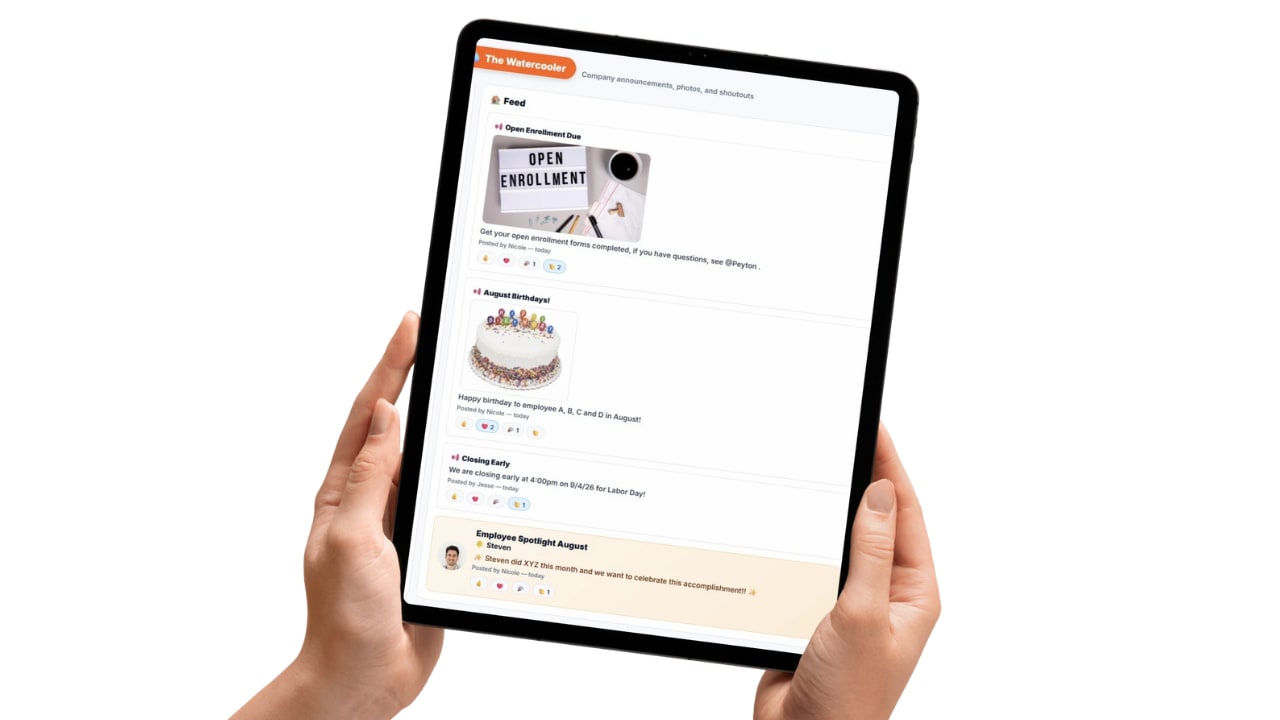
The two biggest weaknesses in most employee of the month programs, choosing from memory instead of a record and never explaining the win publicly, are exactly what Updoot's performance review and Watercooler tools are built to solve together.
- Performance reviews for a documented record. Updoot's performance review tools let managers log goals, notes, and specific feedback continuously throughout the month rather than trying to reconstruct it from memory right before an award decision. When it comes time to choose, there is an actual, specific record to point to, which makes the decision faster, fairer, and much easier to defend if anyone asks why.
- Watercooler for the public spotlight. Once a winner is chosen, Updoot's Watercooler feature is built for exactly the announcement piece that most programs skip or under-deliver on: employee spotlights alongside company announcements, in a shared feed the whole team actually checks. Instead of a one-line mention buried in an email, the win gets a real moment, with the specific reason attached, visible to everyone rather than just the winner's immediate team.
- Both live in the same platform employees already use. Because performance tracking and the recognition feed sit inside the same system as scheduling, time tracking, and payroll, running the award does not require a separate spreadsheet, a separate nomination form, and a separate announcement tool stitched together by hand every month.
For a small business without a dedicated HR team, that combination, a real record behind the decision and a real spotlight after it, is what turns employee of the month from a once-a-month scramble into a recognition system that consistently gets full moves out of what is otherwise a small amount of effort.
Final Thoughts
An award for employee of the month works when the decision is defensible and the recognition is visible, and it fails for the opposite reasons: a vague, memory-based decision and a win nobody hears much about. Pick criteria that are specific and set in advance, choose a prize that feels real without needing to be expensive, pair it with genuine public recognition, and layer in peer nominations, spot bonuses, or team awards so the program is not carrying the entire weight of recognition by itself. Do that, and a program that is easy to dismiss as a cliché becomes one of the simplest, lowest-cost ways to make good work visible.
Related Reading
Company Intranet Examples: What Great Employee Intranets Look Like →
The Complete Guide to Performance Reviews: Types, Topics, Scoring →
Creating a Positive Company Culture: Building the Foundation →
Frequently Asked Questions
The award itself matters less than the criteria behind it. A certificate, a reserved parking spot, a small bonus, an extra PTO day, or a gift card can all work, but only if employees believe the selection was fair and tied to something specific they did. Pairing a physical or monetary award with public recognition, like a shoutout in a team meeting or a company feed, tends to matter more to employees than the prize itself.
Good criteria are specific, observable, and tied to things within the employee's control, such as documented performance metrics, peer or customer feedback, attendance and reliability, and specific contributions like solving a problem or helping a teammate. Criteria should be set and shared before the selection happens, not decided after the fact, to keep the program from feeling arbitrary or political.
It can, but only when it is run well. Programs that reward the same one or two people, rely on manager opinion instead of documented performance, or never explain why someone won tend to backfire and lower morale for everyone who was not picked. Programs with clear, consistent criteria and genuine variety in winners tend to boost morale and reinforce the behaviors a company wants to see more of.
Alternatives include peer-nominated recognition, spot bonuses given in the moment rather than on a monthly cycle, a rotating spotlight that is not framed as a competition, team-level awards for group wins, and milestone recognition for tenure or certifications. Many companies run several of these in parallel instead of relying on a single monthly award.
Fair tracking usually means documenting performance continuously rather than relying on a manager's memory at the end of the month. Software that logs goals, review notes, and specific achievements throughout the month gives whoever makes the decision an actual record to point to, which makes the choice easier to explain and harder to dispute.