
Billing Format for Clients: Download Free Template and Examples
.png)
Download our free billing format for clients template below, it's ready to use for freelancers and small businesses. You know you need it if you’ve ever sent an invoice and then waited… and waited… and followed up… you already understand why your billing format for clients matters.
The format of your invoice is not just a document layout. It’s a communication tool, a compliance tool, and a payment accelerator. A poorly structured billing format creates confusion, disputes, delays, and sometimes lost revenue. A strong billing format increases clarity, builds professionalism, and shortens your payment cycle.
Let’s break down exactly what a billing format for clients should include, how to structure it properly, common mistakes to avoid, and how to optimize your invoices to get paid faster.
What Should You Consider in Your Billing Format for Clients?
A billing format for clients is the structured layout and organization of information in your invoice. It determines:
- How services or products are described
- How pricing is calculated
- What payment terms are communicated
- How totals and taxes are displayed
- How easy it is for clients to approve and pay
It applies whether you are a freelancer, agency, contractor, consultant, SaaS company, or product-based business.
Your billing format should remove friction not create it.
The Core Purpose of a Strong Billing Format
A strong billing format serves five major purposes:
1. Clarity
Clients should instantly understand:
- What they are paying for
- How the total was calculated
- When payment is due
If they need to email you for clarification, you’ve already added friction.
2. Legal and Tax Compliance
Your billing format often becomes part of your financial records. It may need to include:
- Business registration details
- Tax ID or VAT number
- Applicable taxes
- Payment terms
Missing required information can cause accounting issues for your client.
3. Professional Credibility
Your invoice reflects your brand. Clean formatting signals stability and reliability. Sloppy invoices suggest operational chaos
.
4. Faster Payment Cycles
Clear line items and visible due dates reduce back-and-forth communication. That shortens your Days Sales Outstanding (DSO).
5. Dispute Prevention
The clearer the structure, the fewer misunderstandings about scope, hours, rates, or billing period.
Essential Elements of a Proper Billing Format for Clients
Every strong invoice should contain the following components.
1. Header Section
Include:
- Your business name and logo
- Contact details
- Invoice number
- Invoice date
- Due date
Tip: Always include an invoice number. It makes accounting reconciliation far easier for both parties.
2. Client Information
List:
- Client company name
- Billing address
- Contact person
- Purchase order number (if applicable)
If your client uses internal procurement systems, missing a PO number can delay payment significantly.
3. Itemized Breakdown
This is where many billing formats fail.
Each line item should include:
- Description of service/product
- Quantity or hours
- Rate
- Line total
Avoid vague descriptions like:
- “Consulting services”
- “Monthly work”
- “Project tasks”
Instead, use clarity:
- “Marketing strategy consultation – 8 hours @ $125/hr”
- “Website design – Phase 2 milestone”
- “Monthly retainer – February 2026”
The goal is transparency without overwhelming detail.
4. Subtotal, Taxes, Discounts
Clearly separate:
- Subtotal
- Discounts (if applicable)
- Tax rate and amount
- Final total
Never bury taxes inside line items unless required by regulation.
5. Payment Terms
This is critical.
State clearly:
- Net 15 / Net 30 / Net 45
- Late payment penalties
- Accepted payment methods
- Payment instructions
If you accept ACH, wire, credit card, or check, specify it. Ambiguity here causes delays.
6. Notes or Supporting Details
Use this section strategically:
- Thank-you message
- Reminder of contract terms
- Payment link
- Bank details
Keep it professional and minimal.
Types of Billing Formats for Clients
Different business models require different structures.
Hourly Billing Format
Best for consultants and freelancers.
Structure:
- Date
- Hours worked
- Description
- Hourly rate
- Total per line
Pitfall: Not tracking time properly leads to disputes.
Fixed Project Billing Format
Used for milestone-based work.
Structure:
- Milestone name
- Description
- Fixed fee
- Completion confirmation
Pitfall: Not referencing contract milestones creates confusion.
Recurring Retainer Billing Format
Used for agencies and ongoing service providers.
Structure:
- Service period (e.g., March 1–31)
- Monthly fee
- Optional breakdown summary
Pitfall: Forgetting to indicate service period can cause accounting issues.
Product-Based Billing Format
Used for goods and inventory.
Structure:
- SKU
- Product name
- Quantity
- Unit price
- Line total
Pitfall: Missing shipping or tax details.
Common Pitfalls in Billing Formats
Let’s address what goes wrong.
1. Overcomplicated Layout
Too many fonts, tables, or inconsistent spacing reduces readability.
Clean wins.
2. Missing Due Date
If you don’t state when payment is due, clients default to their own terms and it's usually longer.
3. Inconsistent Invoice Numbers
Skipping sequences creates accounting confusion.
4. Vague Descriptions
Ambiguity leads to delayed approvals.
5. No Payment Instructions
Never assume the client knows how to pay you.
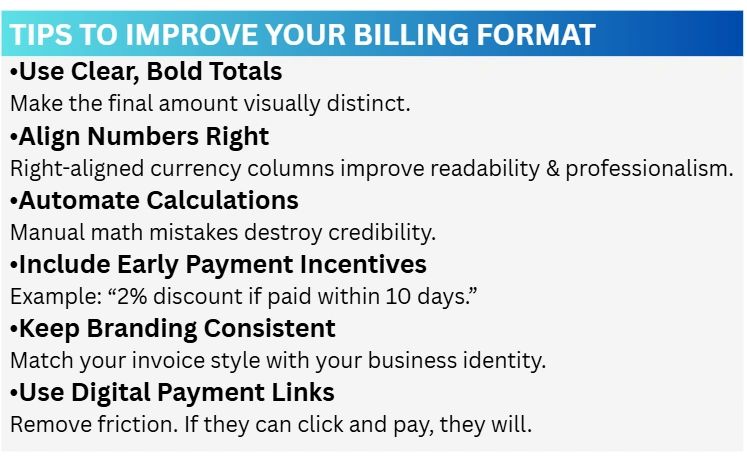
Strategic Insight: Your Invoice Is a Sales Tool
Most people treat invoices as an afterthought.
That’s a mistake.
Your billing format reinforces:
- Your value
- Your structure
- Your operational maturity
A clean invoice tells the client: “This company is organized.”
That matters.
When to Update Your Billing Format
You should review your billing format when:
- You change pricing structure
- You add new services
- You scale your team
- You move from hourly to retainer
- You expand internationally
- You experience repeated payment delays
If clients keep asking the same clarifying questions, your billing format needs improvement.
Why Spreadsheets Eventually Fail
Many businesses start with spreadsheets. That works early.
But as you scale:
- Version control becomes messy
- Manual entry increases errors
- Tax calculations become risky
- Recurring billing becomes tedious
- Client tracking becomes fragmented
At that stage, automation matters.
Billing Format FAQ
Frequently Asked Questions About Billing Formats for Clients
What is a billing format? A billing format is the structure used to present invoices to clients, including details of services and charges.
What should be included in a client invoice? Client information, services provided, hours or rates, total amount, and payment terms.
Why is a clear billing format important? It reduces confusion, speeds up payments, and improves professionalism.
What are common billing formats? Hourly billing, fixed fee, retainer, and milestone-based billing.
How can businesses improve their billing process? Use consistent templates and clear payment terms.
Tie-In: Simplifying Billing with Updoot Invoice Generator
If you’re looking to streamline your billing format for clients, automation is the next logical step.
The Updoot Invoice Generator was built to remove friction from the billing process while keeping invoices clean, professional, and structured.
Here’s what it helps solve:
- Automatic invoice numbering
- Clean, professional formatting
- Tax and subtotal calculations
- Client data management
- Recurring billing
- Export-ready formats
- Faster invoice creation
Instead of manually formatting line items every time, you can standardize your billing structure across all clients.
That means:
- Fewer errors
- Faster billing cycles
- Stronger brand consistency
- Better payment turnaround
When your billing format is consistent and automated, you reduce mental load and increase operational stability.
And that matters as you grow.
Frequently Asked Questions
What is a billing format for clients? A billing format is the structured layout used to present invoices to clients. It determines how services are described, how pricing is calculated, what payment terms are communicated, and how easy it is for clients to approve and pay.
What should every client invoice include? Every invoice should include your business name and contact details, an invoice number and date, the client's company name and billing address, an itemized breakdown of services or products with quantities and rates, subtotal, taxes and discounts clearly separated, payment terms, and accepted payment methods.
Why does a clear billing format matter for getting paid faster? Clear line items and visible due dates reduce back-and-forth communication. When clients have to email you for clarification you have already added friction to the payment process. A well structured invoice removes that friction and shortens your payment cycle.
What are the most common billing formats for different business types? Hourly billing works best for consultants and freelancers. Fixed project billing works for milestone-based work. Recurring retainer billing works for agencies and ongoing service providers. Product-based billing works for goods and inventory with SKUs, quantities, and unit prices.
What are the biggest mistakes businesses make with their billing format? The most common mistakes are vague service descriptions that cause delayed approvals, missing due dates that let clients default to their own terms, no payment instructions, inconsistent invoice numbers that create accounting confusion, and overcomplicated layouts that reduce readability.
When should you update your billing format? Review your billing format when you change your pricing structure, add new services, move from hourly to retainer billing, expand internationally, or when clients are repeatedly asking the same clarifying questions about your invoices.
What is Days Sales Outstanding and how does billing format affect it? Days Sales Outstanding or DSO measures how long it takes to collect payment after an invoice is sent. A clear structured billing format with explicit payment terms and instructions directly reduces DSO by eliminating the confusion and back-and-forth that delays payment.
Final Takeaway
Your billing format for clients is not just a document template.
It’s a system.
When structured properly, it:
- Reduces disputes
- Speeds up payment
- Strengthens professionalism
- Improves cash flow
If you’re serious about running your business like a business, not a side project and your billing format should reflect that.
Clean. Clear. Structured. Consistent.
And ideally, automated.
That’s how you get paid faster.
Opens in Google Drive — view and download for free
Related articles about billing and invoicing
How to Make Your Invoices Look Professional
Project Management Software with Invoicing the Complete Guide