
The Time Clock Rounding Guide with Rules, Free Calculator and Best Practices

What Is Time Clock Rounding?
The definition of time clock rounding is the practice of adjusting an employee's exact clock-in or clock-out time to the nearest set interval, typically 5, 6, or 15 minutes, for payroll calculation. It is one of the most common time tracking practices in the country, and one of the most misunderstood.
The practice has been around for decades. Before digital time tracking, payroll teams had no easy way to calculate scattered minutes across dozens of employees every week. Rounding to clean intervals solved that problem by creating a consistent, repeatable process that everyone could follow.
Time Clock Rounding is Not a Free Pass
The problem is that rounding is not a free pass to simplify your numbers however you like. Under the Fair Labor Standards Act, time clock rounding must be neutral. That means it cannot consistently favor the employer or the employee. Across a pay period, the gains and losses from rounding should balance out so that employees end up fully compensated for the time they actually worked.
In 2026, the stakes around rounding are higher than they have ever been. Modern time tracking systems can capture exact clock-in and clock-out times down to the second. Courts and regulators in several states have begun asking a straightforward question: if you can record the exact time, why are you rounding it? California, Washington, and Oregon have all signaled through recent rulings that rounding is increasingly difficult to defend when precise data is available.
Federal Law on Time Clock Rounding (FLSA)
The Fair Labor Standards Act, along with guidance from the U.S. Department of Labor, allows employers to round time but only under strict conditions. These rules are outlined in federal regulations at 29 CFR section 785.48(b) and are actively enforced.
FLSA Requirement 1: Neutral Application
Rounding must balance out over time. It cannot consistently benefit only the employer or only the employee. If your data shows employees consistently lose minutes, your policy fails the neutrality test regardless of how it is written in your handbook.
FLSA Requirement 2: Maximum 15-Minute Increments
You can round to the nearest 5, 6, or 15 minutes. Anything larger, such as 30-minute rounding, is not allowed under federal law. The three permitted intervals are 5 minutes, 6 minutes (one-tenth of an hour), and 15 minutes.
FLSA Requirement 3: No Denial of Pay for Actual Work
You cannot use rounding to avoid paying employees for time they actually worked. If rounding consistently reduces paid time, it becomes a wage-and-hour violation subject to back pay, penalties, and in some states, additional damages.
Real enforcement example: In cases reviewed by the Department of Labor, courts found that even policies described as neutral on paper produced systematic underpayment because employees tended to clock in slightly early but clock out right at quitting time. When roughly two-thirds of rounding decisions worked against employees, the policy failed the neutrality test regardless of its written description.
Does Your State Have Additional Rules?
Beyond federal law, you need to consider your state's rules. This is where many businesses get caught off guard.
| State | Rounding Stance | Key Risk |
|---|---|---|
| California | Strongly disfavored; exact time preferred | Meal period rounding prohibited; significant litigation risk |
| Oregon | Rounding must clearly protect employees | Recent rulings suggest rounding must favor employee, not just be neutral |
| Washington | Allowed in theory; strict enforcement | Meal and rest breaks must be exact; seven-figure judgments issued |
| Massachusetts | Federal-style rules with enhanced penalties | Non-neutral policies can trigger triple damages plus legal fees |
| New York | 15-minute limit strictly enforced | Frequent lawsuits; anything beyond 15-minute rounding is a clear violation |
| Michigan | Follows federal standards | Leans toward 6-minute rounding to reduce large swings |
Multi-state employers: Your time clock rounding policy needs to hold up in the strictest jurisdiction where you have employees. If your system tracks time down to the minute, some states expect you to use that exact data rather than round it. When in doubt, consult a wage-and-hour attorney.
The 3 Allowed Time Rounding Methods
Quarter-Hour Rounding (15 Minutes)
Quarter-hour rounding is the most widely used method, especially in retail, hospitality, healthcare, and manufacturing. It rounds employee time to the nearest 15 minutes and is the maximum permitted under the FLSA. That also makes it the highest-risk option. A single rounding decision can swing up to 14 minutes, and those differences compound across a workforce over time.
The 7-Minute Rule Explained
The 7-minute rule is the standard compliance method for 15-minute rounding. Each 15-minute block has a midpoint at 7.5 minutes. The rule splits at that midpoint so rounding stays neutral.
- 8:01 to 8:07 rounds down to 8:00
- 8:08 to 8:14 rounds up to 8:15
The same logic applies to clock-out times. This repeats every 15 minutes throughout the day.
7-Minute Rule Clock-In Chart
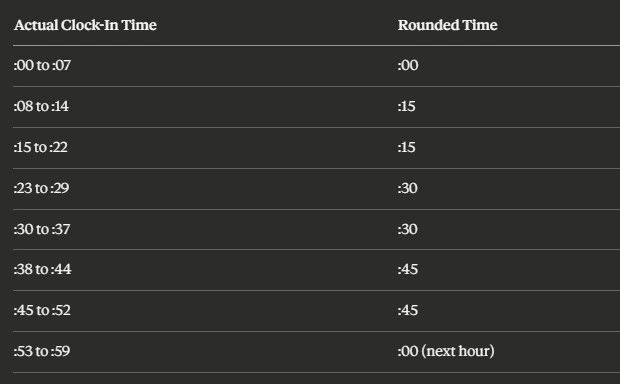
This pattern repeats every hour. Having a clear chart like this reduces confusion and ensures managers do not make judgment calls on the spot.
Tenth-of-an-Hour Rounding (6 Minutes)
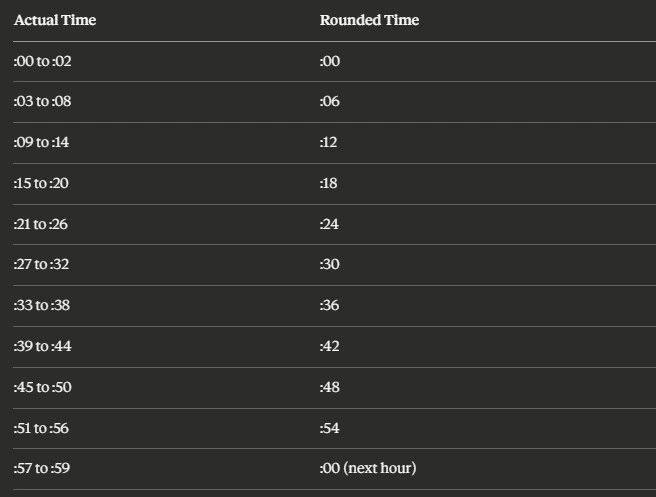
Sixth-minute rounding breaks each hour into ten equal 6-minute blocks. It is most common in accounting, legal services, consulting, and government contracting where time converts cleanly to decimal hours (0.1, 0.2, 0.3). Because each block is only 6 minutes, the maximum rounding difference is just 3 minutes -- a major improvement over 15-minute rounding.
6-Minute Increment Chart
Five-Minute Rounding
Five-minute rounding adjusts time to the nearest 5-minute mark: :00, :05, :10, :15, and so on. It is common in construction, HVAC, field services, and retail with frequent shift changes. The maximum rounding difference is only 2-3 minutes, making it the most controlled and lowest-risk of the three methods.
| Method | Interval | Max Swing | Compliance Risk | Best For |
|---|---|---|---|---|
| 5-minute | 5 min | ~2-3 min | Lowest | Field services, retail |
| 6-minute (tenth) | 6 min | ~3 min | Low | Professional services, billing |
| 15-minute (7-min rule) | 15 min | ~14 min | Highest | Large shift-based operations |
Free Time Clock Rounding Calculator
Enter a clock-in and clock-out time, choose your rounding method, and see the rounded times and total hours instantly.
How Rounding Affects Payroll Calculations
Time clock rounding directly affects how you calculate payroll. Most payroll platforms do not calculate in raw minutes -- they use decimal hours. So 8 hours and 15 minutes becomes 8.25, and 8 hours and 30 minutes becomes 8.50. That is why rounding intervals matter: they need to align with how payroll systems read and process time.
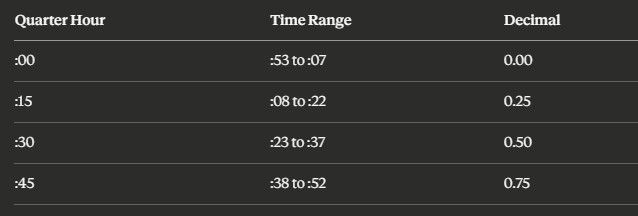
Most payroll errors do not come from the rounding system itself. They happen during the manual handoff -- when rounded time gets re-entered into payroll. If rounding is not applied consistently from start to finish, your payroll numbers will not match your time records. Even small differences of a few minutes per shift across multiple employees result in underpayments or overpayments by the end of the pay period.
Time Clock Rounding Policy Requirements
One of the fastest ways to raise a red flag in an audit is not having a clear, written policy. A strong written policy must include:
- The specific rounding method used (5, 6, or 15 minutes)
- How the rule is applied at clock-in and clock-out with examples
- A clear neutrality statement explaining that rounding is applied automatically without manager discretion
- Where employees can find the policy (employee handbook and onboarding materials)
- Confirmation that the policy matches exactly how the time tracking system is configured
2026 consideration: If your time tracking system captures exact clock-in and clock-out times down to the minute, courts in several states are increasingly skeptical that rounding is necessary. Switching to exact-time payroll calculation eliminates compliance risk entirely and improves employee trust.
How to Audit Your Rounding Policy
Documenting a neutral rounding policy is not the same as proving it is neutral. The Department of Labor and state agencies look at actual data, not just written policies. If you use time clock rounding, audit your data at least quarterly:
- Pull time records and compare rounded time to actual punch times
- Calculate whether employees are gaining or losing time on net across the whole pay period
- Look for patterns by department, shift, or manager -- a policy neutral company-wide can still harm employees in specific locations
- If you find a problem during an internal audit, address it immediately -- adjusting your system is far less expensive than defending a wage-and-hour class action