
How to Hire for Cultural Fit and a Free Hiring Tracker
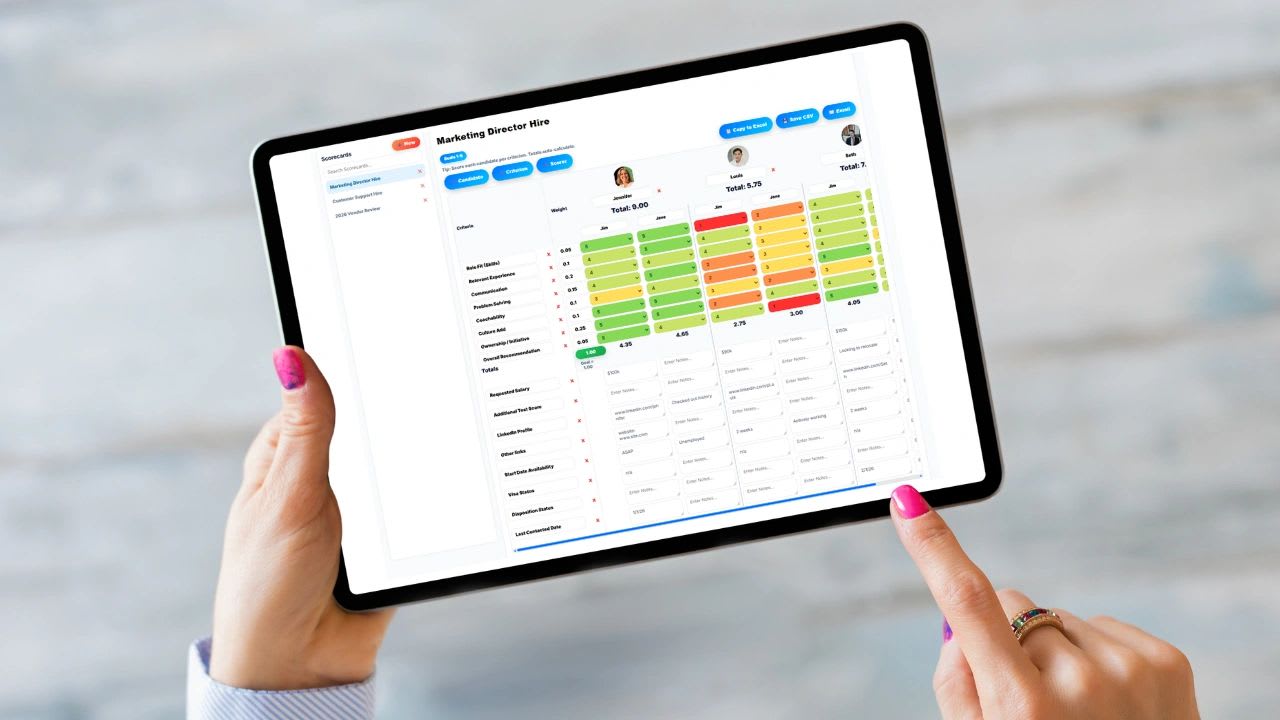
How to hire for cultural fit comes down to three things: define your culture as specific, observable behaviors; test for those behaviors with the same structured questions and work samples for every candidate; and score each person against a written rubric instead of a gut feeling. Done that way, cultural fit predicts who will thrive on your team without turning into "people like us." This guide walks through the full process, the risks to manage, and a free hiring tracker that scores and ranks candidates.
Hiring for skill gets you employees. Hiring for fit and skill together gets you a team. Most hiring processes focus on resumes, experience, and technical ability, which is only half the picture. People rarely fail because they lack skill. They fail because they do not work the way the team works.
What Is Cultural Fit?
Cultural fit is how well a candidate's work style, communication habits, and behaviors match the way your company actually operates. It is not about personality, background, or whether you would enjoy having lunch with them. It is about whether they will do well inside your system. For example:
- A fast-moving startup needs people who act without waiting for complete information.
- A process-heavy company needs people who follow procedures precisely.
- A remote team needs people who communicate proactively in writing.
When there is a mismatch, performance drops even when the skills are strong.
Cultural Fit vs. Culture Add
Hiring for fit does not mean hiring people who think, look, or talk the same. That weakens teams and creates legal risk. The better frame is to look for both:
| Cultural Fit | Culture Add | |
|---|---|---|
| Question it answers | Will this person work well within how we operate? | What will this person bring that we are missing? |
| Focus | Shared working behaviors, such as ownership and communication | New perspectives, skills, and experience |
| Risk if overused | A team of similar people with blind spots | Friction if core working norms do not match |
The tracker below scores both, so neither one crowds out the other.
Why Hiring for Cultural Fit Matters
You can train skills. Behavior is much harder to change. When fit is ignored, you see turnover, team conflict, weak accountability, poor communication, and slower execution. When it is done well, you see faster onboarding, better collaboration, stronger performance, and people who stay.
How to Hire for Cultural Fit in 8 Steps
Step 1: Define Your Culture as Behaviors
You cannot hire for something you cannot describe. "We value teamwork" means nothing in an interview. Translate each value into a behavior you could observe:
| Vague Value | Observable Behavior |
|---|---|
| Teamwork | Gives proactive status updates so nobody is surprised |
| Ownership | Fixes problems they find, even outside their job description |
| Speed | Ships a good first version and improves it, rather than waiting for perfect |
| Transparency | Raises bad news early and brings a proposed solution |
Step 2: Study Your Top Performers
Look at the people who succeed on your team. How do they communicate? How do they manage their work? How do they handle problems? Those patterns define your real culture, which may differ from what is written on your website.
Step 3: Write Behavioral Interview Questions
Ask about what candidates have actually done, not what they would do. Past behavior is the best predictor of future behavior. Use the same questions for every candidate for the same role.
| Behavior | Question | Strong Answer Shows |
|---|---|---|
| Ownership | Tell me about a time you found a problem nobody asked you to fix. | Took action, followed through, shared credit |
| Communication | How do you keep your team updated on your progress? | A specific routine, not "I just tell them" |
| Accountability | Describe a time something went wrong on your watch. What did you do next? | Owned the mistake, fixed it, changed the process |
| Adaptability | Tell me about a time priorities changed suddenly. | Re-planned calmly and communicated the change |
| Independence | Describe a time you had to manage several priorities without direction. | Clear method for deciding what matters most |
Step 4: Evaluate Communication Style
Pay attention to clarity, structure, and responsiveness throughout the process, including emails and scheduling. How someone communicates while trying to get hired is usually the best it will ever be.
Step 5: Use a Real Work Sample
Give finalists a short, realistic task or scenario. Watch how they approach it, what questions they ask, and how they explain their thinking. A work sample shows working style far more reliably than conversation. Keep it short and relevant, and do not use unpaid tasks to get real work done.
Step 6: Score Candidates Against a Rubric
Decide in advance what a 1, 3, and 5 look like for each behavior, then have every interviewer score independently before discussing. Independent scoring prevents the loudest opinion from winning. See the hiring scorecard guide for rubric examples.
Step 7: Involve the Team
Have candidates spend time with the people they would work with. Team members notice collaboration and communication dynamics that managers miss. Give them the same rubric so their input is structured.
Step 8: Watch for Red Flags
- Blaming others for every past failure
- No examples of taking ownership
- Vague answers that avoid specifics
- Needing detailed direction for routine work
- Disrespect toward schedulers, assistants, or junior staff
Free Cultural Fit Hiring Tracker
Free Cultural Fit Hiring Tracker
Score each candidate from 1 to 5 on the same behaviors after every interview. The tracker averages the scores, applies a penalty for red flags, and ranks your candidates so decisions rest on evidence instead of gut feeling.
| Rank | Candidate | Role | Stage | Comm. | Acct. | Prob. | Style | Add | Team | Flags | Score |
|---|
Each red flag subtracts half a point from the average, so a candidate with strong scores and a serious concern does not automatically rise to the top. Copy the tracker to Excel to keep it with your hiring records.
Sample Scoring Rubric
Agree on what each score means before interviews start, so every interviewer uses the same scale:
| Behavior | 1 (Concern) | 3 (Meets) | 5 (Strong) |
|---|---|---|---|
| Communication | Vague, hard to follow, slow to respond | Clear answers, responds on time | Structured, concise, anticipates questions |
| Accountability | Blames others for outcomes | Owns their own mistakes | Owns outcomes and fixes the underlying process |
| Problem-solving | Waits for direction | Solves routine problems independently | Solves new problems and shares the solution |
| Work style fit | Pace or structure clearly mismatched | Comfortable with how the team works | Thrives in and strengthens how the team works |
| Culture add | Brings nothing new to the team | Adds a useful skill or perspective | Fills a clear gap the team has been missing |
Write a one-line reason for every score of 1 or 5. That note is what makes the decision explainable later.
Avoiding Bias When Hiring for Fit
Cultural fit is the most common place for bias to slip into hiring. "Not a culture fit" can become a cover for "not like us," which hurts diversity and can create legal exposure. The U.S. Equal Employment Opportunity Commission explains the employment practices federal law prohibits. To keep fit focused on work behavior:
- Require a specific, job-related reason whenever someone says "not a fit."
- Use the same questions, work sample, and rubric for every candidate.
- Score independently before any group discussion.
- Use diverse interview panels.
- Score culture add alongside fit.
Reinforce Fit After the Hire
Hiring for fit does not end with the offer. The behaviors you screened for need to be reinforced in the first 90 days, or the new hire will adapt to whatever habits they see around them. Share the behavior definitions from Step 1 on day one, pair the new hire with a teammate who models them, and give specific feedback in weekly check-ins. At day 90, compare how the person is actually working with their interview scores. Over time, that comparison shows which interview questions predict success on your team and which ones should be replaced.
The Honest Drawbacks
- Bias risk. Done poorly, it produces a team of similar people.
- Harder to measure. Behaviors are harder to evaluate than technical skills.
- Slower hiring. Work samples and team interviews add steps.
- Requires discipline. The culture must be defined and applied consistently.
Common Mistakes to Avoid
- Hiring on likeability. Liking someone is not the same as alignment.
- Leaving culture undefined. Vague culture leads to inconsistent hiring.
- Unstructured interviews. Without consistent questions, you cannot compare candidates.
- Ignoring red flags. Small concerns in interviews become big problems later.
- Stopping at the offer. Fit is reinforced through onboarding. Use a new hire orientation checklist to set expectations early.
Where Updoot Fits
Once someone is hired, Updoot keeps the behaviors you hired for visible: SOPs set expectations, time tracking and projects show how work gets done, and performance reviews and surveys measure how people are doing. Plans start at $5 per user per month.
Final Thoughts
Hiring for cultural fit is not about hiring people you like. It is about hiring people who communicate well, take ownership, and work the way your team works, while bringing something new. Define the behaviors, test them the same way for everyone, score against a rubric, and track the results.
Sources: U.S. EEOC, Prohibited Employment Policies and Practices.
Opens in Google Drive. View and download for free.
Frequently Asked Questions About Hiring for Cultural Fit
What does hiring for cultural fit mean?
It means evaluating whether a candidate's work style, communication habits, and behaviors match how your company actually operates, such as how decisions are made and how people share updates.
How do you assess cultural fit in an interview?
Define your culture as observable behaviors, ask the same behavioral questions to every candidate, use a short work sample, involve the team, and score each behavior against a written rubric.
What is the difference between culture fit and culture add?
Culture fit asks whether someone will work well within how you operate. Culture add asks what new perspectives or strengths they bring. Strong hiring looks for both.
Can hiring for cultural fit lead to bias?
Yes, if fit is based on personality or similarity. Keep it tied to job-related behaviors, use structured interviews and independent scoring, and require a specific reason whenever someone says a candidate is not a fit.
What are red flags for poor cultural fit?
Common red flags include blaming others, no examples of ownership, vague answers, needing heavy direction for routine work, and treating support staff poorly.
What should a cultural fit hiring tracker include?
Include the candidate, role, stage, scores for communication, accountability, problem-solving, work style fit, culture add, and team feedback, plus red flags and a total score.