Hiring Assessment Tools: Types, How to Choose, and Pitfalls
Hiring assessment tools are structured methods for evaluating candidates beyond a resume and a gut-feeling interview. Skills tests, personality assessments, cognitive ability tests, work sample exercises, and structured interview scorecards all exist to answer the same question in different ways: is this person actually going to be good at this specific job? This guide covers the main types of hiring assessments, how to choose the right combination for your roles, how to build a fair and consistent process, the legal and practical pitfalls that trip up most companies, and a candidate scorecard calculator you can use right now.
Quick Answer
Most effective hiring processes combine two to three assessment types, typically a job-related skills test, a structured interview scorecard, and sometimes a personality or work style assessment. More than that tends to increase candidate drop-off without meaningfully improving hiring accuracy, and assessments that aren't clearly job-related can create legal risk.
What Are Hiring Assessment Tools?
A hiring assessment is any structured method used to evaluate a candidate's fit for a role beyond an unstructured conversation. The goal is consistency: comparing every candidate against the same criteria instead of relying on whichever interviewer happened to like them best.
Unstructured interviews, where each interviewer asks whatever comes to mind, are one of the weakest predictors of job performance despite being the most common hiring method. Structured assessments exist specifically to fix that gap.
6 Types of Hiring Assessment Tools
Skills and Job Knowledge Tests
These directly measure whether a candidate can do the actual tasks the role requires. A coding challenge for a developer, a writing sample for a content role, or a spreadsheet exercise for an analyst position all fall into this category. Skills tests are consistently among the strongest predictors of job performance because they measure the work itself rather than a proxy for it.
Work Sample Tests
A work sample test asks a candidate to complete a small, realistic piece of the actual job, like drafting a sample email campaign or resolving a mock customer complaint. These tend to predict performance even better than general skills tests because they mirror the day-to-day work directly.
Cognitive Ability Tests
These measure general problem-solving, reasoning, and learning ability rather than job-specific knowledge. They're strong predictors across almost every role, but they also carry the highest risk of adverse impact on protected groups if not validated carefully, so they need to be used and interpreted cautiously.
Personality and Work Style Assessments
These evaluate traits like conscientiousness, teamwork style, or communication preferences. They're best used to inform team fit conversations, not as a pass or fail gate, since personality assessments are weaker standalone predictors of performance than skills-based methods.
Structured Interview Scorecards
A structured interview uses the same predetermined questions and a consistent scoring rubric for every candidate. This single change, structure, is what turns an interview from one of the weakest predictors of performance into one of the stronger ones.
Reference and Background Checks
These verify claims made elsewhere in the process rather than predicting new information, but they catch red flags that other assessments miss, particularly around past conduct and employment history accuracy.
How to Choose the Right Assessments for a Role
Simple vs. Comprehensive Assessment Stacks
| Hiring Volume | Recommended Stack |
|---|---|
| Low volume, few hires per year | Structured interview scorecard + one skills test |
| Moderate volume, ongoing hiring | Skills test + work sample + structured interview |
| High volume, many similar roles | Skills test + structured interview + cognitive or work style assessment, standardized across all candidates |
Match the assessment to what actually predicts success in the specific role. A sales role benefits more from a role-play work sample than a coding test. An engineering role benefits more from a technical skills test than a personality assessment. Start with the assessment that most directly mirrors the real job, then add a structured interview on top of it.
How to Build a Fair Hiring Assessment Process in 5 Steps
1. Define What Success Looks Like in the Role First
Before choosing any assessment, write down the three to five things someone actually needs to do well to succeed in this specific job. Every assessment you choose should map directly back to one of those things.
2. Choose Assessments That Are Job-Related
Pick assessments that measure skills genuinely required for the role, not generic tests applied the same way to every position in the company. A job-related assessment is both more predictive and more legally defensible.
3. Apply the Same Process to Every Candidate
Consistency is what makes an assessment process both fair and legally sound. If one candidate skips the skills test because a hiring manager liked them in the phone screen, the whole process loses its value and its defensibility.
4. Use a Weighted Scorecard, Not Gut Feeling
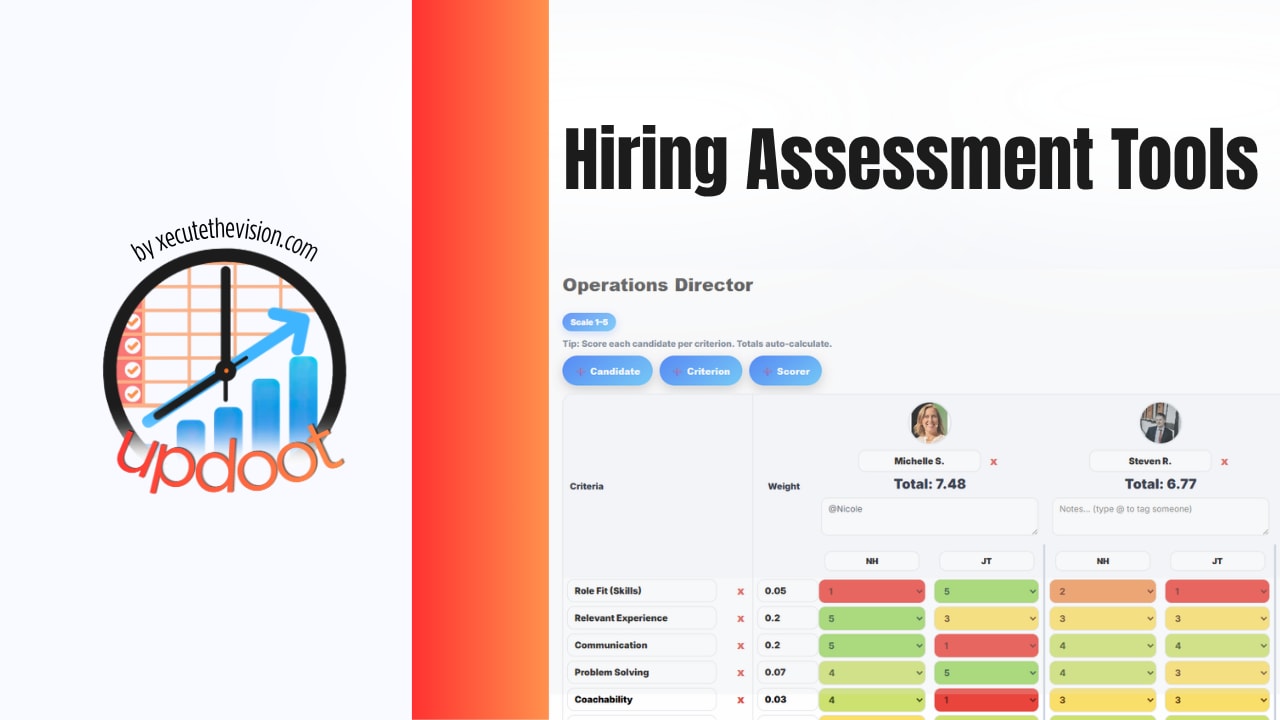
Assign a weight to each assessment based on how strongly it predicts success in the role, then score every candidate against the same rubric. This turns a pile of subjective impressions into a comparable, defensible decision.
5. Review and Validate the Process Periodically
Check whether the candidates who scored well in your assessments are actually performing well on the job six to twelve months later. If there's no correlation, the assessment isn't doing its job and needs to be adjusted or replaced.
Try the Candidate Scorecard Calculator
Weight each evaluation area based on how much it should influence the final decision, then score a candidate to see their weighted composite score.
Weighted Candidate Scorecard
Enter a score from 0 to 100 for each area. Adjust the weights to match what matters most for this role.
Common Hiring Assessment Pitfalls to Avoid
Using Assessments That Aren't Job-Related
A generic personality test applied to every role in the company regardless of what the job actually requires adds little predictive value and increases legal exposure under Title VII disparate impact standards enforced by the EEOC.
Stacking Too Many Assessments
Five or six different tests for one role usually just increases candidate drop-off, especially for in-demand candidates who have other options. Two to three well-chosen assessments almost always outperform a longer, exhausting gauntlet.
Letting One Bad Assessment Score Override Everything
A single weak score shouldn't automatically eliminate an otherwise strong candidate unless that specific skill is truly non-negotiable for the role. Weighted scoring across multiple areas produces better decisions than a single pass or fail gate.
Applying the Process Inconsistently
Skipping steps for candidates who come through a personal referral, or grading different candidates against different standards, undermines both the fairness and the legal defensibility of the entire process.
Never Validating Whether the Assessments Actually Work
Many companies pick an assessment once and never check whether it correlates with actual on-the-job performance. Without that feedback loop, there's no way to know if the process is helping or just adding friction.
Are Hiring Assessments Worth the Time They Add?
Every assessment you add to a hiring process adds friction. A skills test takes a candidate 30 to 60 minutes. A work sample exercise can take longer. Strong candidates with multiple offers on the table sometimes drop out of processes that feel too long or too repetitive, and that's a real cost worth weighing against what the assessment actually catches.
The way to answer this honestly is to track two things over time: how many strong candidates you lose to process length, and how much better your hiring outcomes get because of the assessments you added. If a work sample test consistently identifies people who go on to perform well and screens out people who would have been costly mis-hires, it's earning its place even if it adds a week to the process. If a personality assessment has never once changed a hiring decision, it's probably not worth the friction it adds.
Most companies never actually run this comparison. They add assessments based on what a competitor does or what a vendor recommends, and never check whether it's improving decisions six months later. That single habit, checking outcomes against the assessments used to predict them, is what separates a hiring process that gets better every year from one that just gets more complicated.
How Updoot Helps With Hiring Assessments
Building and running a consistent hiring assessment process by hand, spreadsheets for scoring, email threads for offer letters, manual resume screening, gets harder every time hiring volume grows. Updoot is built to remove that friction directly.
Updoot's AI-powered resume review screens incoming applications against the criteria that actually matter for the role, so hiring managers spend their time on candidates worth a real look instead of manually reading every resume that comes in. Candidate scoring is built into the platform, so instead of juggling a separate spreadsheet for weighted scorecards, every candidate's assessment results, interview scores, and overall ranking live in one place the whole hiring team can see. And once a decision is made, Updoot lets you send and track offer letters directly from the system, so there's no gap between "we picked our candidate" and "the offer is out and we know whether it's been opened."
The goal of any hiring assessment process is the same: make better hiring decisions, faster, and with less guesswork. Updoot is built to handle the tracking, scoring, and communication around that process so your team can focus on the judgment calls that actually require a human.
Frequently Asked Questions
Hiring assessment tools are structured methods used to evaluate job candidates beyond a resume and interview, including skills tests, personality and behavioral assessments, cognitive ability tests, work sample tests, and structured interview scorecards. They help employers compare candidates on consistent criteria rather than gut feeling alone.
Skills and job knowledge tests are the most widely used because they directly measure whether a candidate can do the specific tasks the role requires, such as a coding test for a developer or a writing sample for a content role.
They can be if not designed carefully. Assessments that are not clearly job-related and consistent with business necessity can create disparate impact risk under Title VII of the Civil Rights Act, which the EEOC enforces. Using validated, job-related assessments and applying them consistently to every candidate for a role reduces this risk significantly.
Most effective hiring processes use two to three assessment types, such as a skills test, a structured interview scorecard, and sometimes a personality or culture-fit assessment. Stacking five or six different tests usually increases candidate drop-off without meaningfully improving hiring accuracy.
Well-designed, job-related assessments, particularly work sample tests and structured interviews, are among the strongest predictors of future job performance according to decades of industrial-organizational psychology research. Unstructured interviews and unvalidated personality tests are much weaker predictors on their own.
Yes. A structured interview scorecard and a simple weighted evaluation of resume, skills test, and interview performance can be built in a spreadsheet or a lightweight hiring platform. Dedicated software becomes more valuable as hiring volume grows and comparing candidates manually becomes harder to do consistently.
Final Thoughts
The best hiring assessment process isn't the one with the most steps. It's the one that consistently measures what actually predicts success in the role, applies the same standard to every candidate, and gets validated against real performance over time. Start with one or two job-related assessments done well, and add complexity only when there's evidence it will actually improve your hiring decisions.