
Free Customer Profile Software and Persona Template
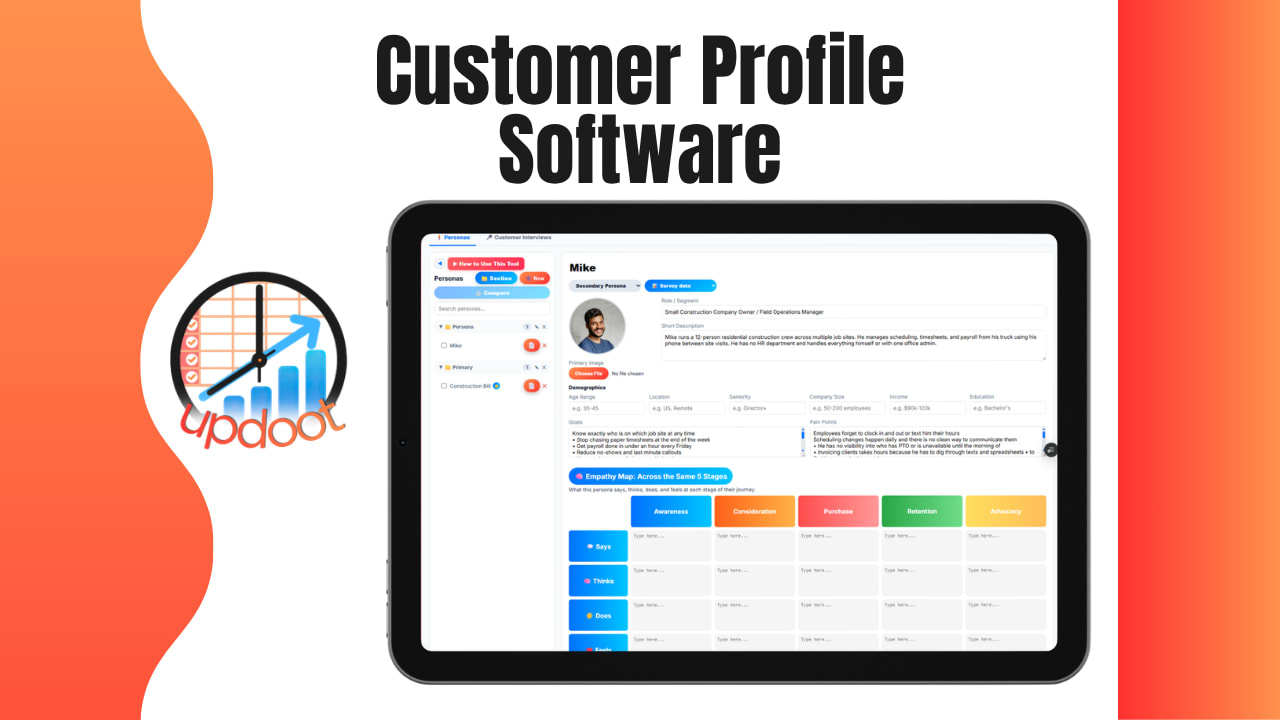
Use the free interactive tool below to start building your own customer profiles. This is the same core exercise I ran as a COO when I paid Bain & Company a genuinely eye-watering fee to help my team figure out exactly who we should be selling to, and who we shouldn't. The deliverable at the end of that engagement was a set of clean, comparable customer profiles. Turns out you don't need a six-figure invoice to get there. You need a structured place to put what you already know about your customers, a way to compare profiles side by side, and something to help you turn messy interview notes into a usable persona. That's exactly what this tool does.
See the Customer Profile Tool in Action
A quick walkthrough of building primary, secondary, and negative profiles, comparing them side by side, and letting the AI assistant turn interview notes into a suggested persona.
What Is Customer Profile Software
Customer profile software is a tool that organizes everything a business knows, or assumes, about the people who buy its product or service into a structured, comparable format. Instead of "our customer is a busy professional who values convenience" sitting in someone's head or scattered across old sales notes, a proper customer profile lays out who this person is, what they're trying to accomplish, what's stopping them, and what would actually get them to buy.
The real value isn't the profile itself, it's being able to put several profiles next to each other and see the differences. A business that sells to three distinct types of buyer, with three different sets of objections, is going to waste money on messaging and product decisions if it treats them as one blob of "the customer."
Free Customer Profile Template
Build Your Customer Profiles
Add a profile for each type of customer you're tracking. Entries save automatically in your browser.
Primary, Secondary, and Negative Users: Why All Three Matter
Most persona work stops at "who's our ideal customer," which only tells you half the story. A complete customer profile exercise covers three distinct categories, and skipping any one of them leaves a gap that shows up later, usually in a marketing budget spent chasing the wrong audience or a sales team wasting hours on leads that were never going to close.
A primary user is who the product or service is genuinely built for, the person most likely to buy, get value quickly, and stick around. This is who product decisions and core messaging should be built around first.
A secondary user still buys, and still gets real value, but isn't the main focus. They might need a slightly different message or a different feature set emphasized, but they're not who the roadmap should bend around.
A negative user, sometimes called an exclusionary persona, is the profile most businesses never bother writing down, and it's often the most valuable one. This is the person who looks like a great fit on paper, checks every demographic box, but consistently doesn't convert, churns within weeks, or eats up a disproportionate amount of support time relative to what they pay. Writing down who this person is, explicitly, is what stops a sales team from chasing them again next quarter.
How to Compare Customer Profiles Side by Side
A single profile is useful. Several profiles sitting next to each other, comparable field by field, is what actually changes decisions. Once you've built out a primary, a secondary, and a negative profile, the comparison view is where patterns show up: maybe your primary and secondary users share the same core goal but hit a different objection right before purchase, or maybe your negative profile shares a demographic with your primary user but is missing the one trigger that actually drives a sale.
This is the exercise that costs real money when a strategy firm runs it for you, structured interviews, workshops, and a facilitator building out comparison matrices across a few weeks of billable hours. The comparison itself isn't complicated once the profiles exist in a consistent format. What's hard is getting the raw information into that format in the first place, which is usually where the interview summarization piece comes in.
Letting AI Summarize Interviews and Suggest Personas
Customer interviews are where the real signal lives, but raw interview notes are messy, and turning ten hours of conversations into three clean profiles used to take a research team days of manual tagging and pattern-spotting. Updoot's customer profile tool includes an AI assistant built for exactly this: paste in interview notes, call transcripts, or even rough bullet points from a sales call, and it will summarize the recurring goals, pain points, and objections, then suggest a draft persona you can edit and slot in as a primary, secondary, or negative profile.
This doesn't replace judgment. You still decide whether a suggested persona is actually a primary user or a negative one, and you still edit the language to match what you know about your own market. What it replaces is the hours of manual synthesis that used to sit between "we did the interviews" and "we have a usable profile," which is usually the step that gets skipped entirely when a team is busy, and is exactly the step that made working with a firm like Bain worth the price tag in the first place.
Related Reading
Why This Works Across Industries
I've run this exact process in several very different industries, and the structure holds up every time even though the answers change completely. A SaaS company's primary user might be a mid-level operations manager who cares about time saved, while a retail brand's primary user cares about price and social proof, and a professional services firm's primary user cares about trust and referrals above almost everything else. The fields, goal, pain point, buying trigger, objection, stay the same. What changes is what actually gets written into them, and that only comes from real conversations with real customers, not a brainstorm in a conference room.
This is really the only reliable way to know, ahead of time, whether a customer is actually going to buy your product or service, versus just looking like they should. Assumptions about "our target customer" that never get tested against real interviews are the single biggest reason marketing spend and sales effort go toward the wrong audience quarter after quarter.
Frequently Asked Questions
Customer profile software is a tool that helps a business build structured profiles of the people who buy, or don't buy, its product or service. It typically organizes information like demographics, goals, pain points, and buying behavior into a format that's easy to compare across different customer types.
A primary user is who the product or service is built for first, the person most likely to buy and get value from it. A secondary user still buys or benefits, but isn't the main focus of the roadmap or messaging. A negative user, sometimes called an exclusionary persona, represents someone who looks like a fit on paper but consistently doesn't convert, churns quickly, or drains support resources, so the business knows who not to chase.
Interviews aren't strictly required, but profiles built only on assumptions tend to drift from reality. Even five or six short conversations with real customers, summarized and compared side by side, usually surfaces patterns a team wouldn't have guessed sitting in a conference room.
Bringing in a top-tier strategy firm to run customer segmentation and persona work typically runs well into six figures once discovery, interviews, and workshops are factored in, which puts it out of reach for most small and mid-sized businesses. Software can't replace every part of that engagement, but it can replicate the core deliverable, structured, comparable customer profiles, for a fraction of the cost.
Yes. The underlying fields, goals, pain points, buying triggers, objections, are generic enough to apply to B2B software, retail, professional services, healthcare, and more. What changes is the specific answers a business fills in, not the structure of the profile itself.
Most teams revisit profiles quarterly, or any time there's a meaningful shift in the market, a new competitor, a pricing change, a new product line. A profile built once and never touched again slowly stops matching who's actually buying.
At minimum: who they are, what goal they're trying to accomplish, what's stopping them today, what would make them buy, and what would make them churn or never convert at all. Comparing that side by side across primary, secondary, and negative users is what turns a list of traits into something a team can actually act on.
Final Takeaway
A customer profile earns its keep the moment it stops a marketing dollar from chasing someone who was never going to buy, or tells a sales rep to spend their energy on the lead who actually looks like a primary user. Start with the free tool above, build out at least one primary, one secondary, and one negative profile, and let the AI assistant turn your next round of customer interviews into a draft persona instead of a stack of notes nobody has time to synthesize. It's the closest thing to a Bain-level customer segmentation exercise you'll get without the six-figure invoice.