
AI-Assisted Hiring Tools: What They Do and 2026 Compliance
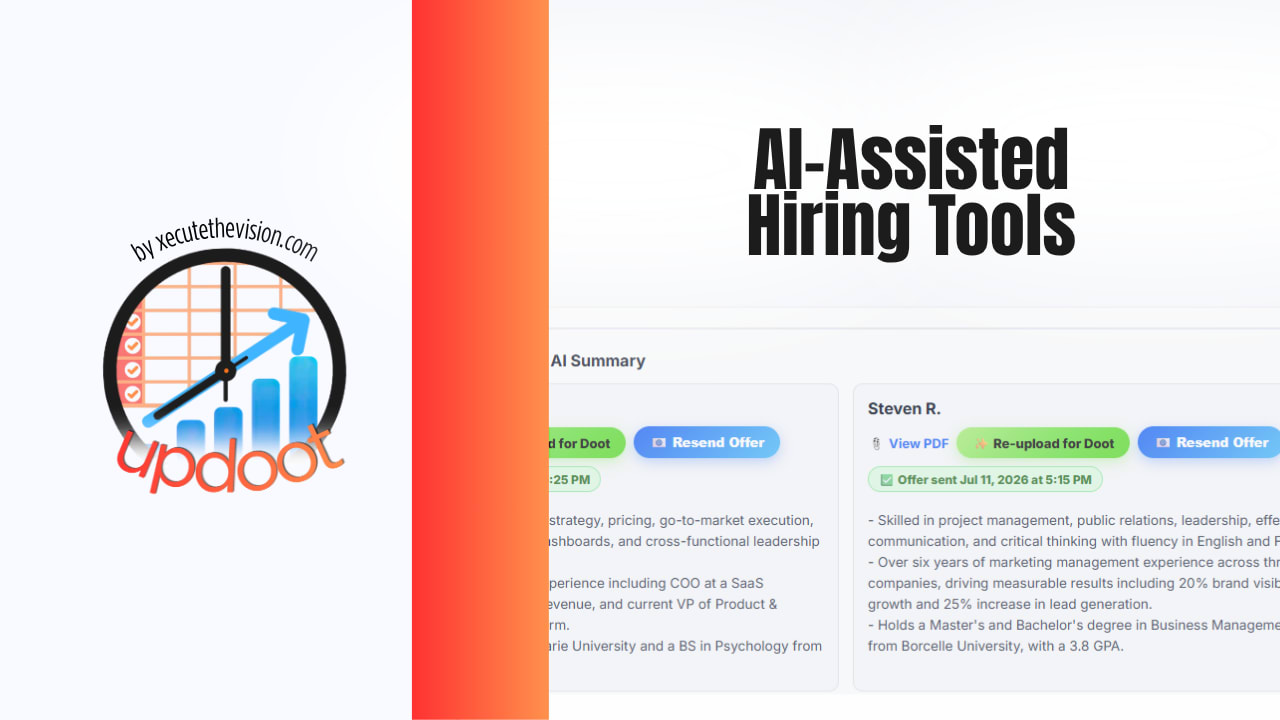
AI-assisted hiring tools use software to help with specific, repetitive parts of the hiring process, screening resumes, matching candidates to roles, pre-screening through chatbots, scoring candidates, and more, so recruiters and hiring managers can spend their time on judgment calls instead of manual busywork. This guide covers what these tools actually do, why companies are adopting them, the compliance landscape as it stands in 2026, how to evaluate a tool before buying it, and the pitfalls that trip up companies that lean on AI too heavily or too carelessly.
Quick Answer
AI-assisted hiring tools speed up high-volume, repetitive tasks, mainly resume screening, candidate matching, and initial scoring, but they work best as an assist to human recruiters, not a replacement for them. In 2026, they're also subject to a growing set of rules: the EEOC applies existing Title VII and ADA disparate impact standards to AI hiring tools, and cities and states including New York City increasingly require independent bias audits and candidate notice.
What Are AI-Assisted Hiring Tools?
These tools fall into a handful of categories, each solving a different bottleneck in the hiring funnel.
Resume Screening and Summarization
AI reads incoming resumes and pulls out the experience, skills, and qualifications relevant to the role, turning a two-page resume into a quick summary a hiring manager can evaluate in seconds instead of minutes. This is usually where AI saves the most time, since resume volume is often the biggest bottleneck in the entire process.
Candidate Matching and Ranking
Beyond summarizing a single resume, matching tools compare an entire applicant pool against the job requirements and rank candidates by fit, helping recruiters prioritize who to review first instead of working through applications in the order they arrived.
Chatbot Pre-Screening
Conversational bots ask candidates baseline qualifying questions, like availability, location, or required certifications, before a human recruiter ever gets involved, filtering out clearly unqualified applicants automatically.
AI Video Interview Analysis
Some platforms analyze recorded video interviews for language, tone, or response content. This category carries the highest scrutiny and the most state-specific legal requirements of any AI hiring tool, and several jurisdictions require explicit candidate consent before it can be used.
Predictive Candidate Scoring
These tools combine resume data, assessment results, and interview performance into a single score meant to predict on-the-job success, similar in spirit to a weighted scorecard but calculated automatically.
Sourcing and Outreach Automation
AI can also search existing databases or public profiles to find passive candidates who match a role and automate the first outreach message, expanding the top of the funnel without manual searching.
Why Companies Are Adopting AI in Hiring
The driver is almost always volume. A role that gets 20 applications can be screened manually without much strain. A role that gets 400 applications cannot, at least not without either delaying the process for weeks or spreading review so thin that strong candidates get missed. AI-assisted screening lets a small recruiting team handle a large applicant pool without sacrificing consistency, and it does it faster than adding headcount would.
Speed also matters competitively. Strong candidates often have multiple offers moving in parallel, and a hiring process that takes three weeks to produce a shortlist loses good candidates to companies that moved faster, regardless of how good the eventual offer is.
The Compliance Landscape in 2026
AI hiring tools are not exempt from existing anti-discrimination law, and a growing number of AI-specific rules now apply on top of it. The rules vary by location and change frequently, so treat this as a starting point, not a compliance checklist, and verify current requirements for your specific situation.
Federal Law Still Applies
The EEOC has been explicit that Title VII and ADA disparate impact standards apply to AI and algorithmic hiring tools the same way they apply to any other selection procedure. If a tool consistently screens out candidates from a protected group at a higher rate, that's a legal problem regardless of whether a human or an algorithm made the decision.
New York City's Local Law 144
NYC's Local Law 144, enforceable since July 2023, is the most established AI hiring law in the country. It requires an independent bias audit within the past year for any automated employment decision tool used to substantially assist hiring or promotion decisions for NYC-based candidates, public posting of a summary of that audit, and at least 10 business days of notice to candidates before the tool is used. The law applies regardless of where the employer is headquartered, if the candidate is NYC-based, it applies. Enforcement scrutiny has been increasing through 2026 after a late 2025 city comptroller audit found gaps in how the law had been enforced.
Illinois and the Growing State Trend
Illinois has required notice and consent for AI-analyzed video interviews since 2020, and expanded its Human Rights Act in 2026 to more broadly prohibit AI-driven employment discrimination and require disclosure when AI is used in employment decisions. Other states are actively moving in the same direction with their own disclosure, audit, or human-review requirements. If you operate in more than one state, building your compliance process around the strictest applicable standard, rather than treating each state as a separate project, is generally the more efficient approach.
How to Evaluate an AI Hiring Tool Before You Buy It
Ask Whether It's Been Independently Bias-Audited
A vendor's internal fairness testing is a starting point, but it isn't the same as an independent audit conducted by a third party with no role in building or selling the tool. Ask directly whether independent audit documentation exists and ask to see it.
Understand What Data It Was Trained On and What It Uses to Score Candidates
A tool trained on historical hiring data can inherit whatever bias existed in those past decisions. Ask the vendor to explain, in plain language, what factors actually drive a candidate's score or ranking.
Confirm There's a Human-in-the-Loop
The tool should support a recruiter's judgment, not replace it. Make sure there's a straightforward way for a human to review, override, or request an alternative process for any AI-driven decision.
Check Candidate Notice and Opt-Out Support
If you operate anywhere with notice or opt-out requirements, the tool needs to support providing that notice and honoring opt-out requests without manual workarounds.
Try the AI Screening Time & Cost Savings Calculator
Estimate how much recruiter time AI-assisted resume screening could save based on your actual application volume.
Time & Cost Savings Estimator
Enter your numbers below. This is a planning estimate, not a guarantee of results.
Common Pitfalls With AI-Assisted Hiring Tools
Removing Human Review Entirely
Letting a tool auto-reject candidates with no human ever looking at the results is both a legal risk and a practical one. Strong, unconventional candidates are exactly the ones an algorithm trained on past hiring patterns is most likely to miss.
Skipping the Bias Audit Because "the Vendor Says It's Fine"
A vendor's own assurances are not a substitute for independent verification, and in jurisdictions like NYC, they don't satisfy the legal requirement either.
Using AI to Replace Judgment Instead of Speeding It Up
The strongest use of AI in hiring is compressing the time it takes to get to a well-informed decision, not removing the decision-making itself. Treating an AI score as the final word rather than one input among several increases both bad hires and legal exposure.
Poor Candidate Communication
Candidates who don't know AI is involved in their evaluation, or who have no way to request a human review, tend to trust the process less, and in a growing number of jurisdictions, that lack of notice is also a legal violation.
Never Re-Checking Whether the Tool Is Still Working Well
Models drift as they process new data, and applicant pools change over time. A tool that was fair and effective at launch can quietly become less so without ongoing monitoring.
How Updoot Uses AI to Make Hiring Faster
Updoot's AI resume tools are built around the biggest bottleneck in most hiring processes: reading resumes at volume. Instead of a hiring manager working through every resume top to bottom, Updoot automatically summarizes incoming resumes, pulling out the experience, skills, and qualifications that actually matter for the role so a candidate can be evaluated in seconds instead of minutes.
That summarization feeds directly into the rest of the hiring workflow. Candidates can be scored consistently against the same criteria, so comparing applicants doesn't come down to whoever a hiring manager happened to read most recently. And once a decision is made, offer letters can be sent and tracked directly from the same system, so there's no gap between picking a candidate and knowing whether the offer has actually been seen.
The goal isn't to remove people from the hiring process. It's to remove the busywork that keeps good hiring managers from spending their time where it actually matters: talking to candidates and making the final call.
Frequently Asked Questions
AI-assisted hiring tools use software to help with parts of the hiring process, including resume screening and summarization, candidate matching and ranking, chatbot pre-screening, video interview analysis, predictive candidate scoring, and outreach automation. They are designed to assist human decision-makers, not replace the final hiring decision.
Yes, but they are subject to existing anti-discrimination law and a growing number of AI-specific regulations. The EEOC has stated that Title VII and ADA disparate impact rules apply to AI hiring tools the same way they apply to any other selection procedure. New York City's Local Law 144 requires an independent bias audit and candidate notice for automated employment decision tools used to evaluate NYC-based candidates, and other states are adopting similar requirements.
A bias audit is an independent evaluation that tests whether an automated employment decision tool produces different selection or scoring rates across race, ethnicity, and sex categories. Under NYC's Local Law 144, employers must have this audit performed by an independent third party, not the vendor, at least once per year.
No. AI hiring tools are best used to handle high-volume, repetitive tasks like initial resume screening and summarization, freeing up recruiters to spend their time on judgment calls, candidate conversations, and final decisions. Removing human review entirely increases both legal risk and the chance of missing strong candidates the tool wasn't trained to recognize.
Yes, often significantly. Manually reading every resume for a role that receives dozens or hundreds of applications can take many hours of recruiter time. AI-assisted resume summarization can reduce that to a fraction of the time by surfacing the qualifications that matter most, though a human should still review the shortlist before decisions are made.
Ask whether the vendor has had the tool independently bias-audited, understand what data the tool was trained on and what data it uses to evaluate candidates, confirm there is a way for a human to review and override its recommendations, and check what notice and opt-out options are available to candidates.
Final Thoughts
AI-assisted hiring tools earn their place when they remove real bottlenecks, mainly the time it takes to get through a large applicant pool, without removing human judgment from the decisions that actually matter. The companies getting the most value out of these tools in 2026 are the ones treating AI as a way to reach a well-informed decision faster, not as a replacement for making the decision at all, and staying on top of the compliance requirements that come with using it.
This article is for general informational purposes and is not legal advice. AI employment law changes frequently and varies by location. Consult an employment attorney for guidance specific to your situation.