
2-2-3 Work Schedule Explained Simply With a Template
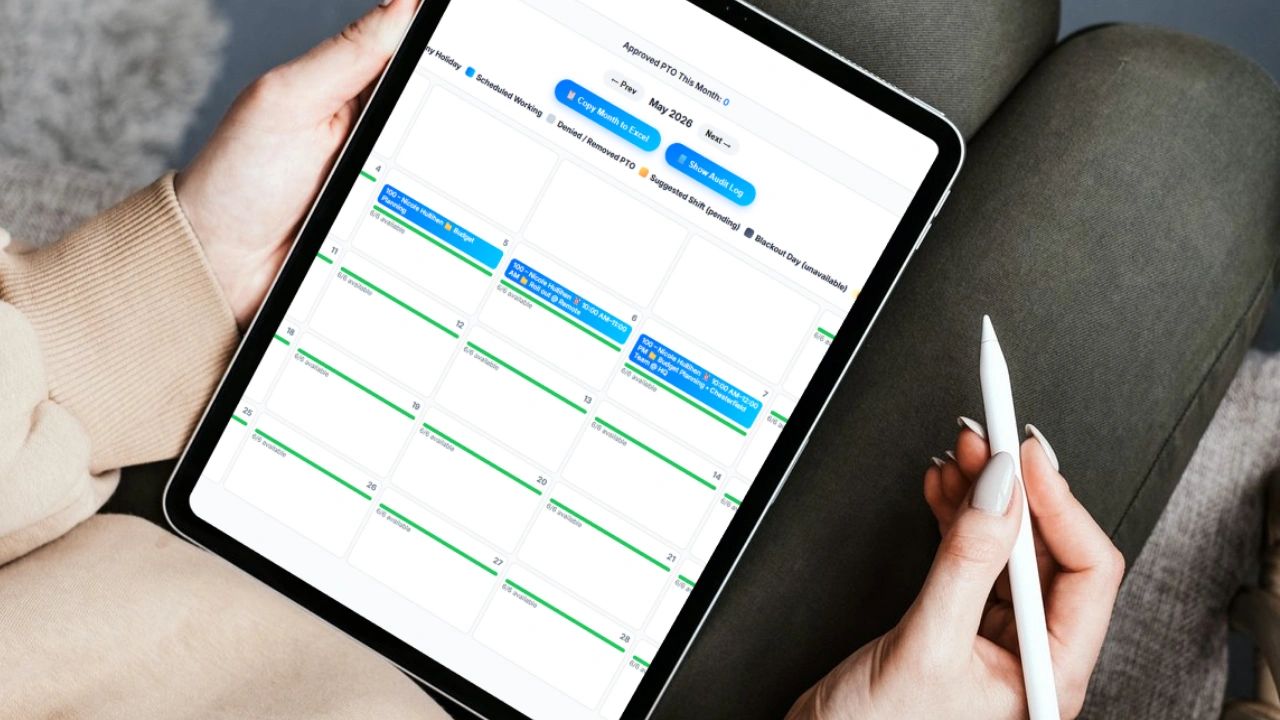
The 2-2-3 schedule is a rotating shift pattern designed for businesses that need 24/7 coverage while giving employees a predictable, repeatable schedule they can actually plan their lives around. It is one of the most widely used shift patterns in manufacturing, healthcare, warehousing, and security -- and for good reason. This guide covers exactly how it works, the two-week template, the pros and cons, and when it is and is not the right fit.
What Is a 2-2-3 Work Schedule?
The 2-2-3 schedule is a rotating shift pattern where employees work 2 days on, take 2 days off, then work 3 days on. The following week flips to 2 days off, 2 days on, and 3 days off. It runs on a two-week cycle using 12-hour shifts and is specifically designed to give employees every other weekend fully off -- one of its biggest advantages over less structured rotation patterns.
Two-Week 2-2-3 Schedule Template
Here is what the two-week rotation looks like day by day:
| Day | Week 1 | Week 2 |
|---|---|---|
| Monday | WORK | OFF |
| Tuesday | WORK | OFF |
| Wednesday | OFF | WORK |
| Thursday | OFF | WORK |
| Friday | WORK | OFF |
| Saturday | WORK | OFF |
| Sunday | WORK | OFF |
Week 1 has the employee working 5 shifts (2 + 3), week 2 has them working 2 shifts. The pattern then repeats. To maintain full 24/7 coverage, most businesses run 4 crews in two shifts -- Team A and Team B covering days, Team C and Team D covering nights -- offset so that when one team works, another is off.
Hours Breakdown
With 12-hour shifts, employees work approximately 60 hours in week 1 (five shifts) and 24 hours in week 2 (two shifts). This averages to around 42 hours per week over the cycle. The heavy week triggers overtime in most states -- whether that is daily or weekly overtime depends on your state's labor law. Businesses running this schedule need to configure payroll and overtime rules correctly, particularly for states like California where daily overtime applies after 8 hours.
The 4-Crew Setup
The standard implementation uses four crews. Team A and Team B cover day shifts on the 2-2-3 rotation. Team C and Team D mirror the same pattern on night shifts. While Team A works, Team B is off, and vice versa. The same applies to C and D. This creates seamless 24/7 coverage with no gaps and predictable handoffs between teams. Each crew always knows who they are handing off to and what state the work is in.
Pros of the 2-2-3 Schedule
Every Other Weekend Off
This is the defining feature of the 2-2-3. When structured correctly, employees get one full weekend off every two weeks. That consistency matters enormously for morale compared to schedules where weekend days off are scattered and unpredictable. Employees can make plans, attend events, and manage family obligations reliably.
Fewer Total Workdays
Even though shifts are 12 hours, employees work fewer days per year than on a traditional 5-day schedule. Most people find that having full days off is psychologically preferable to having more workdays with shorter hours. The 2-2-3 gives employees meaningful blocks of time off rather than scattered half-recovered evenings.
Predictable Rotation
The pattern never changes. Employees know their schedule months in advance, which makes personal planning significantly easier. Managers do not need to rebuild schedules constantly. Once set up, the rotation is self-sustaining and low-maintenance.
Strong 24/7 Coverage
The 2-2-3 is specifically designed for continuous operations. You always have consistent staffing, no coverage gaps, and clean handoffs between rotating crews. For operations that cannot stop -- production lines, emergency services, critical infrastructure -- this reliability is the core reason to use this schedule.
Cons of the 2-2-3 Schedule
12-Hour Shifts Are Demanding
The schedule's biggest downside is built into its structure. Twelve-hour shifts are long regardless of the work involved, and fatigue accumulates over a 3-day stretch of 36 hours in 72 hours. Productivity, decision quality, and safety performance all decline in the final hours of long shifts. For roles with serious safety or quality consequences, this needs to be managed through structured breaks, workload design, and honest assessment of whether your work can sustain 12-hour shifts safely.
3-Day Stretches Are Hard
Working 3 consecutive 12-hour shifts is physically and mentally demanding. In labor-intensive or high-focus environments this is the week that people feel most worn down. New employees unfamiliar with 12-hour shift work often struggle to adapt and may burn out faster than on a traditional schedule.
Communication Gaps Between Teams
Because crews rotate and are off for extended periods, communication continuity requires deliberate systems. Teams can miss updates, training consistency can suffer, and knowledge about ongoing situations can get lost between rotations. Structured shift handoffs and shared documentation are essential to prevent this from becoming an operational problem.
Overtime Complexity
The variable weekly hours -- 60 one week, 24 the next -- create payroll complexity that simpler schedules do not have. Overtime calculations, compliance with daily and weekly overtime rules, and ensuring payroll exports reflect actual hours correctly all require attention. A time tracking system that handles variable weekly schedules is not optional here.
When to Use and When to Avoid the 2-2-3
Use 2-2-3 when you have 24/7 operations requiring continuous coverage, work is shift-based and repeatable, and consistent handoffs between teams matter for quality and safety. It is also a strong choice when employee satisfaction with weekends off is a priority for retention.
Avoid 2-2-3 when work changes daily, you need flexible daily hours, output depends on creativity or energy that 12-hour shifts erode, daily team collaboration is required, or employee fatigue poses a genuine safety risk that 12-hour shifts would worsen.
Using the 2-2-3 Schedule With Updoot
Updoot's scheduling and time tracking is built for exactly this kind of rotating shift operation. You can assign employees to rotating 2-2-3 shift patterns, attach each shift to a project, job, and location, see who is working and where in real time, adjust the rotation without breaking the pattern, and export payroll-ready reports that correctly handle variable weekly hours. The schedule becomes a live operational system rather than a static calendar.