
W2 vs 1099 Employee: Checklist to Choose the Right One
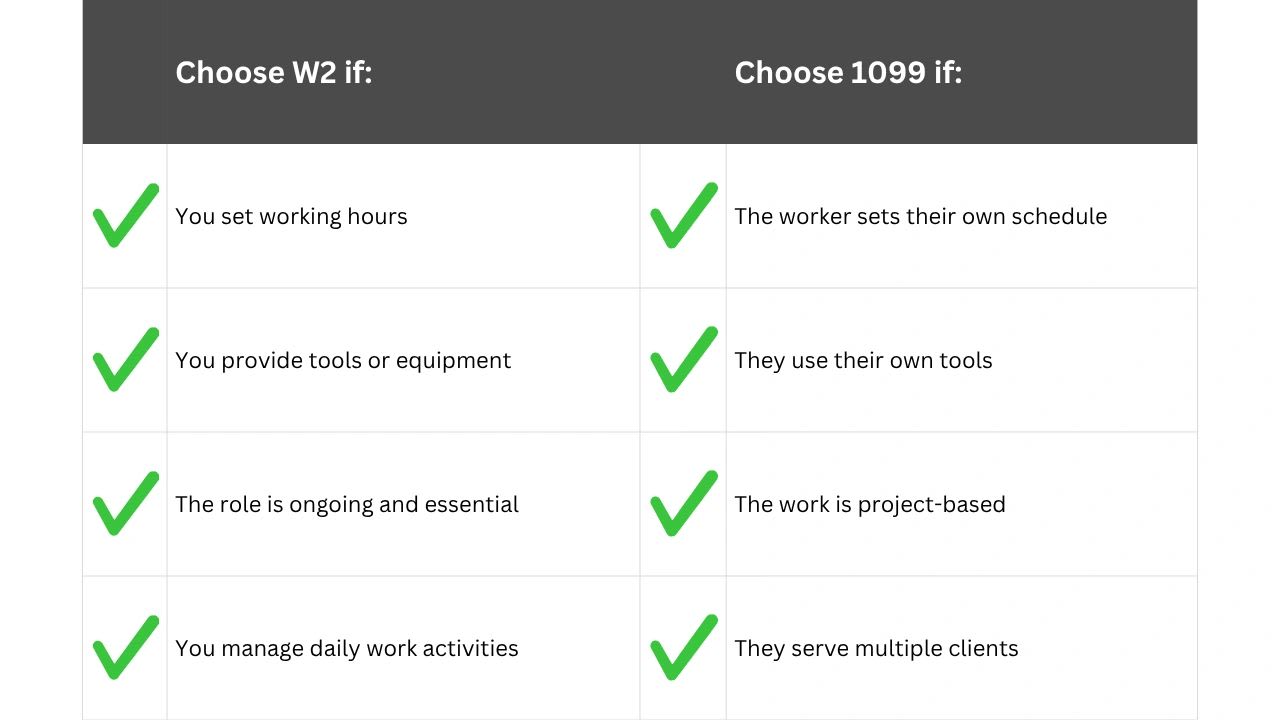
W2 vs 1099 is one of the first big decisions you make when you bring someone onto your team. A W2 employee works for you on your payroll. A 1099 contractor runs their own business and sells you a service. The label you choose decides who pays which taxes, who gets benefits, and how much control you have over the work.
It also decides how much risk you carry. Choose the wrong classification and you can owe back taxes, penalties, and benefits you never budgeted for. Choose the right one and you gain the stability of employees where you need it and the flexibility of contractors where it makes sense.
This guide explains both types of workers in plain language, compares them side by side, walks through the test the IRS actually uses, and shows the real cost of each option. It also includes a free checklist and cost calculator you can use for any role before you make an offer.
What Is a W2 Employee?
A W2 employee is a traditional employee who works directly for your company and is paid through your payroll. The name comes from Form W-2, the wage and tax statement you give each employee after the end of the calendar year, showing what they earned and what was withheld.
When you hire a W2 employee, you take on several responsibilities. You withhold federal income tax from each paycheck, plus state and local income tax where it applies. You withhold the employee's share of Social Security and Medicare taxes. You also pay a matching employer share of those taxes, along with federal unemployment tax and, in most places, state unemployment insurance.
In exchange, you get control. You can set the schedule, assign the tools, define the process, train the person in your way of working, and review not just the result but how it was achieved. W2 employees are also the people who are typically eligible for benefits such as health insurance, paid time off, and retirement plans.
When W2 Employees Make Sense
Employees are the right fit when you need consistent, long-term work that sits at the center of what your business does. If the role follows your schedule, uses your equipment, and would continue with no set end date, you are describing an employee.
They also make sense when you are building a team and a culture. People who share your processes, attend your meetings, and grow with the company are the foundation of a business that can scale. Trying to build that foundation entirely out of contractors rarely works, and it usually runs into classification problems along the way.
What Is a 1099 Contractor?
A 1099 contractor is an independent worker who provides services to your business without becoming your employee. They are in business for themselves. The name comes from Form 1099-NEC, which you file to report nonemployee compensation once your payments to a contractor reach the IRS reporting threshold. The IRS Form 1099-NEC page links the current instructions and threshold.
You do not withhold taxes from a contractor's payments. The contractor is responsible for their own income tax and for self-employment tax, which covers both halves of Social Security and Medicare. Contractors are not eligible for your employee benefits, and they generally provide their own tools and decide how the work gets done.
What you give up is control. You can define the result you want, the deadline, and the price. You should not dictate the contractor's hours, methods, or step-by-step process, because that level of direction is what turns a contractor into an employee in the eyes of the IRS.
When 1099 Contractors Make Sense
Contractors are a strong choice for specialized or short-term work. A web developer who rebuilds your site, an accountant who handles a one-time cleanup, or a consultant brought in for a single project are classic examples.
They also work well for seasonal or overflow demand, as long as the contractor genuinely runs an independent business, serves other clients, and controls how the job is done. If you need flexibility without a long-term commitment and you care about the outcome more than the method, a contractor may be the right answer.
W2 vs 1099: Side-by-Side Comparison
The table below summarizes the practical differences between the two types of workers. It is the fastest way to see how the choice affects taxes, benefits, control, cost, and risk.
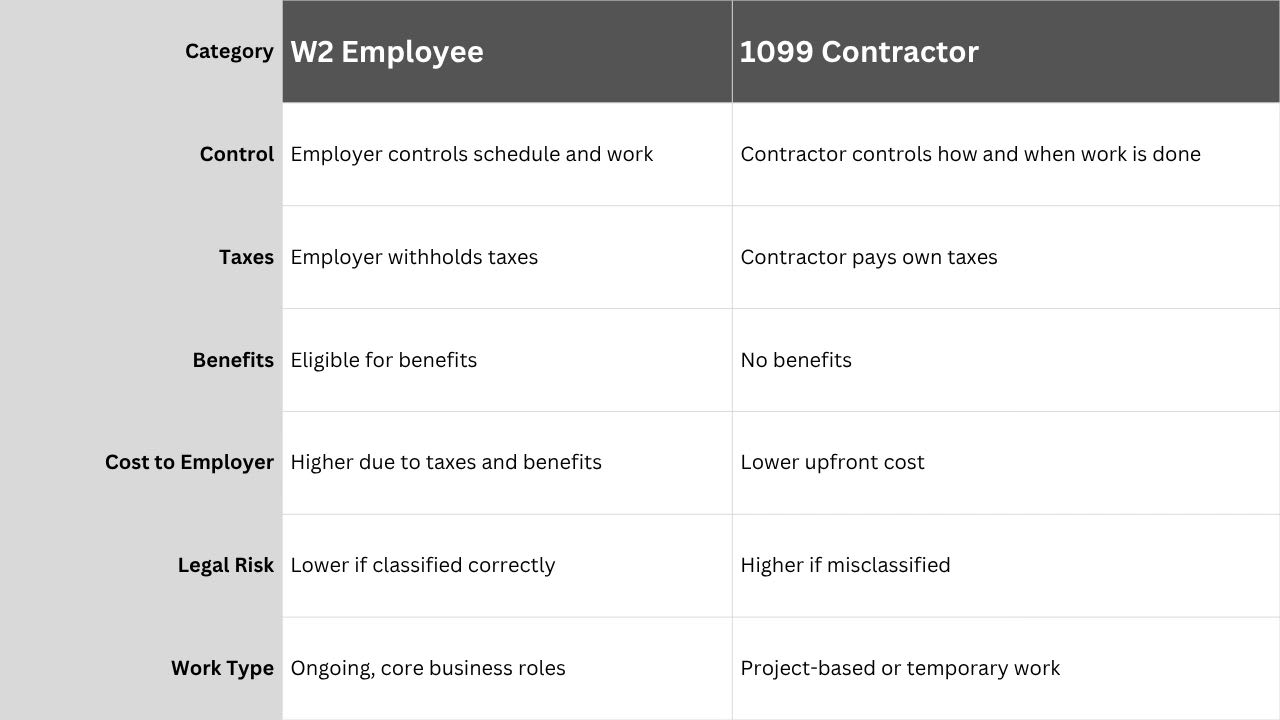
| Factor | W2 employee | 1099 contractor |
|---|---|---|
| Control | You set the schedule, tools, and workflow. | The contractor decides how and when the work is done. |
| Taxes | You withhold income tax and the employee's share of Social Security and Medicare, then pay a matching employer share. | No withholding. The contractor pays income tax and self-employment tax. |
| Benefits | Typically eligible for benefits such as insurance, paid time off, and retirement plans. | No employee benefits. |
| Year-end form | Form W-2. | Form 1099-NEC once payments reach the reporting threshold. |
| Cost to you | Wages plus employer taxes, benefits, insurance, and administration. | A higher hourly rate, but no payroll taxes or benefits. |
| Legal risk | Low when properly classified and paid. | High if the relationship actually looks like employment. |
How the IRS Decides: The Three Categories of Control
You do not get to pick a classification just because it is convenient. The IRS looks at the actual working relationship, and it groups the evidence into three categories. The official explanation is on the IRS independent contractor or employee page.
Behavioral control asks whether the company controls, or has the right to control, what the worker does and how they do it. Detailed instructions, required training, set hours, and evaluation of methods all point toward employment.
Financial control asks whether the business directs the financial side of the job. Who supplies the tools, who pays the expenses, how the worker is paid, and whether the worker can make a profit or take a loss all matter. A contractor invests in their own business and can lose money on a job. An employee does not.
Type of relationship looks at how the two parties see and structure the arrangement. Written contracts, benefits, the expected length of the relationship, and whether the work is a key part of your regular business are all considered.
The IRS is clear that no single factor decides the outcome. You weigh them all together. If you are genuinely unsure, you or the worker can file Form SS-8 to ask the IRS for a formal determination, though the IRS notes that a decision can take six months or more.
Keep in mind that the IRS is not the only agency with a test. The U.S. Department of Labor applies its own analysis under the Fair Labor Standards Act to decide who is owed minimum wage and overtime, and it explains that approach on its misclassification page. States can have their own rules too, so a role that passes one test does not automatically pass every test.
Free W2 vs 1099 Checklist and Cost Calculator
Use the tool below for any role you are about to fill. The checklist asks twelve questions drawn from the three IRS categories, and every "Yes" is a sign of an employee relationship. The cost comparison then shows what the same hours would cost you as a W2 employee and as a 1099 contractor, including employer taxes and benefits.
The example is filled in for a full-time field technician so you can see how it works. Change the answers and numbers to match your own role, then copy the result into Excel with live formulas or print it for your records.
W2 vs 1099 Classification Checklist and Cost Calculator
Answer the twelve questions for one role. Each question comes from the three categories the IRS uses to judge worker status. Every "Yes" points toward an employee relationship. Then compare what the role would cost as a W2 employee and as a 1099 contractor. This is a planning aid, not a legal determination. Nothing you enter is saved or sent anywhere.
Part 1: Control checklist
| IRS category | Question | Answer |
|---|---|---|
| Behavioral control | Do you set the worker's schedule or required hours? | |
| Behavioral control | Do you tell the worker how to do the work, step by step? | |
| Behavioral control | Do you train the worker in your own methods or procedures? | |
| Behavioral control | Do you evaluate how the work is done, not just the finished result? | |
| Financial control | Do you supply the main tools, equipment, or software? | |
| Financial control | Do you pay by the hour, week, or month instead of by the project? | |
| Financial control | Do you reimburse the worker's business expenses? | |
| Financial control | Is the worker unable to make a profit or take a loss on the work? | |
| Financial control | Does the worker work only for you instead of offering services to the public? | |
| Type of relationship | Do you provide benefits such as insurance, paid time off, or a retirement plan? | |
| Type of relationship | Is the relationship expected to continue with no set end date? | |
| Type of relationship | Is the work a key part of your regular, day-to-day business? |
Part 2: Cost comparison
| Cost line | W2 employee | 1099 contractor |
|---|
The True Cost of a W2 Employee
Many owners compare an employee's hourly wage directly with a contractor's hourly rate and conclude that the contractor is expensive. That comparison leaves out everything an employer pays on top of the wage.
On every dollar of wages, you pay a 7.65% employer share of Social Security and Medicare. You pay federal unemployment tax, which usually works out to 0.6% of the first $7,000 of each employee's wages once the normal state credit is applied. You pay state unemployment insurance and workers compensation coverage, whose rates vary by state and industry. Then you add benefits, which can easily reach 20% or more of wages.
Take the example in the calculator. A technician earning $25 an hour for 40 hours a week over 52 weeks earns $52,000. Employer Social Security and Medicare add $3,978, federal unemployment adds $42, benefits at 20% add $10,400, and a 3% estimate for unemployment insurance and workers comp adds $1,560. The total is $67,980, which is about $32.68 per hour worked, or roughly 31% above the base wage.
A contractor billing $38 an hour for the same 2,080 hours costs $79,040. In this case, the employee is actually cheaper. More importantly, the checklist shows that the technician role leans heavily toward employment, so the employee is the only safe choice anyway.
The Biggest Risk: Misclassification
Misclassifying a worker as a 1099 contractor when they should be a W2 employee is one of the most common and costly mistakes a business can make. It usually happens gradually. Someone starts as a short-term contractor, the work keeps coming, and a year later they have a set schedule, a company laptop, and a manager, but they are still paid on a 1099.
The consequences can be serious. The IRS can hold you liable for the employment taxes you should have withheld and paid, along with penalties and interest. Workers who believe they were misclassified can file Form 8919 to report their share of uncollected Social Security and Medicare taxes, which can prompt a closer look at your business. On the labor side, a misclassified worker may be owed back pay for overtime and minimum wage.
You may also face liability for benefits the worker should have received and for unemployment and workers compensation premiums that were never paid. Those costs are almost always larger than whatever the business saved.
If you realize you have misclassified workers, the IRS offers the Voluntary Classification Settlement Program, which lets eligible businesses reclassify workers going forward with reduced federal employment tax liability for past periods.
A Simple Rule of Thumb
If you control how, when, and where the work is done, the worker is probably an employee. If you only control the result, and the worker brings their own tools, sets their own hours, serves other clients, and can profit or lose money on the job, the worker is more likely a contractor. When the answers are split, get professional advice before you decide.
Real-World Example
Imagine you run a residential service business with a mix of workers.
Your full-time technician works 8 to 5, drives your van, uses your equipment, follows your service checklist, and has no other clients. Every factor points to employment, so the technician is a W2 employee.
A freelance designer you hire to create a new logo sets their own hours, uses their own software, works for several other companies, and quotes a fixed price for the project. Every factor points to independence, so the designer is a 1099 contractor.
Now picture a third worker, a part-time bookkeeper who comes in two afternoons a week on a schedule you set and uses your accounting login. It is tempting to call a part-time helper a contractor. The facts say otherwise. Part-time status does not change classification, control does. Treating all three workers the same way, in either direction, would create risk.
Why Classification Matters for Time Tracking and Payroll
Whether someone is a W2 employee or a 1099 contractor, you still need accurate records of their work. For employees, tracked hours drive payroll, overtime, and paid time off. Federal law requires you to keep records of hours worked for most hourly employees, as the Department of Labor explains in its recordkeeping fact sheet.
For contractors, tracked hours or deliverables drive invoices, project costs, and client billing. You also need to know how much you paid each contractor during the year so you can file the correct 1099 forms.
Without a system, this becomes messy fast. Hours are recorded in different places for different workers, payroll is inaccurate, labor costs are hard to see by job, and client invoices miss billable time. Mixed teams need one place where every hour is captured and tagged to the right person, project, and pay type.
The Smarter Way to Manage Both W2 and 1099 Workers
As your business grows, managing a mix of employees and contractors becomes more complex. Updoot is business management software that keeps time tracking for both groups in one place, so you are not juggling spreadsheets, emails, and disconnected apps.
Employees and contractors can log time against specific projects, jobs, or locations. Managers get real-time visibility into who is working and what they are working on. Reports separate hours for payroll from hours for billing, and tracked time can be turned into client invoices in a single click. Updoot costs $5 per user per month, and you can start a free trial to see how it fits your team.
Final Thoughts
The difference between W2 and 1099 workers comes down to control, structure, and responsibility. W2 employees give you stability and the ability to direct the work. 1099 contractors give you flexibility and lower overhead for the right kind of project.
The key is to decide role by role, based on how the work will actually be done, and to revisit that decision whenever a role changes. Back the decision with a system that keeps time, payroll, and billing accurate. Classification is not just a tax question. It shapes how you run your business, manage your team, and protect your bottom line.
Opens in Google Drive. View and download for free.
Related Reading
Frequently Asked Questions About W2 vs 1099 Workers
What is the main difference between a W2 employee and a 1099 contractor?
Control. A W2 employee works under your direction on your payroll, and you withhold and pay employment taxes. A 1099 contractor runs their own business, controls how the work is done, and pays their own taxes.
How does the IRS decide if a worker is an employee or a contractor?
The IRS looks at three categories of evidence: behavioral control, financial control, and the type of relationship. No single factor decides the outcome. All of them are weighed together.
Is a W2 employee more expensive than a 1099 contractor?
Not always. An employee costs the wage plus a 7.65% employer share of Social Security and Medicare, unemployment taxes, workers comp, and benefits. Contractors often charge a higher hourly rate to cover their own taxes and overhead, so the total can be higher or lower.
Can a part-time worker be a 1099 contractor?
Only if the relationship truly meets the contractor tests. Working part time does not change classification. If you set the schedule, supply the tools, and direct the work, a part-time worker is still an employee.
What happens if I misclassify an employee as a contractor?
You can be held liable for unpaid employment taxes, penalties, and interest, and the worker may be owed overtime, minimum wage, or benefits. The IRS Voluntary Classification Settlement Program can reduce past federal tax liability for businesses that correct the problem.
What is Form SS-8?
Form SS-8 lets a business or worker ask the IRS for an official determination of worker status. It is useful when the facts are mixed, but the IRS notes that a determination can take six months or more.
Do I need to track hours for 1099 contractors?
You are not required to track contractor hours the way you track employee hours, but you do need records of what you paid each contractor for 1099 reporting, and hours or deliverables are what support their invoices and your job costs.