
The Vision Tracker: Turning Long-Term Vision to Execution
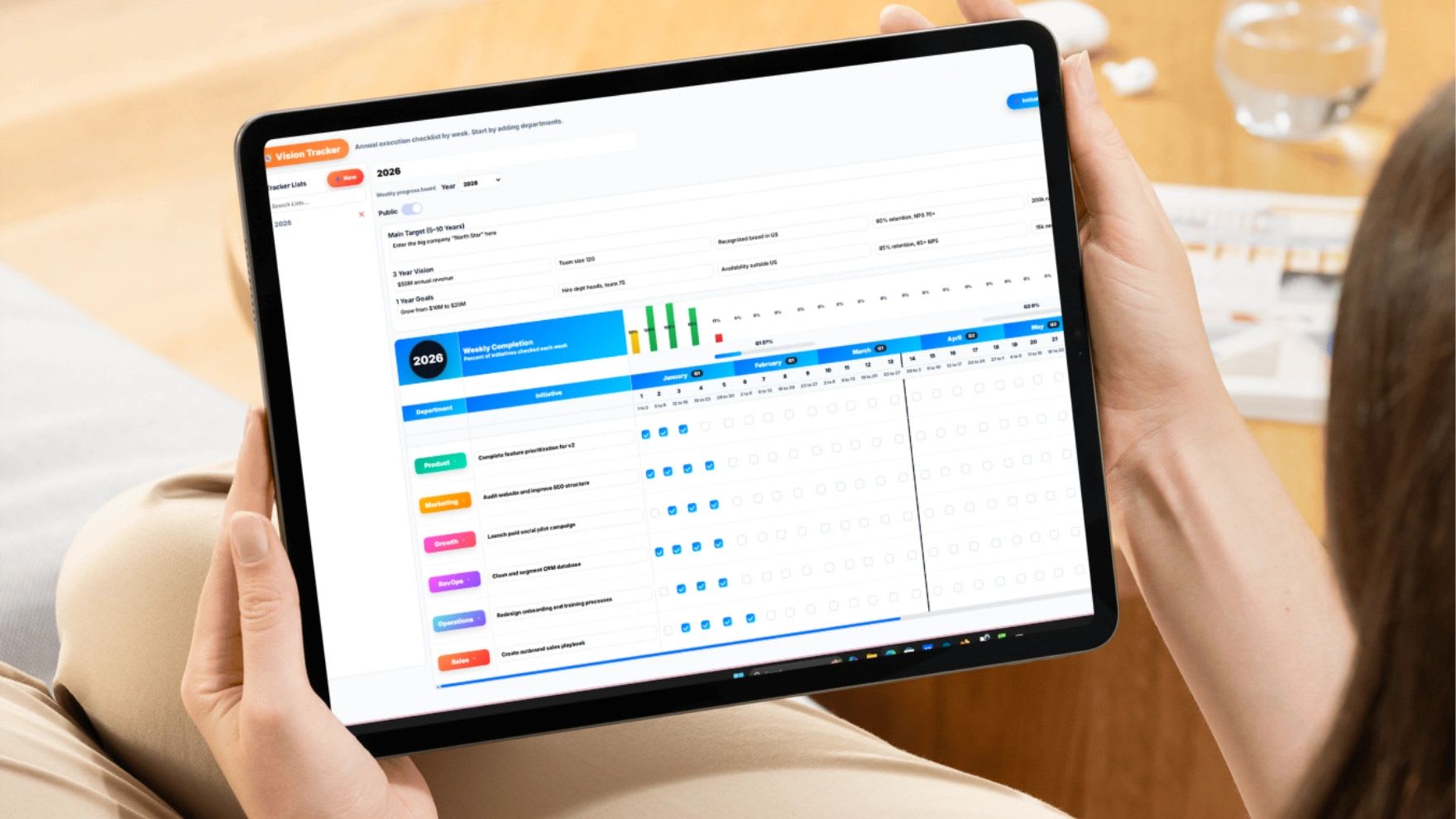
The Vision Tracker is a leadership tool that connects a company's long-term vision to the work its team does every week. One of the biggest challenges leaders face is not coming up with big ideas. It is executing them consistently over time.
Many organizations set ambitious goals at the start of the year, only to watch them fade as daily operations take over. By spring, the strategic plan lives in a slide deck nobody opens, and the team is busy with whatever is loudest that week.
A vision tracker bridges that gap. It lines up a long-term target, a mid-term direction, and short-term goals in one place, then asks a simple question every week: did each goal actually move forward? This guide explains how the system works, how to set up each layer, how to run the weekly and quarterly rhythm, and includes a free vision tracker you can use right now.
Where the Vision Tracker Idea Comes From
The layered approach behind a vision tracker draws on the leadership framework Gino Wickman describes in Traction, the book behind the Entrepreneurial Operating System, or EOS. Its Vision/Traction Organizer asks leadership teams to define a 10-year target, a 3-year picture, a 1-year plan, and quarterly priorities called Rocks, according to EOS Worldwide's overview of the V/TO.
The power of the approach is that it bridges long-term strategic thinking and weekly execution. Instead of letting the vision sit in a document that no one revisits, it creates a system where the whole team works toward the same destination every single week.
What Is a Vision Tracker?
A vision tracker is a tool that aligns long-term company vision with short-term execution. It breaks big strategic goals into smaller milestones and tracks progress consistently, so leaders can see at a glance whether the business is actually moving toward where it wants to go.
A typical vision tracker has four layers. At the top is a main target, the 5 to 10 year goal. Below it sits a 3-year vision, then a set of 1-year strategic goals, and finally weekly execution tracking. Each goal has a department that owns it, and progress is measured each quarter.
| Layer | Time horizon | How many | Question it answers | Example |
|---|---|---|---|---|
| Main target | 5 to 10 years | One | Where is this business ultimately going? | $10M in annual revenue with a team of 50 |
| 3-year vision | 3 years | About five outcomes | What must be true three years from now to stay on course? | $4M revenue, two locations, full leadership team |
| 1-year goals | 12 months | Three to seven, often five | What must we finish this year? | Reach $2M revenue, launch online booking |
| Weekly execution | Each week of a 13-week quarter | One check per goal per week | Did this goal actually move forward this week? | A check in week 6 for online booking |
The goal is simple: make sure every week of work moves the company closer to its long-term vision. When it is used consistently, a vision tracker becomes a practical system for strategic alignment and accountability across the organization.
Step 1: Set the Main Target
The foundation of any vision tracker is the main target. This is the long-term destination for the company, and it answers one question: where do we want this business to be in 5 to 10 years?
Strong main targets are clear, measurable, and ambitious. They should inspire the team while giving leadership a concrete objective to pursue. A revenue figure such as reaching $50M in annual revenue works well. So does a market position, such as becoming the largest regional provider in a niche industry, or a reach goal like serving 100,000 customers worldwide. Achieving market leadership in a specific category is another common choice.
What these examples share is that you could tell, on a given day, whether you had reached them. "Be the best" is not a target. "Serve 100,000 customers" is.
Your vision tracker starts here because this goal becomes the north star for every strategic decision. Without a clearly defined main target, it becomes difficult for leadership teams to align priorities, and even harder to measure progress.
Step 2: Define the 3-Year Vision
Once the long-term destination is clear, the next layer focuses on the 3-year vision. Three years is a useful strategic timeframe because it is long enough for meaningful change but short enough for a leadership team to plan realistically.
Many organizations using a vision tracker define about five major outcomes for the three-year vision. These usually span revenue growth, market expansion, product development, operational efficiency, and leadership team development, so no part of the business is left without a direction.
For example, a company's three-year vision might describe expanding into three new markets, launching two new products, reaching $15M in annual revenue, building a fully staffed leadership team, and creating operational systems that can scale. EOS suggests writing this picture in the present tense, as if it has already happened, which makes it easier for the team to see.
These five outcomes act as the strategic bridge between the long-term main target and the company's yearly priorities.
Step 3: Establish the 1-Year Goals
The next step is deciding what must happen in the next 12 months to stay on track toward the three-year vision. These become the 1-year goals.
EOS recommends the three to seven most important goals for the year, and many leadership teams settle on five, which is what the tracker below uses. Limiting the number of annual goals forces clarity and stops the organization from chasing too many priorities at once.
Good 1-year goals are specific and finishable. Launching a new product feature, increasing revenue by 40%, hiring and onboarding a sales team, improving customer retention to a stated number, and putting a new operational system in place are all examples you could check off by year end.
Each 1-year goal should connect clearly to the three-year vision. The table below shows how the example company's goals feed its three-year outcomes. When the yearly goals are achieved, the company should be measurably closer to its strategic direction.
| 3-year vision outcome | 1-year goal that feeds it | Owning department |
|---|---|---|
| $4M in annual revenue | Reach $2M in revenue | Sales |
| Two locations open and profitable | Launch online booking so the second location fills faster | Product |
| A full leadership team in every seat | Hire an operations manager | Operations |
| Every core process documented and followed | Document the top 20 processes | Operations |
| Customer retention above 90% | Cut first response time under 4 hours | Customer Success |
This alignment is what makes a vision tracker effective. If a proposed goal does not feed any three-year outcome, it is either missing from the vision or it does not belong on the list.
Step 4: Turn Strategy Into Weekly Execution
Most strategic plans fail at execution. A vision tracker addresses this by breaking strategic initiatives into weekly progress checks.
Instead of waiting months to see results, leadership teams track execution every week. Each goal gets one question per week: did it meaningfully move forward? A check means yes. An empty box means no.
Over a quarter, those checks build a visual map of execution. It shows which initiatives are moving steadily, which departments are driving progress, and where bottlenecks are forming. A goal with three empty weeks in a row stands out immediately, long before anyone would have noticed it in a quarterly report.
This weekly cadence keeps strategic initiatives from disappearing under daily operational work.
Step 5: Assign Department Ownership
A vision tracker works best when every initiative has a clear owner. Each strategic goal should be connected to a specific department or team responsible for delivering it, whether that is product development, marketing, sales, operations, or customer success.
Assigning goals to departments makes the vision tracker part of the organization's operating rhythm rather than a leadership exercise. It also makes the weekly check honest, because a named team has to answer for each empty box.
When teams see how their work connects to the larger company vision, engagement and accountability both rise. For individual ownership within a department, pair the tracker with an accountability chart.
Step 6: Review Progress Weekly and Quarterly
The final piece is a consistent review rhythm. Most leadership teams review the vision tracker in two ways.
Weekly Leadership Meetings
During the weekly leadership meeting, the team reviews each goal's check for the week and identifies where attention is needed. Off-track goals become discussion items, and the team agrees on a specific action before the meeting ends. The Level 10 meeting format is built for exactly this kind of review.
This catches issues quickly, before they become major obstacles.
Quarterly Strategic Reviews
Every 90 days, leadership steps back and evaluates three things: progress toward the 1-year goals, whether the initiatives are producing results, and whether adjustments are needed. This is also when EOS teams set new Rocks for the next quarter.
The quarterly cadence keeps the company adaptable while holding it to the long-term vision.
The Weekly Execution Cadence
A vision without consistent execution is just an idea. The vision tracker turns annual initiatives into weekly accountability checkpoints. Instead of reviewing goals once a quarter, or worse, once a year, leaders measure progress every single week.
Weekly Initiative Tracking
Each strategic initiative goes into the tracker, and every week the team marks whether meaningful progress occurred. This creates a visual system that answers one simple question: are we advancing this initiative consistently or not?
Over time, the weekly marks reveal patterns. Some initiatives move forward regularly. Others stall or lose momentum after a strong start. And some departments show a pattern of empty weeks that signals they may need more resources or fewer priorities.
Weekly tracking lets leadership step in early instead of discovering problems months later.
Department Accountability
Vision execution is not only leadership's responsibility. It is shared across the organization. Each initiative is assigned to a department or team, such as product, marketing, operations, sales, or customer success.
This structure clarifies ownership and reinforces accountability. When everyone understands their role in achieving the vision, alignment improves.
Progress Visibility
Another key benefit of weekly tracking is visibility. Instead of wondering whether goals are on course, leadership can see progress as it happens.
Many teams visualize this with weekly completion percentages, department progress bars, and quarterly summaries. The tracker below does all three: it scores each goal's consistency, draws a progress bar for each, and rolls results up by department. These visual signals show leadership where attention is needed at a glance.
Free Vision Tracker
Use the tracker below to put the whole system on one page. Enter your main target and 3-year vision, list up to five 1-year goals with the department that owns each, and check every week in which a goal genuinely moved forward.
Set the current week of the 13-week quarter, and the tracker works out each goal's consistency, which is the share of weeks so far in which it moved. Goals at 80% or higher are on track, 50% to 79% are worth watching, and anything below 50% is off track. The example company is in week 8 of its quarter.
Copy to Excel gives you the same layout with live COUNTIF formulas that score each goal against the current week, or print the tracker to bring to your weekly meeting.
Vision Tracker
Write your main target and 3-year vision, list up to five 1-year goals with an owning department, and check each week in which the goal genuinely moved forward. Set the current week of the 13-week quarter and the tracker scores each goal's consistency, flags what is off track, and rolls progress up by department. Copy it to Excel with live formulas or print it for your weekly meeting. Nothing you enter is saved or sent anywhere.
1-year goals and weekly progress
Quarterly Rhythm and Strategic Reviews
Weekly tracking feeds a broader rhythm of quarterly evaluation. Every 90 days, leadership should ask which initiatives are moving forward consistently, which goals are behind schedule, and whether the annual priorities are still the right ones.
This checkpoint keeps the organization agile while it stays committed to the larger vision. The aim is not rigid adherence to a plan. It is disciplined execution with strategic awareness.
Why Vision Tracking Works
Organizations usually struggle with execution for four reasons. Goals are too vague to act on. Progress is not tracked often enough to catch problems. Ownership is not clearly defined. And teams lose sight of the long-term strategy in the rush of daily work.
The vision tracker addresses all four. A long-term target and a 3-year direction keep the strategy visible. Five focused annual goals keep it specific. Weekly tracking keeps it frequent, and department ownership keeps it accountable.
Together, these turn strategy into part of daily work. Instead of reviewing the vision once a year, teams interact with it every week.
Bringing Vision Execution Into a Single Tool
Many organizations try to track these elements in spreadsheets or disconnected systems, but the process works far better when everything lives in one place. That is exactly why we built the Vision Tracker inside Updoot, which is business management software for $5 per user per month.
In Updoot, leadership teams define the main target, set the 3-year vision priorities, and track 1-year strategic goals. Each goal breaks down into weekly execution checkpoints, responsibility is assigned by department or team, and progress is visible across the entire year. You can start a free trial to see it alongside your tasks, meetings, and scorecards.
Instead of scattered documents, spreadsheets, and meeting notes, everything lives in one execution dashboard. The result is a clear connection between long-term strategy and the weekly actions that make it happen.
Final Thoughts
Vision is not just something you write down. It is something you execute. A vision tracker connects the two by linking a main target, a 3-year vision, and a small set of 1-year goals to a weekly check that nobody can ignore.
When teams see progress every week, the path from big ideas to real results becomes much clearer.
Sources
EOS Worldwide: What Is the V/TO (Vision/Traction Organizer)?
Opens in Google Drive. View and download for free.
Frequently Asked Questions About the Vision Tracker
What is a vision tracker?
A vision tracker is a leadership tool that connects a long-term main target, a 3-year vision, and 1-year goals to weekly execution, so the team can see every week whether the business is moving toward its vision.
How is a vision tracker related to EOS and Traction?
It draws on the Vision/Traction Organizer from Gino Wickman's Traction, which asks leadership teams to set a 10-year target, a 3-year picture, a 1-year plan, and quarterly Rocks.
How many 1-year goals should we set?
EOS recommends the three to seven most important goals for the year. Many teams choose five, which keeps focus without leaving major areas of the business out.
How often should we review the vision tracker?
Check each goal weekly in your leadership meeting, and step back every 90 days for a quarterly review of progress, results, and priorities.
What does consistency mean in the tracker?
Consistency is the share of weeks so far in which a goal genuinely moved forward. In the free tracker, 80% or higher is on track, 50% to 79% is worth watching, and below 50% is off track.
Why assign goals to departments?
A named owner makes the weekly check honest and shows which teams are driving progress and which may need help or fewer priorities.
Can I track my vision in Excel?
Yes. The free tracker on this page copies to Excel with live COUNTIF formulas that score each goal against the current week of the quarter.