
What is a Gartner Magic Quadrant Chart and How to Use One
This is an easy explanation of what each quadrant is in a Gartner Magic Quadrant and how to use it. Your vision is to know your competition. Not only analyze your competitors but also get a visual you can share with the business about where you rank in comparison. This article will discuss the Gartner Magic Quadrant, how it works, and how small businesses can adapt the concept to build competitive clarity even without a Gartner research subscription.
You need written goals and competitive details, of course, but would it not be nice to have a visual that shows where you are versus your competitors at a glance? Something everyone in the business can understand without reading a 20-page competitive analysis document? A visual that could be posted somewhere visible, kept top of mind, and referred back to whenever the team needs a reminder of where you are and where you are going?
That is exactly what the Gartner Magic Quadrant is designed to do. And even if Gartner has never researched your industry, the framework itself is one of the most useful strategic tools a business of any size can borrow and apply to their own competitive landscape.
What Is a Gartner Magic Quadrant?
The Gartner Magic Quadrant is a research methodology and visual framework developed by the global research and advisory firm Gartner. It is used to evaluate and compare companies within a specific technology market, plotting competitors on a two-axis chart that maps their current ability to execute against the completeness of their vision for the future.
The chart is divided into four quadrants, each representing a different competitive position. The X-axis measures completeness of vision -- how well a company understands where the market is going and how clearly they have articulated a strategy to get there. The Y-axis measures ability to execute -- how well a company delivers on its current products, services, operations, and customer relationships.
As you move right on the chart, vision becomes stronger. As you move up, execution becomes stronger. A company in the upper right corner is both visionary and highly capable of executing on that vision. A company in the lower left is still developing both.
Gartner produces Magic Quadrant reports for dozens of technology categories including cloud platforms, cybersecurity tools, CRM software, and marketing automation. These reports involve significant research investment including vendor demonstrations, customer surveys, analyst interviews, published financial data, and social media analysis. They are widely used by technology buyers and investors to evaluate which vendors are worth considering.
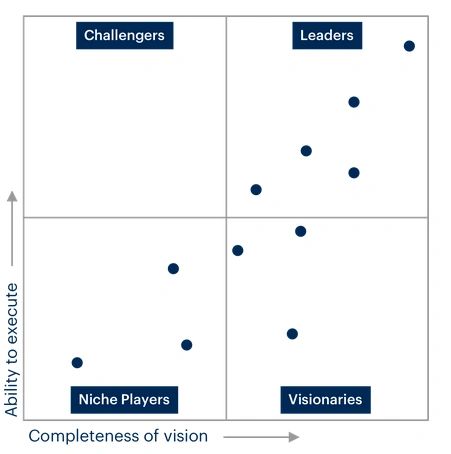
| Quadrant | Position on Chart | Characteristic |
|---|---|---|
| Leaders | Upper right | Strong vision and strong execution |
| Visionaries | Lower right | Strong vision, still building execution |
| Challengers | Upper left | Strong execution, weaker forward vision |
| Niche Players | Lower left | Focused segment, developing both dimensions |
The Four Quadrants Explained
It is important to understand that no single quadrant is definitively the best place to be. Each position has its own advantages, characteristics, and strategic implications. The goal is not to reach a specific quadrant but to understand honestly where your business sits today and where you want it to go.
1. Leaders
Leaders occupy the upper right quadrant. They excel in both their current execution and their vision for the future. Leaders typically have a large and established customer base, strong brand recognition, and the market influence to shift the direction of an entire category. When a Leader makes a strategic decision, the rest of the market tends to respond.
Being a Leader is the position most businesses aspire to, but it comes with its own risks. Leaders can become complacent. They can be slow to respond to disruptive innovation from smaller competitors. And maintaining a Leadership position requires continuous investment in both vision and execution that not every business can sustain.
For a small business mapping its competitive landscape, identifying the Leaders in your space is essential. These are the benchmarks everyone is measured against, the businesses setting customer expectations, and the competitors whose moves you need to anticipate.
2. Visionaries
Visionaries occupy the lower right quadrant. They have a strong and often innovative vision for where the market is going, but they have not yet built the execution capability to match that vision. A Visionary might be introducing a new business model, developing a genuinely differentiated product approach, or targeting an emerging customer need that the Leaders have not yet addressed.
In an established market, a Visionary is often a smaller or newer business that has identified an opportunity the incumbents have missed or are too slow to pursue. For small businesses, the Visionary quadrant is often an honest and aspirational position. You may have a clear picture of where your market is headed and a distinctive approach to serving customers that the larger players do not have. If your execution is still catching up to your vision, the Visionary quadrant is where you belong right now -- and that is not a weakness. It is an honest assessment of your current stage and a clear indication of what to build next.
3. Niche Players
Niche Players occupy the lower left quadrant. They focus on a specific customer segment, geography, or use case rather than competing across the full market. They tend to be less innovative than Visionaries and less operationally powerful than Challengers, but they serve their specific audience well and have built a sustainable position doing so.
A new business often starts in the Niche Player quadrant -- not because it is poorly run but because it is still building its vision and execution capability. A more established business in the Niche Player quadrant has typically made a deliberate choice to serve a specific segment rather than compete broadly, which can be a perfectly sound strategy. Niche Players are easy to underestimate. A competitor in the lower left may be highly profitable and deeply entrenched in a specific customer segment even if they do not have the scale or visibility of the Leaders.
4. Challengers
Challengers occupy the upper left quadrant. They execute extremely well today and often have a significant share of the market, but their vision for where the market is going is not as strong as the Leaders. They have built strong operational and commercial capability, but they may be investing in yesterday's direction rather than tomorrow's opportunity.
Challengers are often large, well-resourced companies that have built dominant positions through execution rather than innovation. They have the capability to become Leaders if they can sharpen their vision, or they can become vulnerable to disruption if the market shifts faster than they can adapt. For a small business, identifying the Challengers in your space tells you where significant market share lives that may be vulnerable to a more visionary competitive approach.
How Small Businesses Can Use the Magic Quadrant Framework
Gartner puts enormous resources into its research. Their reports reflect months of structured work before a single company gets placed on the chart. If you are a small business attempting to use this framework, that depth of methodology is not realistic for your resources. But the framework itself is completely adaptable. You do not need Gartner-level research to build a useful competitive quadrant. You need honest assessment, available information, and the discipline to place yourself and your competitors accurately rather than optimistically.
Start with your competitor list. Identify the five to ten competitors most relevant to your business. These should be companies your customers actually consider when they are evaluating their options, not every business in your broader industry.
Research each competitor across two dimensions. For execution, look at their customer reviews, operational stability, team size and growth trajectory, customer retention signals, and how consistently they deliver on their promises. For vision, look at their product roadmap signals, marketing messaging, investment in innovation, response to market changes, and how clearly they articulate where they are taking their product or service.
Place each competitor honestly. Resist the temptation to put every competitor in the lower left so your business looks dominant by comparison. An inaccurate quadrant is worse than no quadrant at all because it leads to strategic decisions based on a false picture of reality.
Place your own business honestly. This is the hardest part. Where are you actually executing well right now? Where is your vision genuinely strong versus where is it aspirational? An honest self-assessment is the foundation of a useful competitive visual.
Use it as a living document. The competitive landscape changes. A Visionary competitor who closes a funding round may become a Challenger within 18 months. A Leader who loses key executives may slip. Your own position should be moving as you execute on your strategy. Review and update the quadrant at least twice per year.
Why This Visual Matters for Your Entire Team
One of the most underappreciated benefits of the Magic Quadrant framework for small businesses is not strategic planning. It is team alignment and motivation. When every person in your business can look at a single visual and understand where you sit relative to your competition, where you are aiming, and what movement on that chart looks like, strategic conversations become much more grounded.
Sales teams understand who they are competing against and what the competitive positioning story is. Operations teams understand what execution improvement means in the context of market position. Leadership teams have a shared reference point for evaluating decisions. A competitive quadrant posted in your office or shared in your regular team meetings transforms competitive strategy from an abstract leadership conversation into a visible, shared goal that the entire organization can orient around.
Using Updoot to Build Your Competitive Analysis
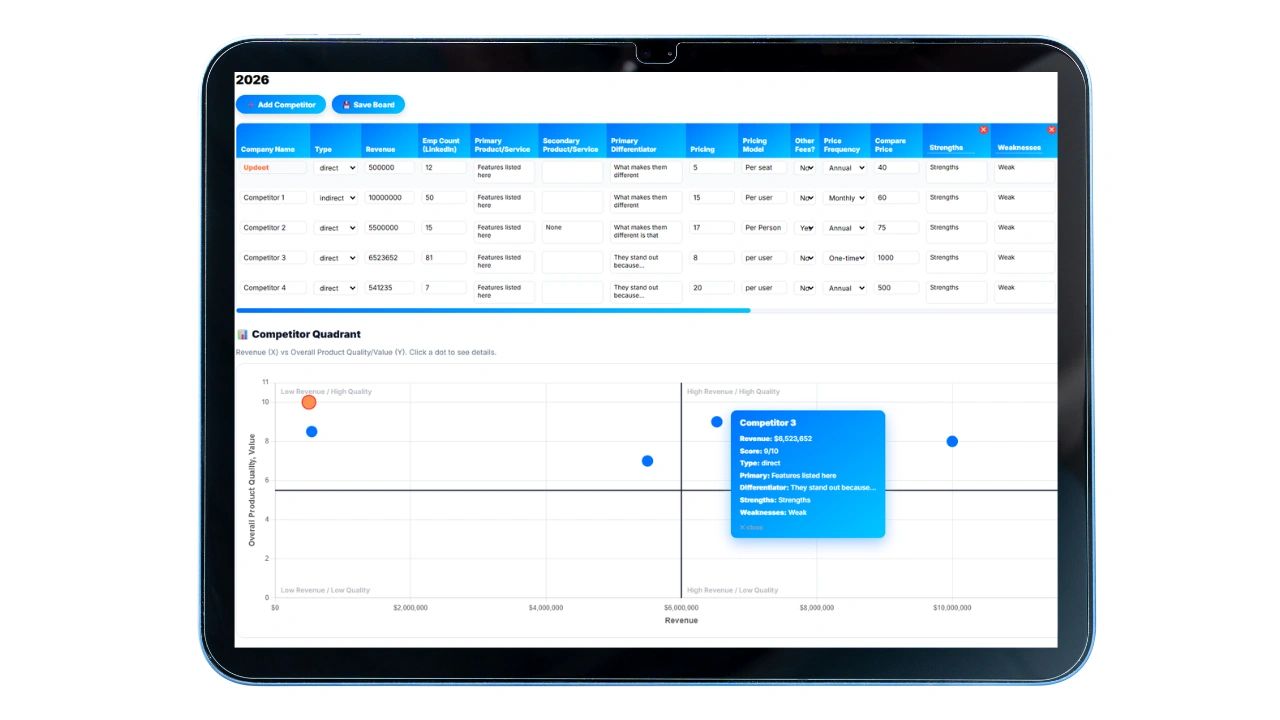
Before you can plot competitors on a quadrant, you need the competitive intelligence to place them accurately. Updoot's competitor analysis tool gives you a structured place to document what you know about each competitor, track how your positioning compares, and build the data foundation that makes a competitive quadrant meaningful rather than guesswork. Once you have your analysis documented, plotting your business and your competitors on a Magic Quadrant gives you the visual your entire team can use to understand where you are and where you are going.
Related Reading
Customer Personas vs Ideal Customer Profile (ICP) →
References: Gartner Magic Quadrant Methodology | TechTarget: Gartner Magic Quadrants