
Solve Problems in Minutes vs. Days of Debate with 5 Why's

Your vision is to understand when a problem occurs, the cause of it quickly so that you can resolve it. Ideally, you wouldn’t be spending time talking about it over and over and thinking about what it may be or what could be. The solution is to approach problems with the 5 Whys. This article reviews the 5 Why's, where it came from, when to use it, and how to use it to quickly solve a sales-based problem.
What is the 5 Whys?
It’s one of the easiest concepts to remember. When a problem occurs, as the question ‘Why?’ five times and you will figure out the cause.
Where did the 5 Whys Method come from?
This came out of the 1930s, by Sakichi Toyoda, the person who founded Toyota. It stemmed from the need to understand what was going on by seeing it versus people getting together and talking about what the problem is from a distance. The thought is that when you are in the mix and actually witnessing or experiencing the problem, that is how a solution will be best developed.
Why is the 5 Whys better than another approach?
The 5 Whys is useful because sometimes you will find that someone didn’t do something they were supposed to. It’s easy to point the finger and be done with it, but you are much better off by figuring out why that person didn’t do what they were supposed to do. You may find issues completely unrelated to what it seems and instead, find something that can be fixed for the future.
Who can use the 5 Whys technique?
Anyone can use the 5 Whys, whether it’s an employee or manager. This applies to most types of problems.
How do you know when to stop with the Whys?
One thing to note is that sometimes you may only need 3 Whys and sometimes you may need 7. Sometimes you may have multiple paths to get to the root cause. A great way to test the causes is to ask ‘if this cause were fixed or removed, would the outcome have been different?’ If the answer is no then keep going but if it’s yes, you’ve done this successfully.
When should you use 5 Whys?
Anytime you have a problem that could have multiple causes or when you find yourself in a situation where you have multiple ideas as to the why try mapping it out. It’s important to note that you need to make sure the answers are facts so that your map is accurate. Additionally, make sure the people you are working with are involved in the problem directly to avoid going down the wrong path.
Case example in how to use the 5 Whys
Let’s say you have a lead for a large account that seemed very much interested in being a client and then all of the sudden, you can’t get ahold of them. You start at the top with your problem of a potential client won’t return calls. This image is a basic path of how a client not getting back to you is not because of something you said, a competitor, or anything else you may brainstorm as an issue, it’s instead an issue of the sales rep not being trained well enough. This will guide you in upcoming interactions much better than it would to debate.
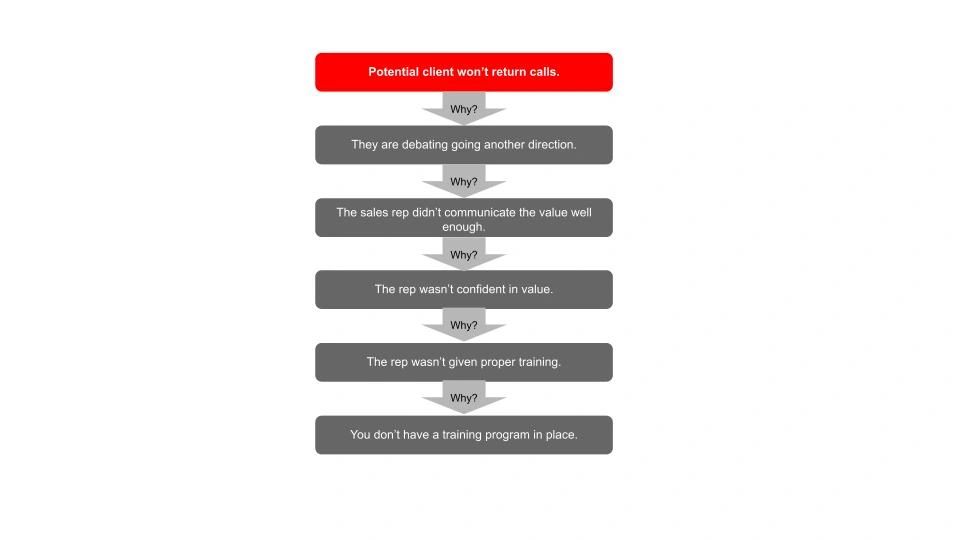
If we were to test out the cause and ask ‘if this cause were fixed or removed, would the outcome have been different’, the answer would be yes. The lead could choose to go elsewhere for other reasons of course, but in this case, to be lacking in a sales training program is a major problem so to develop one would likely cause many more conversions. This is likely to be a significant improvement to sales. You could take this further though and ask why you don't have a sales training program. Maybe it's because you don't have the time to assemble it and you need additional resources, but it could be that it just simply hasn't been needed until now. As always, this is a tool to use, but you have to incorporate your years of experience and knowledge of the business to really determine how to improve.
Now that you know the cause, it’s then time to develop an action plan, the communication plan with timelines, and then a way to review at a later date to determine if this was successful.
Give the 5 Whys a try the next time you encounter a problem and comment as to how it went!
Written by Nicole Hullihen October 3rd, 2021
References to learn more about the 5 Whys Technique
https://www.cms.gov/medicare/provider-enrollment-and-certification/qapi/downloads/fivewhys.pdf