
Simple vs. Compound Interest and the Formulas

Your vision is to have a better handle on the actual interest being paid out for various loans, whether it's simple or compound interest.
Anytime you need to borrow money to pay for something, the lender is going to charge you interest, even if it’s not upfront. Sometimes you get interest-free for a year, and if you pay it off, you’re all set but if you don’t, or you don’t get a deal like that, you need to understand what those numbers are going to look like.
On the other hand, you may be investing and want to know what you will earn in interest rather than spending.
Simple interest when borrowing money
Simple interest is calculated based on the principal and is often found on auto loans or short-term personal loans.
Why would you want a loan with simple interest?
It benefits the borrower if you pay ahead of time, but it more often benefits the lender if you take a longer time to pay as you can see in our example.
Simple Interest = P x I x N
P = Principal, or starting balance
I = Annual interest rate
N = Length or term of loan in years
Simple Interest Example 1
First, let’s go over simple interest in an example where you are the borrower and you financed a college course of $10,000 at an annual interest rate of 6%.
Simple interest if you pay in one year = $10,000 X .06 X 1 year = $600, or you pay $10,600
Simple interest if you pay in two years = $10,000 X .06 X 2 years = $1200, or you pay $11,200
By taking 2 years, with the extra year to pay that off, you are giving away another $600!
Simple Interest Example 2
Second, let’s look at another example but this time a loan for a handbag business. Let’s say you need $50,000 at a rate of 8% over 3 years.
Simple interest if you pay in one year = $50,000 X .08 X 1 year = $4,000, or you pay $54,000
Simple interest if you pay in two years = $50,000 X .08 X 2 years = $8,000, or you pay $58,000
Simple interest if you pay in three years = $50,000 X .08 X 3 years = $12,000, or you pay $62,000
Each year you take to pay this one off is costing another $4,000!
Compound interest investing in a handbag business
This looks complicated, but this article is going to walk through the formula to calculate the compound interest you could expect to earn when you invest in a handbag business. Compound interest is calculated based on the principal and the interest accumulated each period.
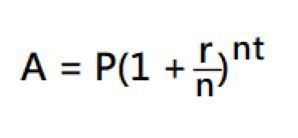
Total (A): This is the future value of your principal after the years or time that you specify.
Principal (P): This is what you are beginning with, or beginning balance that interest will be based on. It could be a loan balance or the amount you invested in the handbag business. For this example, you invest a principal of $50,000.
Rate (r): This is the interest rate or amount in a decimal form that you are expecting your investment to increase. For example, you expect investment in the handbag business to return 8% per year, so that would be entered as .08.
Compounding Frequency (n): This is how often interest gets added to the principal. This could be annual, every 6 months, quarterly, monthly, and so on. For this example, we are going to say that 8% interest rate gets added quarterly, or 4 times per year. The more frequently interest compounds, the higher the return.
Time (t): This is the number of years of the investment. You will need to convert months to years, so, 36 months will need to be 3 years.
Now, plug in the figures to see where you land.
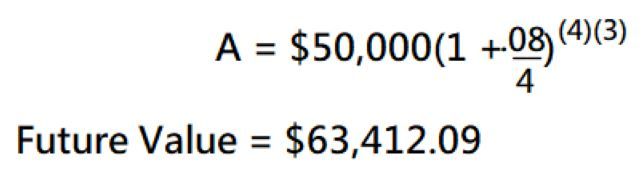
In summary, if you invest $50,000 in this handbag business, with an 8% return for 3 years, you will end up with $63,412 in three years rather than just $50,000.
Finally, you could also look at both examples of simple interest and the handbag business. Notice that with simple interest, everything else being the same, the total paid or earned, depending on whether you’re the lender or borrower, in interest in 3 years is $12,000. Notice that if the interest is compounded, it’s actually $13,412.09, another $1,412 dollars!
Simple interest is generally better if you are the borrower and if you’re the investor, compound interest is better.
References to learn more about simple and compound interest
https://www.fool.com/investing/how-to-invest/stocks/compound-interest/
https://www.investor.gov/financial-tools-calculators/calculators/compound-interest-calculator