
RFQ Meaning: What It Is, When to Use It and a Free Template
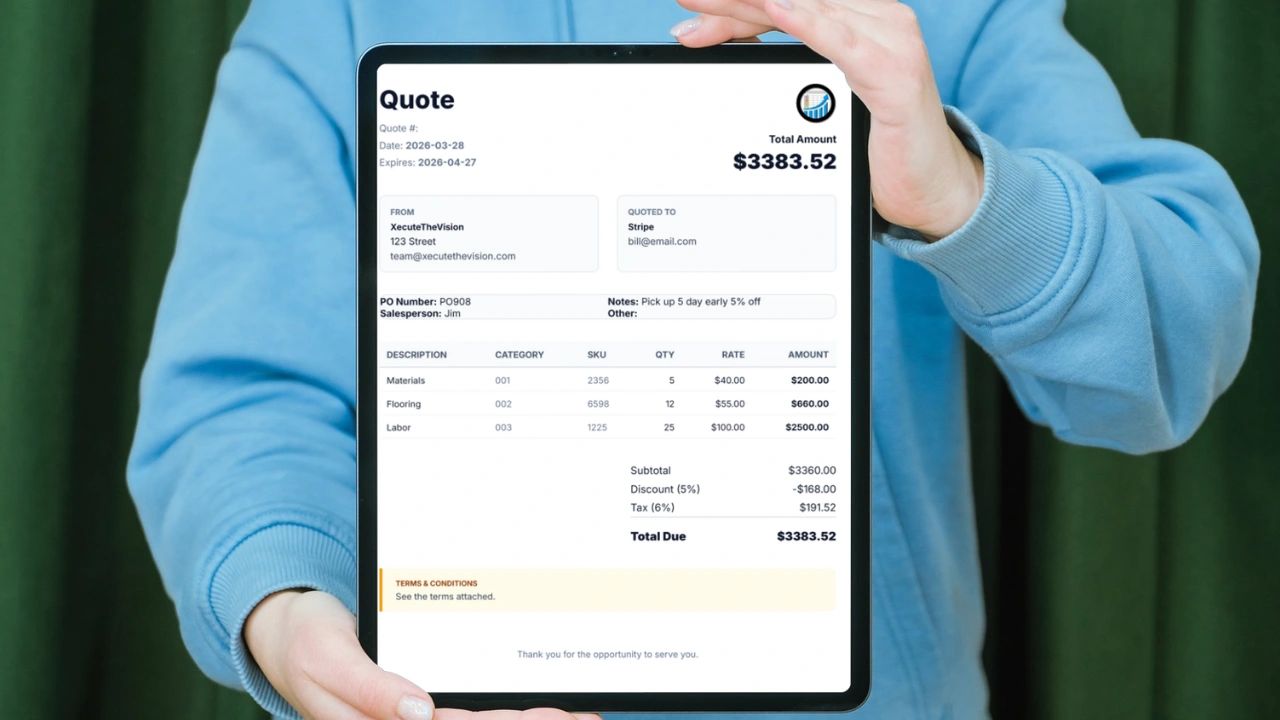
RFQ stands for Request for Quotation, and it is one of the most important documents in procurement, vendor selection, and cost control. An RFQ is not just a request for pricing. It is a structured way to control cost, compare vendors, and protect your margins. Used correctly, it becomes a powerful operational tool that most small and mid-size businesses never use formally -- and pay for that gap in hidden costs and poor vendor comparisons.
What Does RFQ Mean?
RFQ stands for Request for Quotation. It is a formal document a business sends to one or more vendors asking for pricing on specific products or services. The keyword is specific. An RFQ is not a casual inquiry or a quick email asking roughly how much something costs. It is a structured document that gives vendors exactly what they need to give you an accurate price -- nothing more and nothing less.
Businesses use RFQs when they already know what they need and the only remaining question is how much it will cost and who can deliver it best.
What an RFQ Includes
Detailed specifications: Every relevant detail about the product or service you need. Dimensions, materials, grade, model number, software version, whatever applies. The more precise your specifications, the more accurate and comparable the quotes you receive will be.
Quantities: The exact amount you need. Not approximately 500 units -- exactly 500 units. Quantity affects pricing significantly because vendors price differently at different volume thresholds. Vague quantities produce vague pricing.
Requirements: Any specific standards, certifications, compliance requirements, or quality thresholds the product or service must meet. Requirements not stated upfront often appear as expensive surprises later.
Delivery expectations: When you need it, where it needs to go, and any specific delivery conditions. A vendor who cannot meet your timeline is not a viable option regardless of their price.
What Vendors Send Back
Pricing: The cost per unit, total cost, or service fee in whatever format you specified. A well-designed RFQ tells vendors exactly how to present their pricing so you are not comparing a per-unit quote from one vendor against a total project quote from another.
Terms: Payment terms, warranty terms, return policies, and any conditions attached to the pricing. Terms matter as much as price. A vendor offering net-60 payment terms is effectively giving you additional cash flow compared to one requiring payment upfront.
Availability: Whether the vendor can fulfill your order within your required timeframe. Lead times and stock levels belong in the vendor's response and should factor into your decision alongside price.
RFQ vs Quote vs RFP
| Document | Who Sends It | When to Use It |
|---|---|---|
| RFQ | You send to vendors | You know exactly what you need -- just need pricing |
| Quote | Vendor sends to you | Their response to your RFQ with pricing and terms |
| RFP | You send to vendors | You need vendors to propose a solution, not just price one |
RFQ
You already know exactly what you need. The only open question is price. An RFQ is the right document when your decision is primarily driven by cost and you want multiple vendors to quote the same clearly defined scope. The RFQ assumes the solution is already defined. You are not asking vendors what to buy. You are asking what it will cost.
Quote
A quote is not something you send. It is something you receive. It contains the vendor's pricing, terms, and availability for the scope you defined. When responses come back in inconsistent formats with different assumptions, comparison becomes a project in itself -- which is why a structured RFQ matters.
RFP
An RFP is used when you do not fully know the solution yet. You know the problem or the outcome you need but you are asking vendors to tell you how they would approach it. Use an RFP when the solution is part of what you are evaluating. Use an RFQ when the solution is already defined and price is what you are evaluating. Sending the wrong one wastes weeks.
When to Use an RFQ
You Have Clear Specifications
If you can describe exactly what you need in writing with enough detail that any competent vendor could price it without asking follow-up questions, you are ready to send an RFQ. If you still have open questions about what you need, resolve those first or use an RFP instead.
You Want to Compare Multiple Vendors
The entire value of an RFQ process is the ability to compare vendors against each other on equal terms. If you are reaching out to three or more vendors, a standardized RFQ ensures every vendor is quoting the same thing and you are making a genuine comparison rather than a guess.
Price Is a Key Decision Factor
When cost is one of your primary evaluation criteria, the structured pricing format of an RFQ gives you the clean data you need to make a cost-based decision confidently. If price is not a primary factor and you care more about capability or approach, an RFP is likely more appropriate.
You Need Consistency in Responses
Consistency is what makes comparison possible. When every vendor responds to the same document with the same required information in the same format, your evaluation becomes straightforward. Without it, comparison requires decoding inconsistent proposals and making assumptions that introduce error.
Why RFQs Matter: The Real Value
Most businesses skip RFQs and go straight to informal inquiries. A quick email, a phone call, a message asking roughly how much something costs. That approach feels faster. It almost always costs more in the end.
When you ask a casual question you get a casual answer. Vendors fill in the gaps in your requirements with their own assumptions. One vendor assumes standard packaging. Another quotes premium packaging. One includes delivery. Another does not. You receive three numbers that appear to answer the same question and are actually answering three different questions. Comparing them is meaningless.
Apples-to-Apples Comparison
Every vendor is quoting the exact same thing because you gave every vendor the exact same document. When vendor A quotes $4.20 per unit and vendor B quotes $4.80 per unit, you know the difference is price -- not a difference in scope. That clarity is the foundation of a sound purchasing decision.
Cost Control
Hidden costs are almost always the result of vague procurement. When a vendor has unanswered questions in your request, they either make assumptions that may not match your needs or they leave room in their pricing to cover unknowns. An RFQ that covers every relevant detail leaves no room for ambiguity and therefore no room for costs to appear later.
Faster Decision Making
A structured RFQ process requires more upfront work but is significantly faster at the finish because evaluation is clean. When every vendor has responded in the same format with the same information, comparing them is a matter of reading a table rather than decoding inconsistent proposals.
Better Negotiation Power
When you have three formal quotes from three qualified vendors, you have leverage. You can go back to your preferred vendor with a competitor's lower price and ask them to match it. Without multiple formal quotes, you have no reference point. You are negotiating blind.
What to Include in an RFQ
1. Company and Vendor Information
Your business name, address, and the name and contact details of the person managing the RFQ process. Capture vendor name and contact details at the top too so every response is clearly identified from the start.
2. RFQ Details
A unique RFQ number for internal tracking, the issue date, and the response deadline -- the date and time by which vendors must submit. A deadline is not optional. An RFQ without one is a suggestion, not a process. Vendors prioritize based on urgency and without a deadline your RFQ sits behind everything that has a clear due date.
3. Product or Service Description
The most important section and the one most commonly done poorly. Your description needs to be specific enough that any qualified vendor can price it without guessing.
4. Quantity
Always specify exact amounts. Saying "approximately 500 units" gives vendors an excuse to quote a range rather than a specific number. A specific quantity produces a specific price.
5. Pricing Format
Tell vendors exactly how to present their pricing. Specify whether you want per-unit pricing, a total cost, or a line-item breakdown. If you do not specify, one vendor quotes per unit, another quotes a total project price, and a third quotes a monthly fee. Comparing them requires conversion and assumptions that introduce error.
6. Delivery Requirements
The date by which delivery must be complete, the exact delivery address, and any special conditions such as inside delivery or specific handling requirements. A vendor who cannot meet your timeline is not a viable option -- stating requirements upfront filters them out before they waste anyone's time.
7. Payment Terms and Validity Period
State your preferred payment terms and how long the vendor's quote must remain valid. This matters because prices change and you need enough time to evaluate and decide without the quote expiring. Net-30 or net-60 are standard starting points for most vendor relationships.
Free Fillable RFQ Template
Fill out the form below, then click Copy RFQ to get the complete formatted document ready to send to vendors.
Common RFQ Mistakes
Vague Requirements
The most expensive mistake. When requirements are vague, vendors fill the gaps with their own assumptions -- assumptions that are almost never identical across multiple vendors. You think you are choosing the best value. You are actually choosing the vendor whose assumptions happened to align most favorably with an incomplete brief.
Before sending an RFQ, read the product description and ask whether someone who has never spoken to you could price it accurately. If the answer is no, it needs more detail.
No Deadline
Responses trickle in over days or weeks, making it impossible to compare quotes submitted at different times under different market conditions. Your procurement process stalls. Set a deadline that gives vendors enough time to respond properly -- seven to fourteen business days is appropriate for most standard RFQs.
No Standard Format
If you send five vendors a free-form description and ask them to reply however they see fit, you receive five completely different documents. Comparing them takes hours and still leaves you uncertain whether you are comparing like with like. A template that vendors fill in solves this entirely.
Ignoring Total Cost
Unit price is the number that gets the most attention. It is often the least important number to focus on exclusively. Total cost includes the unit price plus delivery, payment terms, minimum order quantities, return policies, warranty coverage, and operational cost of managing the vendor relationship.
A vendor quoting $4.00 per unit with $500 in mandatory shipping, net-7 terms, and a 200-unit minimum may cost significantly more than one quoting $4.50 per unit with free shipping, net-30 terms, and no minimum. Always build a total cost comparison before making a final decision.
How Updoot Connects Your RFQ Process to the Rest of Your Business
Most businesses treat RFQs as one-time events. The data lives in an email thread or a spreadsheet that nobody looks at until the next time you need to buy the same thing. That disconnection is where purchasing decisions stop improving over time.
Updoot's vendor management scorecards give you a structured place to track vendor performance after the RFQ process is complete. Every vendor gets a scorecard that captures delivery time, quality, responsiveness, and cost over time. When you run your next RFQ, you are not starting from scratch -- you have documented performance data on every vendor you have worked with.
The budget to actual tracker connects your purchasing decisions directly to your financial performance. When you accept a vendor quote, that cost flows into your project budget. As the work proceeds you can see in real time whether actual vendor costs are tracking against what you quoted -- the difference between a business that controls its margins and one that discovers problems at the end of the month.
The P&L builder gives you the big picture view of how vendor costs are affecting overall profitability across the business. Instead of knowing you got a good price on one order, you can see how your total vendor spend is trending relative to revenue over time.
Related Reading