Performance Improvement Plans (PIPs): A Complete Guide for Anyone
A performance improvement plan (PIP) is a structured, documented way to help an employee improve performance in specific areas. Done correctly, it is not punitive. It is a roadmap that gives the employee a genuine, fair shot at success while giving the company clear documentation of expectations and support.
In short, a PIP identifies specific performance gaps, sets measurable goals, and outlines a support timeline, usually 30 to 90 days. It is a tool for support and accountability, not an automatic first step toward termination, and it works best with clear examples, realistic goals, and regular check-ins.
This guide covers what a PIP is, when to use one, the components of a strong plan, how the process works step by step, what to cover in the meeting, best practices, and common mistakes. It also includes a free PIP builder that assembles a complete plan with a dated check-in schedule.
Key Takeaways
A PIP identifies specific performance gaps, sets measurable SMART goals, and defines a support timeline, usually 30 to 90 days. It is not a disciplinary tool by default, though it can lead to termination if performance does not improve within the timeline.
The strongest PIPs use specific data and examples rather than vague statements, and they include real support such as coaching, training, or resources. Regular check-ins, weekly or every two weeks, matter more than the plan document itself in deciding whether a PIP actually works.
What Is a Performance Improvement Plan?
A performance improvement plan is a formal, documented plan used to help an employee improve performance in specific areas. It identifies expectations, provides clear guidance, and sets measurable goals with defined timelines.
A PIP has five purposes. It clarifies the areas where performance does not meet expectations. It sets clear, measurable improvement goals. It provides the resources, coaching, or training needed to improve. It establishes timelines for reviewing progress. And it aligns the employee's performance with the organization's objectives.
A PIP is not a disciplinary tool, although it can lead to consequences if performance does not improve. Its primary goal is support and accountability. Used well, the same structure works for an employee working toward a promotion as well as for someone correcting a performance gap.
When to Use a PIP
A PIP is appropriate when an employee consistently misses performance targets or KPIs, when feedback from performance reviews or 360 evaluations shows the same gaps again and again, when behavioral or process issues are affecting the team or the organization, and when there is real potential for improvement with structured support.
A PIP should not be the first step after a minor mistake. Early coaching and informal feedback come first. A PIP is the next step when that feedback has not led to change, and it should never be the first time an employee hears that there is a problem.
Components of a Strong Performance Improvement Plan
A well-designed PIP includes six critical components. The difference between a plan that helps and one that does not usually comes down to how specific each one is.
| Component | What to include | Weak version | Strong version |
|---|---|---|---|
| Objective | What must improve and why it matters | "Improve your attitude" | "Bring response times in line with the team standard so customers are not waiting" |
| Performance issues | Specific behaviors, outcomes, or KPIs, with data and examples | "You are slow" | "First response time averaged 9 hours over six weeks against a 4-hour standard" |
| Measurable goals | SMART goals with quantifiable targets | "Do better on tickets" | "Average first response under 4 hours for the final four weeks of the plan" |
| Action steps and support | Coaching, training, resources, and who does what | "Let me know if you need help" | "Weekly coaching, two shadowing shifts, and the product course" |
| Timeline and checkpoints | A reasonable period and scheduled check-ins | "We will review later" | "60 days with weekly check-ins on set dates" |
| Consequences and next steps | What happens if expectations are or are not met | Left unstated | Possible outcomes stated plainly and respectfully |
1. Clear Objective
State the purpose of the plan: what the employee must improve and why it matters to the organization. One or two sentences is enough.
2. Specific Performance Issues
List the specific behaviors, outcomes, or KPIs that are not meeting expectations. Use examples and data to show the gap, such as dates, numbers, and the standard being missed, rather than general impressions.
3. Measurable Goals
Define SMART goals, meaning specific, measurable, achievable, relevant, and time-bound. Each goal should have a quantifiable target so both of you will know, without debate, whether it was met.
4. Action Steps and Support
Identify the resources, coaching, or training that will help the employee improve. Spell out the manager's responsibilities as well as the employee's, because a plan in which only one side has commitments is not really a support plan.
5. Timeline and Checkpoints
Set a reasonable timeframe, often 30 to 90 days, depending on the complexity of the role and the goals. Schedule regular check-ins to monitor progress and give feedback along the way rather than waiting for the end date.
6. Consequences and Next Steps
Be transparent about the potential outcomes if expectations are not met. Emphasize that the plan is designed for success, but that accountability is required.
How a PIP Works, Step by Step
| Step | What happens | Output |
|---|---|---|
| 1. Preparation | Gather data, examples, and feedback; identify patterns | A written PIP draft |
| 2. Presentation and discussion | Private meeting to walk through the plan | Shared understanding and signatures |
| 3. Monitoring progress | Weekly or biweekly check-ins | Documented notes after each meeting |
| 4. Evaluation and follow-up | Review results at the end date | Completion, extension, or next steps |
Step 1: Preparation
Collect performance data, examples, and feedback from reviews, managers, or peers. Look for patterns in behavior, productivity, or skills gaps. Then prepare a written PIP document with all the relevant details, and review it with HR if your company has an HR function.
Step 2: Presentation and Discussion
Schedule a private meeting to review the PIP with the employee. Present the plan in a supportive, professional tone, and make sure the employee understands the expectations, the goals, and the support being provided. Ask both parties to sign the plan to acknowledge it was discussed, not necessarily that the employee agrees with every point.
Step 3: Monitoring Progress
Hold regular check-ins, weekly or every two weeks. Discuss progress, challenges, and any additional support needed, and document each conversation for accountability and transparency. Short written notes after each meeting, shared with the employee, prevent surprises at the end.
Step 4: Evaluation and Follow-Up
At the end of the PIP period, evaluate whether the goals were achieved. There are three common outcomes: successful completion and continued employment; extended support with revised goals when progress is real but incomplete; or, as a last resort, termination if performance remains unsatisfactory. Before making a termination decision, it is wise to review the documentation with HR or an employment professional.
Topics to Cover in a PIP Meeting
The meeting where you present the plan sets the tone for everything that follows. Cover each of these topics, and leave room for the employee to respond.
| Topic | What to cover |
|---|---|
| Performance gaps | Where expectations are not met, with specific examples |
| Goals and KPIs | The measurable targets the employee must reach |
| Support and resources | Training, mentoring, or tools that will be provided |
| Timeline and milestones | Deadlines and check-in dates |
| Feedback and dialogue | Time for the employee's questions and perspective |
| Behavior and professionalism | If relevant, collaboration, communication, or cultural fit |
Free Performance Improvement Plan Builder
Use the builder below to put together a complete PIP in minutes. Enter the employee, role, manager, and department, choose a start date, a plan length of 30, 60, or 90 days, and weekly or biweekly check-ins. List each performance issue with a specific example, then add SMART goals with a measure and a target for each.
The builder assembles the finished plan, including a dated check-in schedule and signature lines, and flags anything missing, such as a goal with no measure. Every field is optional, but the more detail you add, the more useful the plan will be. The example shows a customer support specialist on a 60-day plan. Copy it to Excel for a tracker with live end date, days remaining, goal status, and check-in date formulas, or print the finished plan.
Performance Improvement Plan Builder
Fill in the details and the builder assembles a complete PIP document with a dated check-in schedule. Add as many performance issues and SMART goals as the situation needs. Copy it to Excel for a tracker with live date and status formulas, or print the finished plan. Nothing you enter is saved or sent anywhere.
Performance issues (one per line, with a specific example)
SMART goals
Support and resources provided
Outcome if goals are not met
Your plan
Best Practices for a Performance Improvement Plan
Focus on growth. Emphasize development and improvement, not punishment. The tone of the first meeting often decides whether the employee engages or disengages.
Be specific. Avoid vague statements. Use data and concrete examples the employee can recognize.
Keep it fair. Make sure expectations are realistic and achievable within the timeline, and consistent with what is expected of others in the same role.
Maintain transparency. Document everything and communicate openly, including progress the employee is making.
Provide ongoing support. Check-ins, coaching, and resources are critical for success. A plan with no support is a paper trail, not a plan.
Act in time. Address performance issues as soon as they are observed, not months later when frustration has built up on both sides.
Common Mistakes to Avoid
The most common mistake is using a PIP only as a disciplinary step, which employees quickly recognize and which undermines the whole process. Close behind are vague or unrealistic goals, failing to provide the support or resources the plan promises, skipping follow-up or check-ins, and ignoring the employee's input or feedback.
A PIP is most effective when employees feel supported, understood, and accountable.
Conclusion
A performance improvement plan is a powerful tool for managers and HR teams to guide underperforming employees toward success. By clearly defining expectations, setting actionable goals, and offering structured support, organizations can improve performance and engagement, keep high-potential employees, align workforce capabilities with organizational objectives, and build a culture of accountability and growth.
Remember that a PIP is not a punishment. It is an opportunity for employees to succeed, grow, and contribute meaningfully to the organization. When it is executed thoughtfully, it is a win for both the employee and the business.
Updoot is business management software that keeps performance reviews, goals, HR records, and check-in notes in one place for $5 per user per month. You can start free today.
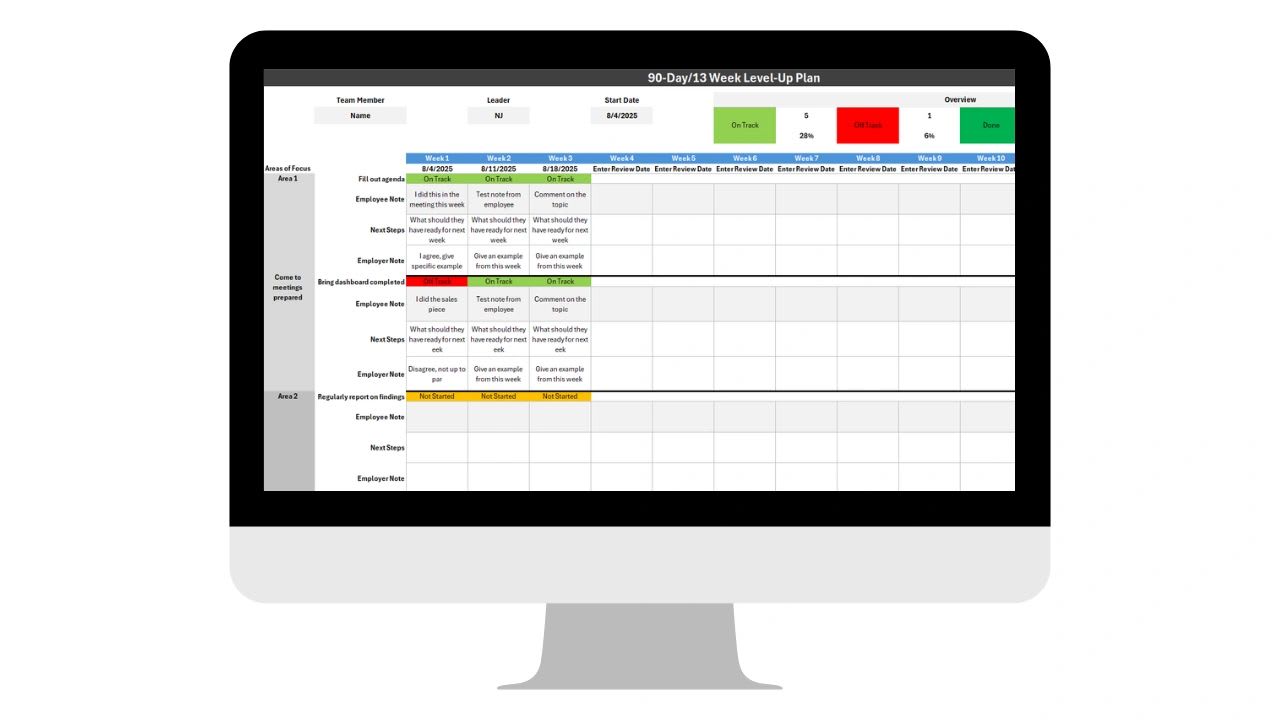
Opens in Google Drive. View and download for free.
Related Reading
How to Do a Performance Review (Step-by-Step With Template) →
Frequently Asked Questions About Performance Improvement Plans
What is a Performance Improvement Plan?
A Performance Improvement Plan, or PIP, is a formal, documented plan used to help an employee improve performance in specific areas. It identifies expectations, sets measurable goals with defined timelines, and outlines the support a manager will provide along the way.
Is a PIP the same as being fired?
No. A PIP is not a disciplinary tool or a formality before termination, even though it can lead to termination if performance does not improve. Its primary purpose is support and accountability, giving an employee a structured, documented opportunity to meet clear expectations.
How long should a PIP last?
Most PIPs run 30 to 90 days, depending on the complexity of the role and the nature of the performance gap. The timeline should be long enough to show real, sustained improvement, with regular check-ins built in rather than a single review at the end.
When should a manager use a PIP instead of informal coaching?
A PIP fits when an employee consistently misses performance targets or KPIs, when repeated feedback has not led to change, or when a performance or behavioral gap is affecting the team. A single minor mistake usually calls for informal coaching first.
What should be included in a PIP document?
A strong PIP includes a clear objective, the specific performance issues with examples, measurable SMART goals, the support and resources the employee will receive, a timeline with check-in dates, and a transparent statement of what happens if expectations are not met.
Should the employee sign the PIP?
It is common to ask for a signature acknowledging the plan was discussed. Make clear that signing confirms receipt, not agreement with every point, and give the employee space to add comments.
What happens at the end of a PIP?
The manager reviews results against the goals. Common outcomes are successful completion, an extension with revised goals when progress is real but incomplete, or further action if performance has not improved.