
RASCI Charts: The Hidden Secret to Clarity and Accountability
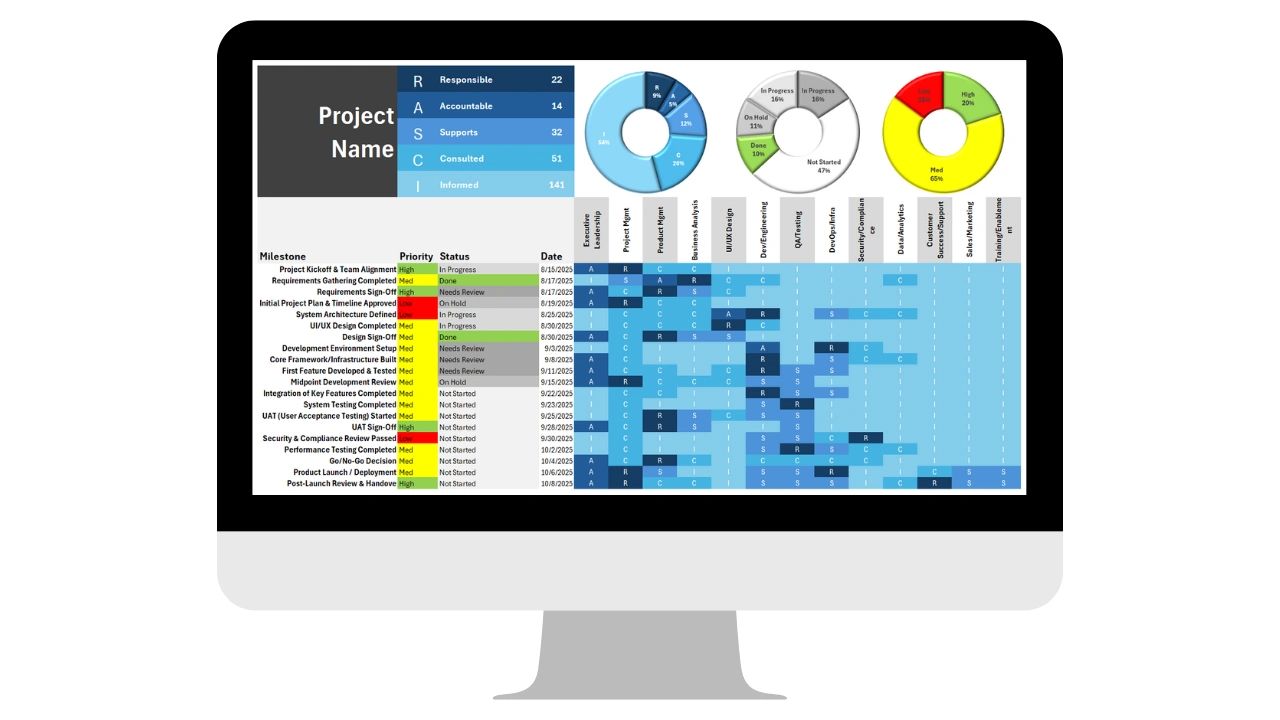
In any organization, confusion about who owns what task is a silent productivity killer. Emails pile up, decisions stall, and team members waste hours figuring out whether they’re supposed to do it or someone else.
Enter the RASCI chart a simple yet powerful tool that can transform how teams work.
What is RASCI?
RASCI stands for:
- R – Responsible: The person who actually does the work.
- A – Accountable: The person ultimately answerable for the task’s success; they approve and sign off.
- S – Support: Those who assist in completing the task.
- C – Consulted: People whose input is sought before decisions are made.
- I – Informed: People who need to be kept updated on progress or outcomes.
A RASCI chart is essentially a table that maps tasks or decisions against roles or team members. By defining these five roles for every task, you eliminate confusion, duplication, and bottlenecks.
Why RASCI Charts Matter
Organizations without clear ownership often suffer from:
- Decision delays: Nobody knows who is responsible for approval.
- Duplicated effort: Multiple people do the same work without realizing it.
- Accountability gaps: Mistakes happen, and no one is clearly responsible.
- Communication overload: Teams spend too much time updating everyone instead of executing.
A RASCI chart addresses all of these by clearly defining who does what and who needs to know.
Benefits include:
- Clarity: Everyone knows their responsibilities and role in each task.
- Accountability: One person is accountable for each key decision or deliverable.
- Efficiency: Reduces back-and-forth emails and unnecessary meetings.
- Alignment: Ensures all stakeholders are consulted or informed appropriately.
- Onboarding and scaling: Makes it easy to integrate new team members without confusion.
Who Needs a RASCI Chart?
RASCI charts are valuable in almost any context, but particularly for:
- Project teams: Complex projects with multiple dependencies.
- Cross-functional initiatives: Marketing, operations, product, and finance often overlap.
- Executives and leadership teams: For clarity on decision-making authority.
- Startups scaling quickly: Avoid chaos as responsibilities shift or new hires join.
- Change management: Helps clearly assign roles for process or system implementation.
Essentially, any team facing confusion, delayed decisions, or unclear accountability can benefit from a RASCI chart.
How to Fill Out a RASCI Chart
Here’s a step-by-step guide:
1. List all tasks or deliverables
Start by creating a vertical column for every key task, milestone, or decision. Be specific as vague tasks like “marketing” don’t work as well as “Write Q3 campaign copy.”
2. List all roles or team members
Across the top, list every person or role involved. This can be individual names, teams, or departments. At times, you may not need all of the letters as some can have crossover in smaller organizations so just don't use them.
3. Assign R, A, S, C, I for each task
- Responsible (R): Who actually performs the task?
- Accountable (A): Who signs off on the final outcome? Only one person should be accountable per task.
- Support (S): Who helps the responsible person complete it?
- Consulted (C): Who must provide input before the task can be completed?
- Informed (I): Who needs updates on progress or completion?
4. Review and confirm
Share the chart with the team and adjust based on feedback. Ensure there’s exactly one accountable person per task too many leads to confusion.
5. Use it actively
The RASCI chart isn’t just a document. Reference it in meetings, project planning, and decision-making to ensure alignment and clarity.
Tips for Making RASCI Charts Work
- Keep it simple: Don’t overcomplicate with too many tasks or roles.
- Use colors or symbols: Highlight responsibilities visually for easier reference.
- Treat it as living: Update as roles change or projects evolve.
- Pair with project management tools: RASCI charts integrate well with tools like Asana, Monday.com, or Excel templates.
- Avoid “everyone is accountable”: One accountable person per task is critical.
Overall
A RASCI chart may seem like a small tool, but its impact on clarity, speed, and accountability is massive. Teams that use RASCI charts:
- Make decisions faster
- Reduce wasted effort
- Scale projects without confusion
- Onboard new members efficiently
If your team is struggling with unclear ownership, duplicated work, or delayed decisions, a RASCI chart is one of the simplest, most effective ways to regain control and move faster.
Because clarity isn’t just nice it’s a competitive advantage.