
If You Don’t Do It, Customers and Employees Will: Build a Company Roadmap
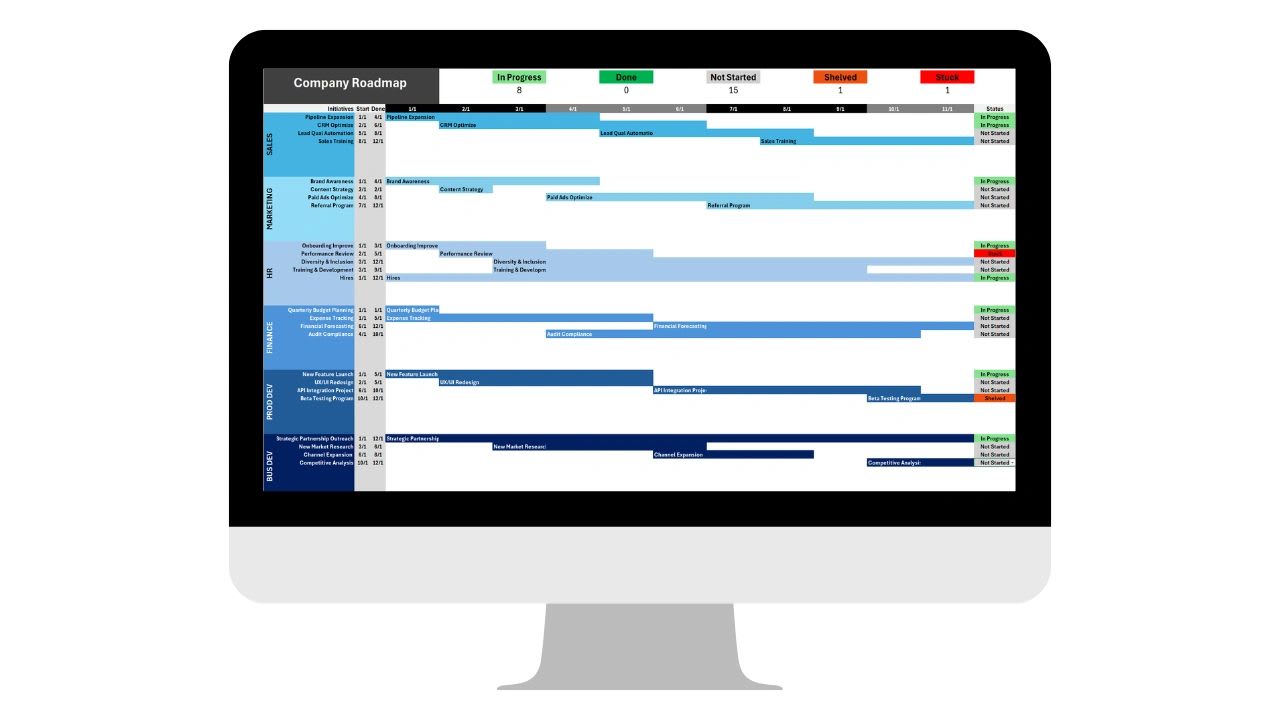
A company roadmap is how you make sure your business tells its own story. Every business tells a story. The question is whether you are the one telling it, or whether employees and customers are left to guess and fill in the blanks themselves.
When your team does not know where the company is headed, they make assumptions. When your customers do not see your vision, they imagine one. And most of the time, those assumptions do not line up with your actual goals.
The solution is simple but powerful: create a company roadmap. This guide covers what a roadmap is, why every business needs one, who should have one, how to build it, and what to include, with a free company roadmap builder below.
👉 Download the Company Roadmap Template here
What Is a Company Roadmap?
A company roadmap is a high-level plan that shows where your business is going and the major steps you will take to get there. It is not a to-do list or a task tracker. It is the big picture.
Think of it as your business GPS. It does not tell you every turn, but it lays out the milestones, the direction, and the destination. Employees can see how their work contributes to the bigger vision. Customers can see how your product, service, or company is evolving over time.
I recommend starting simple: a one-year roadmap broken into four quarters. That way, you are thinking far enough ahead to set direction but not so far ahead that the plan becomes irrelevant.
Why Every Business Needs a Company Roadmap
The difference between a business with a roadmap and one without shows up in how people behave.
| Without a roadmap | With a roadmap |
|---|---|
| Employees guess. They wonder what matters most, duplicate work, or get stuck waiting for direction. | Transparency builds trust. Employees know the plan, and customers see your commitment. |
| Customers guess. They fill in the blanks about where you are headed, sometimes assuming you are stagnant, disorganized, or not listening. | Alignment increases productivity. When everyone rows in the same direction, things get done faster. |
| Leaders spin their wheels. Without alignment, they waste energy chasing too many priorities at once. | Accountability becomes natural. Goals, resource plans, and milestones are written down, shared, and visible. |
| Growth feels like talk. People hear ambitions but see no plan. | Confidence grows. People see you are planning for growth, not just talking about it, and get excited about what is coming. |
Who Should Have a Company Roadmap?
The short answer: every organization.
| Organization | How a roadmap helps |
|---|---|
| Startups | Rallies small teams, attracts investors, and reassures early customers |
| Small and mid-sized businesses | Creates focus when resources are tight and priorities compete |
| Enterprises | Aligns large teams across departments, regions, and product lines |
| Nonprofits | Communicates impact goals to donors, volunteers, and the communities served |
Industries vary, but the principle is universal. Tech companies use roadmaps to show upcoming product releases. Service businesses use them to signal growth plans and capacity. Manufacturers use them to align production and supply chain strategies. Even creative agencies use them to show clients how their capabilities and offerings will evolve.
If your business touches employees, customers, investors, or partners, your organization needs a roadmap.
How to Build a Company Roadmap That Works
Here is a simple six-step framework to get started.
Step 1: Choose Your Timeframe
Start with one year. You can expand later once the habit is in place.
Step 2: Break It Down by Quarter
Four clear phases are easier to track and adapt than one long list.
Step 3: Identify Your Big Priorities
Think in terms of outcomes, not tasks. For example, write "Launch customer feedback program" instead of "Send survey." Three to five big priorities for the year is plenty for most small businesses.
Step 4: Make It Visual
Your roadmap should be skimmable in under a minute. Boxes, timelines, or grids work well.
Step 5: Share It
A roadmap no one sees is not a roadmap; it is a file. Share it with employees and, when appropriate, customers.
Step 6: Update It Quarterly
Businesses change, and so should your roadmap. Treat it as a living tool, not a static artifact.
What to Include in a Company Roadmap
Your roadmap does not have to be complicated. Start with these five elements.
| Element | What it answers | Example |
|---|---|---|
| Vision | The why behind your direction | Be the most trusted home service company in our region |
| Major goals | What you plan to accomplish | Grow recurring revenue from maintenance plans |
| Key initiatives | How you will get there | Add a maintenance plan offering |
| Milestones by quarter | Checkpoints to measure progress | 50 customers enrolled by the end of Q3 |
| Ownership | Who is accountable for each initiative | Maya owns the maintenance plan launch |
Pro tip: keep it simple. A roadmap that is too detailed turns into a project plan, which defeats the purpose. The details belong in your project tracker; the roadmap shows the destination and the major stops.
Company Roadmap Examples
A SaaS company shares a public roadmap with customers, building trust by showing upcoming features and gathering feedback before they are built.
A small professional services firm creates a one-page internal roadmap so employees know when hiring, training, and new service launches are planned, and nobody is surprised by a new hire or a new offering.
A manufacturer uses a roadmap to keep sales, production, and distribution aligned, reducing costly bottlenecks when a new product line ramps up.
The common thread? Transparency and alignment.
Free Company Roadmap Builder
Use the builder below to draft your first one-year roadmap. Write your vision in one sentence, then add each initiative as an outcome with a quarter, an owner, a milestone, and a status. The builder lays it out as a one-page board by quarter that you can print and share.
It also checks the basics. In the example, a home service company has seven initiatives across the year, one already done. The website refresh has no owner, so the builder flags it, because an initiative nobody owns is an initiative nobody delivers.
Copy the roadmap to Excel, where the quarter counts, owner flags, and percent done stay live formulas, or print it for your next all-hands meeting. For a ready-made version, download the Company Roadmap Template.
Company Roadmap Builder
Write your vision in one sentence, then list the big initiatives for the year with a quarter, an owner, the milestone that proves it is done, and a status. The builder lays them out as a one-page roadmap by quarter and flags initiatives with no owner and quarters that are empty or overloaded. Nothing you enter is saved or sent anywhere.
Your one-page roadmap
Lead the Narrative With a Company Roadmap
Here is the truth: if you do not clearly communicate where your business is going, employees and customers will write their own version of your roadmap, and it may not be the one you want.
A company roadmap is your chance to lead the narrative, inspire confidence, and align your entire ecosystem around a shared future. To make it easy, I have created a Company Roadmap Template you can download and use today.
👉 Download the Company Roadmap Template here
Give your team and your customers clarity. Stop the guessing game, and start building trust through transparency. When you are ready to connect the roadmap to the work, Updoot is business management software for $5 per user per month with a Vision Tracker and Gantt roadmap builder built in.
Opens in Google Drive. View and download for free.
Related Reading
The Vision Tracker: Turning Long-Term Vision Into Execution →
Goal Tracker Inspired by Traction by Gino Wickman →
What Is a Gantt Chart and How to Create a Gantt Chart in Excel →
Frequently Asked Questions About Company Roadmaps
What is a company roadmap?
A company roadmap is a high-level plan that shows where your business is going and the major steps to get there. It shows the big picture, not individual tasks.
What should be included in a company roadmap?
A vision, major goals, key initiatives, milestones by quarter, and an owner for each initiative.
How far ahead should a company roadmap go?
Start with one year broken into four quarters. That is far enough to set direction without the plan becoming irrelevant.
Should you share your roadmap with customers?
Often, yes. Sharing a customer-facing version builds trust and shows your business is evolving. Keep sensitive internal items on the internal version only.
How often should a company roadmap be updated?
Review and update it every quarter, and any time a major change in the business shifts your priorities.
What is the difference between a roadmap and a project plan?
A roadmap shows outcomes, milestones, and owners at a high level. A project plan breaks each initiative into detailed tasks, dates, and dependencies.
Who owns the company roadmap?
The leadership team owns it, usually led by the CEO or COO, with a named owner for every initiative on it.