
How to Use Customer Feedback to Build a Product Roadmap
Use our free customer feedback template to build a product roadmap that actually gets shipped. Most product roadmaps fail before they ever reach a customer. They are built in conference rooms by people who are convinced they already know what users want, stacked with features that sound good in theory, and organized around gut instinct dressed up as strategy. The result is a document that satisfies no one, launched into a market that never asked for it.
The fix is not complicated, but it requires discipline: build your roadmap from the outside in. That means putting customer feedback at the center of every prioritization decision you make, and creating a system that continuously translates what users say into what your team actually builds.
Here is how to do it properly.
Start by Defining What "Feedback" Actually Means
Before you collect anything, get clear on what counts as useful feedback. Not all input is equal. A feature request from a churned user carries different weight than a repeated complaint from your highest-value accounts. A five-star review tells you less than a 90-minute user interview. A support ticket about a bug is not a roadmap signal the same way a pattern of 200 identical tickets is.
Useful feedback for roadmap planning generally falls into a few categories:
Direct qualitative input covers interviews, focus groups, open-ended survey responses, and recorded user sessions. This is where you find the "why" behind behavior. A user might tell you they stopped using a feature not because it was broken, but because finding it took too long. That kind of nuance does not show up in your analytics.
Quantitative behavioral data tells you what users do, not what they say. Feature adoption rates, session lengths, drop-off points in onboarding flows, and usage frequency are all signals. When you cross-reference these with qualitative input, patterns become a lot harder to ignore.
Reactive feedback is what comes in through support channels, review sites, social media, and sales conversations. It is often emotionally charged, which makes it easy to dismiss. Do not. Reactive feedback is usually triggered by real friction, and friction is exactly what your roadmap should be designed to reduce.
Competitive displacement data is underused by most teams. When you win a deal, ask why. When you lose one, ask the same question. The answers shape your roadmap just as much as what your existing users say.
Build a Customer Feedback Collection System Before You Need It
The biggest mistake product teams make is trying to gather feedback after a roadmap decision has already been made, just to validate what they already planned. That is confirmation bias with extra steps.
Instead, build a continuous feedback loop that runs independently of any specific feature cycle. This means setting up dedicated channels and habits:
Quarterly user interviews should be non-negotiable. Talk to a cross-section of your user base, not just the happy ones. Include users who barely engage with your product, because their friction points reveal what your most forgiving power users have learned to work around. Aim for a consistent set of questions each quarter so you can track sentiment shifts over time, and leave room for open-ended exploration.
In-product feedback widgets capture feedback at the moment of use, which is when it is most accurate. A well-placed prompt asking "How could this feature work better for you?" after a user completes a task yields far richer responses than a monthly email survey sent to the whole list.
Customer Success alignment is often the most underutilized source of roadmap intelligence. Your CS team hears the same complaints dozens of times before they ever make it into a formal feedback channel. Create a lightweight process for them to log themes and route them to the product team regularly, not quarterly.
Sales call recordings are a goldmine. Prospects reveal what is missing from your product in real time, often in specific, actionable language. If your sales team closes deals in spite of a feature gap, that gap belongs on your roadmap.
Organize Customer Feedback Into Themes, Not Features
When feedback starts flowing in, the instinct is to turn each piece into a feature request and add it to a list. Resist this. Raw feedback is messy, contradictory, and often misleading at the individual level.
Instead, organize feedback into themes. A theme is a recurring pattern that points to an underlying need, not a specific solution. "Users want a dark mode" is a feature request. "Users struggle to use the product for long periods in low-light environments" is a theme. One tells you what to build; the other tells you why it matters and leaves room for better solutions.
Tag and categorize feedback as it comes in. Most teams find that somewhere between five and twelve recurring themes emerge from a consistent feedback corpus. These themes become the building blocks of your roadmap, because they represent genuine user needs rather than individual wishlist items.
Common themes tend to cluster around onboarding friction, workflow integration, reporting and visibility, collaboration features, and performance issues. Yours will vary depending on your product and market, but the process of finding them is the same: read the feedback, find the pattern, name the underlying problem.
Prioritize Ruthlessly Using a Structured Framework
Once you have themes, you need a way to rank them. This is where many teams fall apart. Everything feels urgent. Every customer who sends feedback feels like their request should be at the top of the list.
A simple but effective framework for prioritizing feedback-driven roadmap items uses three dimensions:
Frequency measures how often a theme appears across your feedback corpus. If 40% of your user interviews surface the same friction point, that is not a coincidence. Weight high-frequency themes heavily.
Impact estimates the effect on user outcomes if the problem were solved. A theme that affects a small number of power users who drive a disproportionate share of your revenue might outrank a theme that appears more frequently among users with lower engagement. Tie impact estimates to your business metrics wherever possible.
Effort is the cost of building the solution. A high-frequency, high-impact problem that requires six months of engineering time might rank below a medium-frequency problem that could be solved in two weeks, depending on your current situation.
Tools like RICE scoring (Reach, Impact, Confidence, Effort) or simple weighted matrices can operationalize this process. The specific framework matters less than the discipline of applying it consistently across every roadmap decision.
Connect Feedback to Product Roadmap Items Explicitly
One of the most important things you can do when building a feedback-informed roadmap is to make the connection between user input and roadmap items visible and explicit. Every item on your roadmap should trace back to specific feedback signals.
This serves two purposes. First, it forces rigor. If you cannot point to feedback that supports a roadmap item, you have to ask whether it belongs there at all. Second, it builds trust. When you share your roadmap with customers, being able to say "we built this because of what you told us in March" creates a feedback loop that encourages more users to share input in the future.
Document the feedback sources behind each roadmap item in whatever tool your team uses to manage the roadmap itself. Even a simple notation linking a feature to a cluster of support tickets or a set of interview quotes is better than nothing.
Communicate Your Roadmap to Customers
A roadmap shaped by customer feedback is only as powerful as the communication surrounding it. Customers who share feedback and never hear from you again stop sharing. Close the loop consistently.
This does not mean sharing every detail of your internal planning. It means telling customers which themes you are working on, roughly when, and what drove the decision. A quarterly "here is what we heard, here is what we are doing about it" communication builds more trust than any feature announcement.
Be honest about trade-offs. If a frequently requested feature is not on the near-term roadmap, explain why. Customers can handle nuance. What they cannot handle is silence or the feeling that their input disappeared into a void.
Revisit and Revise
A roadmap built on customer feedback is not a static document. New feedback will challenge your assumptions. Market conditions shift. Features you thought would solve a problem turn out to solve a different one.
Build a regular cadence for revisiting your roadmap against your feedback data. Monthly reviews of incoming themes and quarterly reassessments of priorities keep the roadmap alive rather than turning it into a historical artifact.
Track the outcomes of decisions you made based on feedback. Did solving that theme actually improve the metrics you expected? If not, you have learned something valuable about how you interpret feedback, and that knowledge improves your next cycle.
The Right Product Roadmap Tools Make the System Work
Collecting, organizing, and acting on customer feedback at scale requires tools that support the workflow rather than create friction. Dedicated feedback management platforms, CRM integrations, and roadmapping tools all play a role, but the most important tool is the one that connects feedback data to roadmap decisions in a single view.
This is where Updoot's customer profile feature becomes particularly valuable. Rather than treating feedback as a collection of individual messages, Updoot builds rich customer profiles that aggregate input across all of your feedback channels. You can see exactly which customers have flagged a given theme, what their usage patterns look like, and how their feedback has evolved over time. That context turns raw feedback into prioritization intelligence, because you can filter and segment by customer type, revenue, engagement level, or any other dimension that matters to your business.
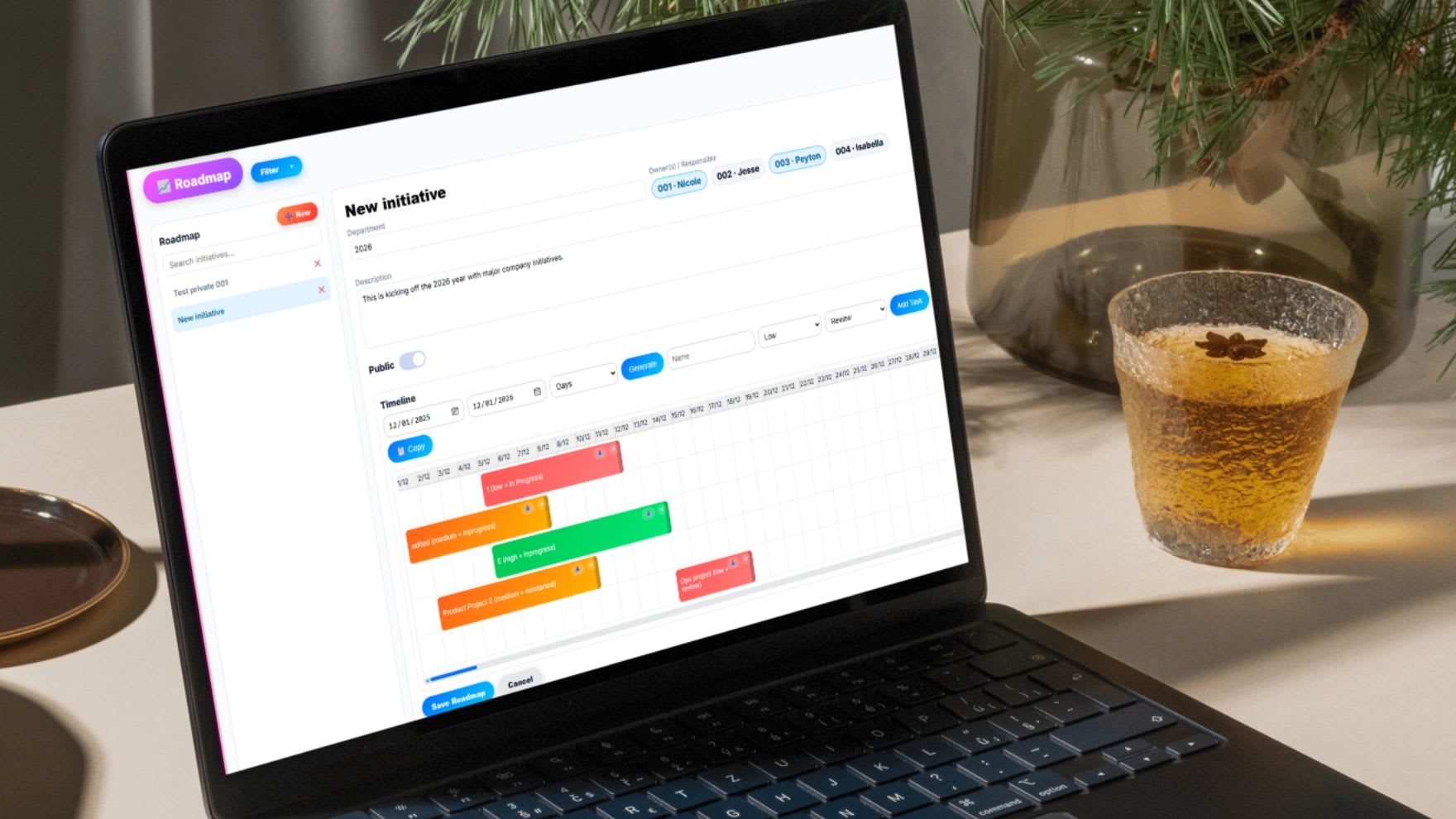
Pair that with Updoot's Gantt-style roadmap builder, and you have a complete system: feedback collected and organized through customer profiles, then mapped directly onto a visual timeline that the whole team can work from. The Gantt view makes dependencies visible, surfaces scheduling conflicts before they become problems, and gives stakeholders a clear picture of what is coming and when. It is the kind of tool that makes a feedback-driven roadmap not just possible but sustainable, because it reduces the administrative overhead that causes most teams to abandon the process after a quarter or two.
Frequently Asked Questions
What is the difference between customer feedback and a feature request?
Customer feedback describes a problem or friction point. A feature request describes a solution. Good roadmap planning starts with the problem, not the solution, because the solution a customer suggests is rarely the best one available.
How often should you collect customer feedback for roadmap planning?
At minimum quarterly, but the best teams build continuous feedback loops that run independently of any specific feature cycle so decisions are never made in a vacuum.
What do you do with contradictory customer feedback?
Organize it into themes rather than individual requests. Contradictions at the individual level often reveal a consistent underlying need when you zoom out and look at patterns across your entire feedback corpus.
How do you prioritize customer feedback on a product roadmap?
Use a framework that weighs frequency, impact, and effort. RICE scoring is a popular option. The specific framework matters less than applying it consistently to every roadmap decision.
Should you share your product roadmap with customers?
Yes. Customers who share feedback and never hear back stop sharing. A simple quarterly update on what you heard and what you are doing about it builds more trust than any feature announcement.
Final Thought
Building a product roadmap from customer feedback is not about giving every customer exactly what they ask for. It is about listening well enough to understand the real problems underneath the requests, and being disciplined enough to make prioritization decisions that serve the broadest set of genuine user needs.
The teams that do this consistently build better products. Not because they are smarter, but because they have stopped guessing.