
Hiring Scorecard: How to Hire Better and Faster
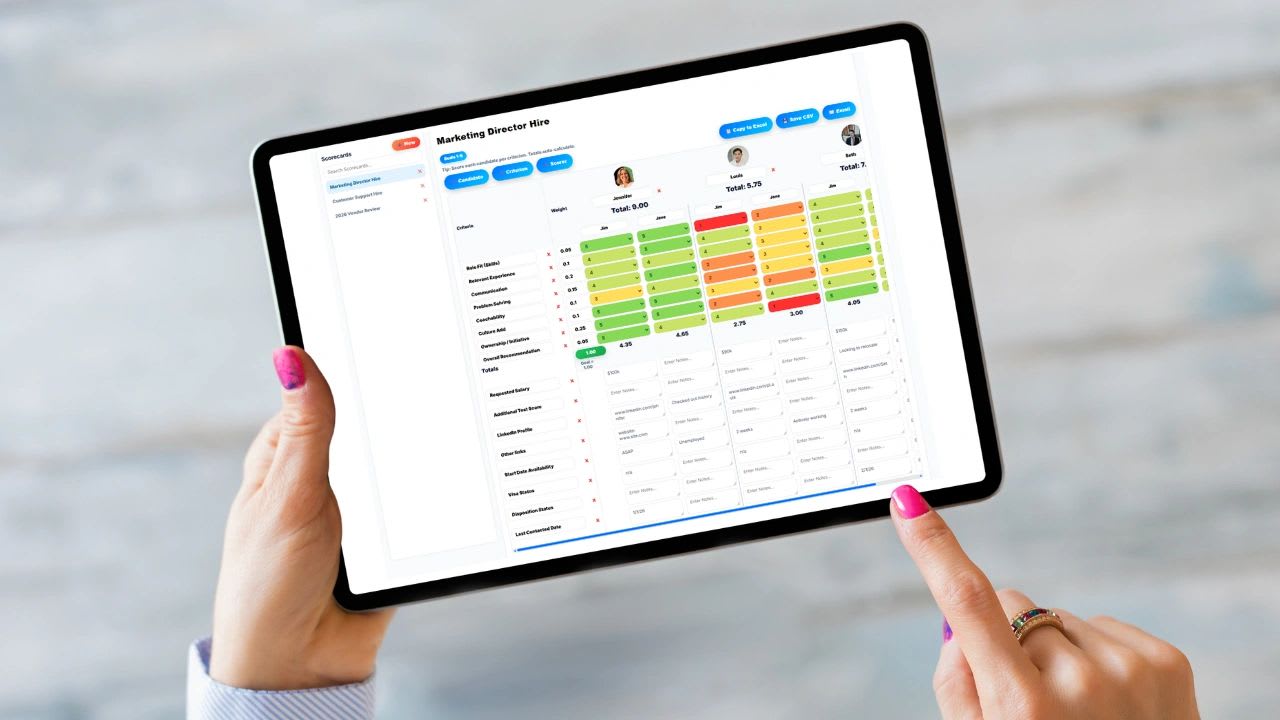
A hiring scorecard is a simple sheet that lists what a new hire must accomplish, the handful of skills that matter most, and how each interviewer should score them. It sounds basic, but it changes the whole process. Instead of walking out of an interview and asking "did we like them?", your team asks "did they show us they can do this job?"
Most bad hires are not talent problems. They are evaluation problems: different interviewers asking different questions, charm winning over evidence, and decisions made on gut feel. A scorecard fixes that by giving everyone the same yardstick.
Below you will learn what goes into a strong scorecard, how to build one in five steps, and how to use the free weighted scorecard tool to compare your candidates.
What Is a Hiring Scorecard?
A hiring scorecard is a structured evaluation tool that rates every candidate for a role against the same predefined criteria. Each criterion gets a score, usually on a 1 to 5 scale, and often a weight that reflects how much it matters. The result is a comparable score for every candidate plus an overall recommendation.
Instead of "did I like them?", a scorecard asks:
- Did they show the skills the role requires?
- Can they deliver the outcomes this role is responsible for?
- Do they work the way our team works?
- What evidence supports each score?
Why a Hiring Scorecard Matters
Every hire affects revenue, productivity, morale, customer experience, and turnover. A bad hire costs more than a salary. It costs the time spent recruiting, training, managing the problem, and hiring again. Without structure, decisions tend to be emotional, inconsistent, hard to defend, and impossible to improve over time. A scorecard makes hiring repeatable and gives you data you can learn from.
Problems a Hiring Scorecard Solves
| Problem | What Happens Without a Scorecard | What the Scorecard Changes |
|---|---|---|
| Inconsistent interviewing | Each interviewer asks different questions and judges differently | Everyone scores the same criteria on the same scale |
| Bias | Charisma and similarity win over competence | Scores must be backed by evidence tied to the job |
| Vague expectations | Nobody agrees on what success looks like | Role outcomes are written down before interviews start |
| Groupthink | The loudest opinion decides | Interviewers score independently before discussing |
What to Include in a Hiring Scorecard
1. Role Outcomes
Define what the person must achieve, not just their duties. "Generate 15 qualified leads a month," "cut invoice processing time by 20% within 90 days," or "close 25% of inbound opportunities." Outcomes change how you interview, because you start looking for evidence of results rather than a good conversation.
2. Core Competencies
The skills needed to deliver those outcomes, such as communication, problem-solving, technical ability, time management, or closing. Pick five to eight so interviewers can stay focused.
3. Values and Working Style
Culture should not mean "someone I would grab coffee with." Score specific behaviors like ownership, speed of execution, customer focus, and collaboration. See how to hire for cultural fit for ways to do this without bias.
4. Experience and Qualifications
Relevant experience, industry exposure, required certifications, and past measurable results. These matter, but they should not outweigh evidence that the person can do the work.
5. Weights
Not every criterion matters equally. Assign a weight to each so the most important factors drive the final score. For a sales role, results might carry 30% while industry experience carries 10%.
6. Overall Recommendation
End with a clear call: Strong Hire, Hire, Lean No, or No Hire. This makes side-by-side comparison easy.
How to Create a Hiring Scorecard in 5 Steps
Step 1: Define the Role
Before you post the job, write down what this person must accomplish in the first 90 days, what problems they are solving, and what success looks like at six months. Most hiring mistakes start with unclear expectations. A clear job description helps.
Step 2: Choose and Weight the Competencies
Pick five to eight measurable criteria and replace vague words with definitions. "Good communicator" becomes "explains complex topics clearly and checks for understanding." Then assign weights so the criteria that matter most count most.
Step 3: Define the Scoring Scale
| Score | Meaning |
|---|---|
| 5 | Exceptional. Strong, specific evidence well beyond the requirement. |
| 4 | Strong. Clear evidence of the skill with minor gaps. |
| 3 | Meets expectations. Adequate evidence. |
| 2 | Below expectations. Limited or unconvincing evidence. |
| 1 | Does not demonstrate the skill. |
Step 4: Tie a Question to Each Competency
Every competency gets at least one structured question, asked the same way to every candidate. For problem-solving: "Tell me about a time you found a process inefficiency and fixed it. What changed as a result?"
Step 5: Score Independently Before Discussing
Each interviewer submits scores and a short note of evidence before the debrief. This prevents the first or loudest opinion from swaying the group and makes the discussion about evidence.
Free Weighted Hiring Scorecard
Adjust the competencies and weights for your role, then score each candidate. The ranking updates as you go.
Free Weighted Hiring Scorecard
Set the competencies for the role and how much each one matters. Then score each candidate from 1 to 5. The scorecard calculates a weighted score, gives a recommendation, and ranks your candidates side by side.
1. Competencies and Weights
| Competency | Weight (%) |
|---|
2. Candidates
Recommendations use these cutoffs: 4.3 and above is Strong Hire, 3.6 to 4.29 is Hire, 3.0 to 3.59 is Lean No, and below 3.0 is No Hire. Adjust them to match how selective the role needs to be.
Hiring Scorecard Template for Excel
Prefer a spreadsheet? Paste this template into cell A1 of a blank sheet. Weights are in column B as decimals, and the last row calculates each candidate's weighted score with SUMPRODUCT.
Competency	Weight	Question Asked	What a 5 Looks Like	Candidate A	Candidate B
Role outcomes and results	0.30	Walk me through a result you delivered that is similar to this role's 90-day goal.	Specific, measurable results with their own role clearly explained	5	3
Problem-solving	0.20	Tell me about a time you found a process inefficiency and fixed it.	Clear diagnosis, action, and measured improvement	4	4
Communication	0.20	Explain a complex project you worked on to someone outside your field.	Structured, concise, checks for understanding	4	5
Ownership and accountability	0.20	Describe a mistake you made at work and what happened next.	Owns it, fixes it, changes the process	5	3
Relevant experience	0.10	What experience prepares you for the first 90 days here?	Directly relevant experience with results	3	5
Weighted score	=SUM(B2:B6)			=SUMPRODUCT($B$2:$B$6,E2:E6)	=SUMPRODUCT($B$2:$B$6,F2:F6)
Does a Hiring Scorecard Reduce Bad Hires?
It improves the odds considerably. Bad hires usually come from overweighting personality, missing skill gaps, skipping structured evaluation, or rushing. A scorecard slows down emotional decisions and replaces them with evidence. It will not remove all risk, but it makes decisions consistent, explainable, and easier to improve. When a hire does not work out, you can look back at the scores and see which criteria missed.
Sample Scorecard for a Customer Success Manager
| Competency | Weight | Interview Question |
|---|---|---|
| Retention results | 30% | Tell me about an at-risk account you turned around. What did you do and what was the result? |
| Customer communication | 20% | Walk me through how you would deliver bad news to a frustrated client. |
| Problem-solving | 20% | Describe a recurring customer issue you traced back to its root cause. |
| Organization | 20% | How do you keep 40 or more accounts from slipping through the cracks? |
| Product aptitude | 10% | How do you learn a new software product well enough to teach it? |
Notice that every competency ties to what the role must deliver, and every question asks for a past example. That combination is what makes scores meaningful.
How to Run the Debrief
- Collect all scores first. No discussion until every interviewer has submitted.
- Start with the biggest disagreements. Where scores differ by two or more points, ask each person for the evidence behind their score.
- Stick to the criteria. If someone raises a concern that is not on the scorecard, decide whether it is job related before it influences the decision.
- Make the call and record why. A one-line reason helps later when you check which hires worked out.
Hiring Scorecard vs. Interview Notes
| Interview Notes | Hiring Scorecard |
|---|---|
| Subjective | Measured against defined criteria |
| Unstructured | Same format for every candidate |
| Hard to compare | Side-by-side scores |
| Hard to analyze | Creates data you can learn from |
Notes still matter. The best scorecards include a short line of evidence for each score.
Common Hiring Scorecard Mistakes
- Too many criteria. Twelve competencies means none get real attention.
- Vague definitions. If interviewers read "communication" differently, their scores will not be comparable.
- Scores without evidence. Ask for a one-line reason with every score.
- Changing criteria midway. Every candidate for a role should be scored on the same scorecard.
Keep Scorecards Connected to the Rest of Your Team Data
Scorecards stored in documents and spreadsheets get lost and are rarely compared with how hires actually perform. When hiring data lives next to goals, performance reviews, and team management, you can check whether your scorecards predict success and refine them.
Updoot includes a built-in hiring scorecard system where you create role-specific scorecards, set competency weights, standardize scoring across interviewers, compare candidates side by side, and connect hiring decisions to performance tracking. Plans start at $5 per user per month.
Final Thoughts
A hiring scorecard turns hiring from a judgment call into a repeatable process. Define the outcomes, choose and weight a few competencies, ask every candidate the same questions, score independently, and let the evidence decide. Your hires get better, and your process gets faster because everyone knows what they are looking for.
Opens in Google Drive. View and download for free.
Related Reading
How to Hire for Cultural Fit and a Free Hiring Tracker →
Frequently Asked Questions About Hiring Scorecards
What is a hiring scorecard?
A hiring scorecard is a structured evaluation tool that rates every candidate for a role against the same predefined outcomes and competencies, usually on a 1 to 5 scale, to produce comparable scores and a recommendation.
What should be included in a hiring scorecard?
Include the role's key outcomes, five to eight core competencies with weights, values or working style criteria, relevant experience, a defined scoring scale, and an overall recommendation.
How many competencies should a hiring scorecard include?
Most scorecards use five to eight. Fewer keeps interviewers focused, and more tends to dilute attention on what really matters.
How do you weight a hiring scorecard?
Assign each competency a percentage based on how much it drives success in the role, then multiply each score by its weight and add them up. The result is a weighted score out of 5.
Should small businesses use hiring scorecards?
Yes. Small teams feel every hiring mistake more, and a simple scorecard protects limited time and budget.
Should interviewers score candidates independently?
Yes. Having each interviewer submit scores before the group discussion prevents groupthink and keeps the conversation focused on evidence.