
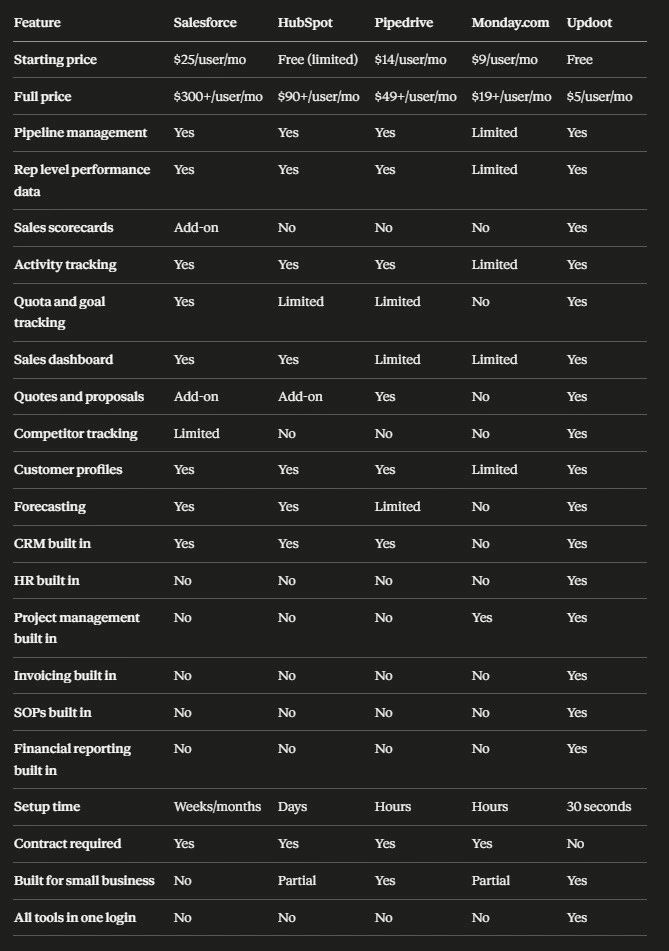
Best App for Sales Performance Tracking: A Quick Comparison Chart
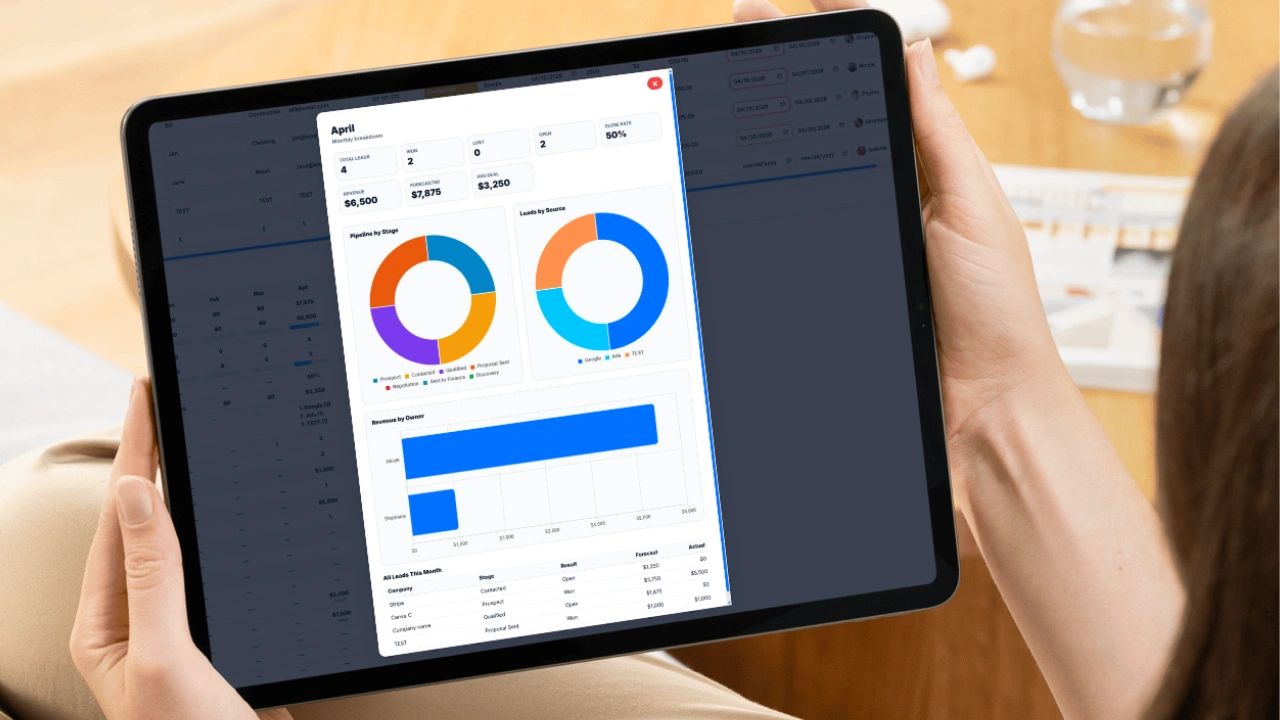
Use our free list of what to look for in selecting a sales performance tracking app.
Why Sales Performance Tracking Matters More Than Most Businesses Realize
Most small and mid-sized businesses know their top line revenue number. They know roughly how much is coming in each month. But when you ask them which rep is closing the most deals, which lead source is converting at the highest rate, which part of the pipeline is stalling, or what the average deal size looked like last quarter compared to this one, the answers get fuzzy fast.
That gap between knowing your revenue and understanding your sales performance is exactly where businesses lose money. Reps who are underperforming go uncoached. Leads that are ready to close sit untouched for too long. Deals that should have been won get lost to a competitor who followed up faster. Managers make decisions based on gut feel instead of data.
The right sales performance tracking app fixes all of that. It gives you visibility into what is actually happening in your pipeline, who is performing, what is working, and where the gaps are. For small and mid-sized businesses especially, that visibility is the difference between growing with intention and just hoping the numbers hold up month to month.
What to Look for in a Sales Performance Tracking App
Before comparing specific tools, it helps to know what actually matters when choosing a sales performance tracking app. Not every business needs the same features, but there are a handful of things that separate genuinely useful tools from ones that look good in a demo and collect dust after month two.
Pipeline Visibility
A good sales performance tracking app shows you every deal in your pipeline, where it is in the process, how long it has been there, and what the next step is. Without that visibility, you are flying blind. Pipeline visibility is the foundation that everything else is built on.
Rep Level Performance Data
You need to be able to see performance broken down by individual rep, not just as a team total. Which rep is closing the most deals? Which one has the longest average sales cycle? Which one is generating a lot of activity but not converting? Rep level data lets you coach specifically instead of generally.
Activity Tracking
Closed deals are a lagging indicator. They tell you what already happened. Activity tracking tells you what is about to happen. Calls made, emails sent, meetings booked, proposals sent, follow-ups completed. Tracking activity alongside results lets you catch performance problems before they show up in the revenue numbers.
Conversion Rates by Stage
Knowing your overall close rate is useful. Knowing where deals are dropping out of your pipeline is more useful. If you are losing deals consistently at the proposal stage, that is a pricing or presentation problem. If you are losing them at the first meeting, that is a qualification problem. Stage by stage conversion data tells you exactly where to focus your coaching and process improvement.
Quota and Goal Tracking
Your tracking app should make it obvious at a glance whether each rep is on track to hit their number for the month, quarter, or year. Color coded dashboards, progress bars, and real-time updates against quota give managers and reps alike a clear picture of where things stand without having to run a report.
Forecasting
A good sales performance tracking tool helps you forecast future revenue based on what is actually in your pipeline. Weighted forecasts that account for deal stage and probability give you a more realistic picture than just adding up every open opportunity.
Integration With the Rest of Your Business
Sales does not happen in a vacuum. Your sales data should connect to your invoicing, your customer profiles, your project management, and your leadership planning. A sales tracking app that operates in isolation forces you to manually reconcile data across multiple systems, which wastes time and creates errors.
The Most Common Sales Performance Tracking Apps
Salesforce
Salesforce is the most widely recognized CRM and sales tracking platform in the world. It is deeply powerful, highly customizable, and built to scale to enterprise level complexity. It also comes with a steep learning curve, significant implementation costs, and a price tag that puts it out of reach for most small businesses. Salesforce is a serious tool for serious sales organizations with the budget and staff to support it.
HubSpot
HubSpot offers a free CRM with solid pipeline tracking and some useful sales performance features. The free version is genuinely useful for very early stage businesses, but the features that matter most for serious sales performance tracking live behind paid tiers that get expensive quickly. HubSpot is a strong marketing platform and a decent sales tool, but it is primarily built around inbound marketing workflows rather than field sales or service-based business sales processes.
Pipedrive
Pipedrive is a pipeline-focused CRM that is popular with small sales teams. It is clean, intuitive, and does a good job of keeping reps focused on the next action. It is a solid standalone sales tool but it does not connect to the rest of your business operations, so you end up with good sales data living in one place while your HR, finance, and operations data lives somewhere else entirely.
Monday.com
Monday.com is a work management platform that can be configured to track sales pipelines. It is flexible and visually clean, but it is not purpose-built for sales performance tracking and the configuration required to make it work well for sales can be significant. Like Pipedrive, it does not natively connect your sales data to HR, finance, or operations.
Updoot
Updoot is an all-in-one business management platform that includes a full CRM and sales performance tracking module built specifically for small and mid-sized businesses. What makes Updoot different from every other tool on this list is that your sales performance data lives in the same platform as your HR data, your project management, your invoicing, your SOPs, your budgeting, and your leadership planning. That means when a deal closes, it connects directly to the rest of your business. When a rep hits their quota, that performance data sits right next to their performance review in the HRIS. No manual reconciliation, no exporting data between systems, no paying for five different tools that do not talk to each other.
How Updoot Handles Sales Performance Tracking
Updoot's sales module was designed by someone who has actually run sales teams in small businesses, not by enterprise software engineers optimizing for Fortune 500 use cases. The result is a tool that is practical, fast to set up, and genuinely useful from day one.
CRM and Pipeline Management
Updoot's CRM gives you a full view of every deal in your pipeline. You can track leads from first contact through close, assign deals to specific reps, set deal values, track deal stage, log notes and activity, and see exactly where every opportunity stands at any given moment. The pipeline view is clean and visual so your team can see their deals without digging through menus or building custom reports.
Customer Profiles
Every contact and company in your pipeline has a dedicated profile that captures the full relationship history. Notes, deal history, communication logs, and any custom fields your business needs. When a rep leaves or a new rep takes over an account, nothing gets lost. The relationship history is all there.
Quotes and Proposals
Updoot includes a quoting and proposal tool that lets your team generate professional quotes directly inside the platform. Instead of building quotes in Word or Excel and emailing them as attachments, your team creates quotes inside Updoot where they are tracked, versioned, and connected to the deal they belong to. This eliminates the version control chaos that kills deal momentum in a lot of small businesses.
Sales Scorecards
Updoot includes sales scorecards that give you a structured way to evaluate rep performance across multiple dimensions. Not just closed revenue, but activity, pipeline health, conversion rates, and customer satisfaction. Scorecards give managers a consistent framework for coaching conversations and make performance reviews grounded in real data instead of impressions.
Competitor Tracking
One of the more unique features inside Updoot's sales module is the competitor tracker. You can log information about competitors, track which deals they are showing up in, note their pricing and positioning, and build a running picture of the competitive landscape your team is operating in. This is the kind of intelligence that usually lives in someone's head or a random spreadsheet, and having it centralized makes your whole team sharper.
Sales Dashboard
The sales dashboard inside Updoot gives managers and reps a real-time view of performance against targets. Revenue closed, pipeline value, conversion rates, deals by stage, and activity metrics are all visible in one place. There is no need to pull a report or export data to see where the team stands. The dashboard updates in real time as deals move through the pipeline.
Connection to the Rest of the Business
This is where Updoot genuinely separates itself from standalone sales tracking tools. When a deal closes in Updoot, that information is immediately available to your finance team for invoicing, to your operations team for project kickoff, and to your leadership team for revenue forecasting. Your sales rep's performance data sits right next to their HR profile, their time tracking records, and their performance review history. Your sales pipeline connects to your company roadmap and your budget tracker.
That kind of cross-functional visibility is what allows small businesses to actually operate like a coordinated team instead of a collection of disconnected departments all working in their own systems.
How to Choose the Right Sales Performance Tracking App for Your Business
The right tool depends on where your business is and what your biggest pain points are right now.
If you are a very early stage startup with no sales team and limited budget, the free tier of HubSpot or a simple spreadsheet might be enough to get started. If you are a growing small business with a sales team of two to twenty people and you are tired of managing everything manually, you need something more structured.
The question to ask is not just which tool tracks sales the best in isolation. The question is which tool fits into how your whole business actually runs. If your sales data needs to connect to your invoicing, your HR, your operations, and your financial reporting, a standalone CRM creates more work than it saves because you are always reconciling data between systems.
That is the argument for a platform like Updoot. You are not just buying a sales tracking app. You are building a single operating system for your whole business where sales, HR, finance, operations, and leadership all live in one place and all talk to each other.
Frequently Asked Questions
What is the best app for sales performance tracking for small business?For small and mid-sized businesses that want sales tracking connected to the rest of their operations, Updoot is the strongest option. It combines CRM, pipeline management, sales scorecards, quoting, competitor tracking, and a real-time sales dashboard with HR, project management, invoicing, and financial reporting in one platform.
How do I track sales rep performance?The most effective approach combines activity tracking, pipeline data, and outcome metrics. Track calls, meetings, and proposals alongside conversion rates and closed revenue. Updoot's sales scorecards give you a structured framework for evaluating rep performance across all of these dimensions.
Do I need a CRM to track sales performance?A CRM is the foundation of sales performance tracking. Without it, your pipeline data lives in spreadsheets or in your reps' heads, which makes consistent coaching and forecasting nearly impossible. A platform like Updoot gives you a CRM as part of a broader business management system so you are not paying for a standalone tool that does not connect to anything else.
How much does Updoot cost for sales tracking?Updoot is free to get started and $5 per user per month after that. There are no contracts, no setup fees, and no hidden costs. The sales module is included in the full platform along with HR, project management, invoicing, and everything else.
The Bottom Line
Sales performance tracking is not optional if you want to grow with intention. The businesses that scale consistently are the ones that know their numbers at the rep level, the pipeline level, and the revenue level, and that use that data to coach their teams, improve their processes, and forecast their future.
The best app for sales performance tracking is one that gives you that visibility without requiring a full-time admin to maintain it, without costing more than the deals it helps you close, and without operating in isolation from the rest of your business.
For small and mid-sized businesses, Updoot delivers all of that in one platform at a price that makes sense from day one.
Learn more about apps for business
Vacation Scheduling Software: How to Find the Best
Every Small Business App You Need in a List
AI-Powered Software for Running a Small Business
Workday HRIS vs Updoot HRIS Easy Comparison Chart
Best CRM for SaaS: What You Need to Look For
Homebase Scheduling vs. Updoot Scheduling
ClockShark Pricing vs. Updoot Pricing: Let's Talk Value
Shift Swap Software for Restaurants, Construction, Retail, More